
Current geopolitical dynamics have elevated the importance of the Middle Corridor (Trans-Caspian International Transport Route) beyond the level of an economic project, turning it into one of the key elements of Eurasia’s strategic security and geopolitical architecture. In this process, Azerbaijan’s role is also transforming from a transit country into a regional strategic hub.
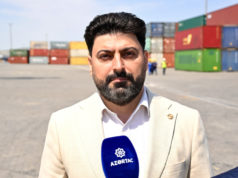
Denizxeber.az bildirir ki, that political analyst Elnur Enveroglu expressed these views.
The political analyst stated that the Russia-Ukraine war has seriously changed Europe’s logistics map. As a result of sanctions, political risks, and rising insurance costs, European companies have gradually begun to seek alternative routes. From this perspective, the Middle Corridor is no longer just an alternative, but an essential part of the risk diversification strategy. Risks arising around the Strait of Hormuz, international logistics projects passing through Iran facing sanctions, and the weakening of regional stability are causing investors to prefer more reliable corridors. Against this background, the Middle Corridor passing through the Caspian Sea is assessed as a more stable alternative geopolitically.
According to Elnur Enveroglu, Azerbaijan’s main advantage is not limited only to its favorable geographical location. Over the past decade, the expansion of the Baku port, the modernization of the Baku-Tbilisi-Kars railway, the creation of the Alat Free Economic Zone, the introduction of digital customs systems, and massive investments in logistics infrastructure have turned Azerbaijan’s transit potential into a real economic advantage. In other words, geography has been complemented by correct state policy.
“In April of this year, when receiving participants in the meeting of heads of government and vice presidents of member states of the Organization of Turkic States, President Ilham Aliyev drew special attention to the strategic importance of the Middle Corridor. Emphasizing that the Middle Corridor fully aligns with Azerbaijan’s interests, the head of our state stated that in the current geopolitical situation, the Middle Corridor, the Trans-Caspian corridor, the Zangazur corridor, and other projects implemented in this direction carry even greater significance,” Elnur Enveroglu noted.
The politologist stressed that Azerbaijan’s energy diplomacy is one of the main directions complementing the country’s transport policy. Against the background of Europe’s strategy to reduce dependence on Russian gas, Azerbaijan is already accepted as an important energy partner. If energy and transport combine on the same geopolitical platform, this further increases the country’s strategic significance. For Europe, Azerbaijan is becoming an essential partner both in terms of energy security and the continuity of supply chains. The importance of the Middle Corridor is also steadily growing for Central Asian countries. Kazakhstan, Uzbekistan, and Turkmenistan do not want to keep their export routes dependent on a single direction. They are showing more interest in the Trans-Caspian route to gain safer access to European markets. This accelerates Azerbaijan’s transformation into one of the main hubs of interregional integration.
“The emerging new geopolitical reality also opens up additional opportunities for Azerbaijan’s foreign policy. The expansion of cooperation with the European Union, Central Asian states, China, Turkey, and Gulf countries can strengthen Baku’s multilateral diplomacy. Azerbaijan’s policy of building balanced relations with various geopolitical centers gains even greater importance in such a setting,” the political analyst emphasized.