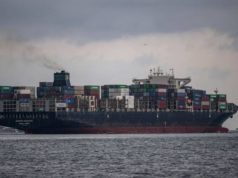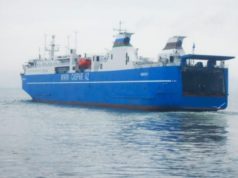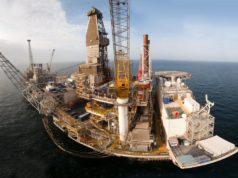

Astana and Baku have agreed to cooperate on the establishment of the new Trans-Caspian ferry system “Caspian Bridge” as well as a joint intermodal freight terminal.
The first agreement sets out the main principles and areas of cooperation between the parties in preparing and implementing the project to establish the new Trans-Caspian ferry system “Caspian Bridge”. In particular, it envisages the development of regular freight transportation across the Caspian Sea using modern high-capacity ferries, as well as the improvement of port and terminal infrastructure.
The second document defines the main terms for establishing an intermodal freight terminal and a joint venture. The new terminal is expected to be established within the territory of the Baku International Sea Trade Port in Alat. Its operations will focus on increasing container and other freight traffic, as well as strengthening the integration of maritime and rail transport.
Overall, the implementation of the “Caspian Bridge” initiative is intended to improve the efficiency of freight transportation, reduce the time required for the sea crossing and port operations, and increase the capacity of the transport route. The development of ferry services and the establishment of a new freight terminal are viewed as part of broader cooperation between the two countries aimed at strengthening the region’s transport infrastructure. The parties will next need to work out the investment model and financial terms for implementing the joint projects.
The initiatives are also particularly important for the development of the Trans-Caspian International Transport Route, known as the Middle Corridor, which connects China and Central Asian countries with Europe via Kazakhstan, the Caspian Sea, Azerbaijan, Georgia and Türkiye.
To what extent can the use of high-capacity ferries and the development of port infrastructure reduce the time required for the sea crossing of the Caspian? What volumes of container traffic are needed to improve the route’s economic efficiency and attractiveness to international carriers? And how could the implementation of the “Caspian Bridge” ferry system enhance the competitiveness of the Middle Corridor?
Sea-news.az reports that Media.Az asked these questions to well-known Azerbaijani transport and logistics expert Rauf Agamirzayev.
According to him, the first of the signed documents lays the foundation for developing key transport infrastructure and constructing higher-capacity ferry crossings.
“The main objective of this agreement between the Samruk-Kazyna Fund and AZCON Holding is to systematically coordinate these processes. Against the backdrop of growing freight volumes, the shallowing of the Caspian Sea represents a particular risk factor, directly affecting the implementation of new logistics projects. Overcoming this challenge requires close cooperation among the Caspian littoral states, the development of port infrastructure and the gradual formation of a new merchant fleet taking into account hydrological risks. The specialised Super Ferry project, also known as the ‘Caspian Bridge’, is intended to address the current and future challenges related to fleet renewal and the creation of a sustainable transport system,” the expert said.
He noted that, alongside infrastructure development, there is a sustained trend toward growing freight flows, particularly in container transportation.
“To achieve maximum economic efficiency in logistics, it is necessary to reach a target volume of 300,000–500,000 twenty-foot equivalent units (TEUs), which would make this route significantly more attractive to international carriers.
“Another important advantage of the Caspian Corridor is the broad range of cargo it can handle: liquid bulk cargo such as oil, dry bulk cargo such as grain and mineral fertilisers, as well as uranium and oversized cargo. This diversification provides the logistics system with a high degree of flexibility and reduces its dependence on a single cargo category. As trade volumes grow, the capacity of the infrastructure and the specifications of the vessels must increase in sync, while the multimodal nature of transportation and the diversity of cargo enhance the route’s overall efficiency and multi-directional attractiveness,” R. Agamirzayev said.
The expert believes that amid the disruption of traditional trade routes caused by military conflicts and increased risks, the Caspian route is gaining strategic importance.
“Although the current cost of transportation along this route may be perceived as relatively high, in the long term the corridor could be transformed into a premium, high-speed and predictable route,” he stressed.
He also noted that amid global competition for freight flows across the Eurasian space, the Middle Corridor is rapidly gaining momentum.
“The sustainability and competitiveness of this route are ensured by the presence of a developed network — pipelines, port infrastructure, airports, railways and roads — as well as integration with related projects such as the Zangezur Corridor and the China–Kyrgyzstan–Uzbekistan railway currently under construction. The meetings held and agreements reached further strengthen the positioning of the Caspian route within the global transport system,” R. Agamirzayev concluded.