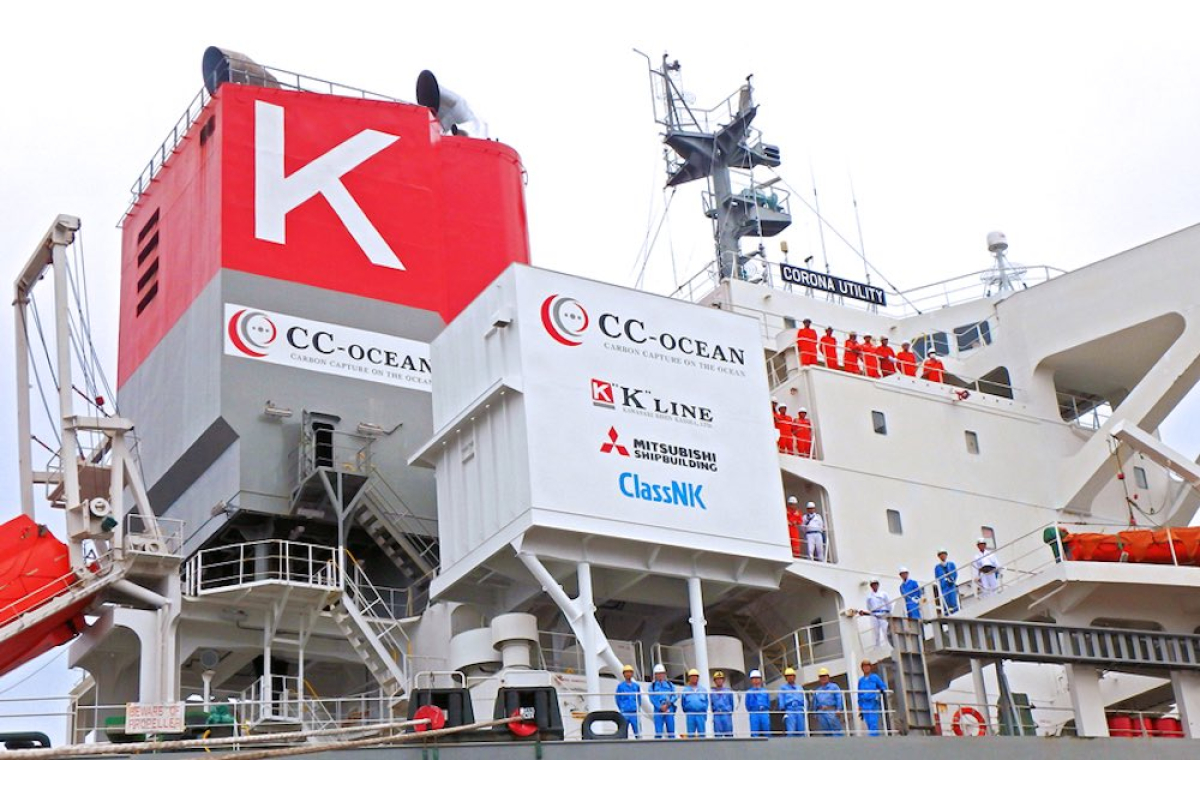
The international classification society DNV has published a new recommended practice document for the standardized measurement and verification of the efficiency of Onboard Carbon Capture and Storage (OCCS) systems on vessels.
According to sea-news.az this new framework document, designated as “DNV-RP-0698,” establishes a uniform methodology for shipowners, shipyards, and technology companies to evaluate OCCS systems in both newbuild vessels and modernization (retrofit) projects.
Importance and Application Areas of the Technology
According to DNV, approximately 90% of the global fleet currently still utilizes conventional fossil fuels. For vessels that cannot easily transition to alternative or low-carbon fuels, onboard carbon capture technology is considered one of the most realistic and effective transitional solutions for reducing emissions. The International Maritime Organization (IMO) has also already initiated the development of official regulations in this direction, with the process expected to be finalized by 2028.
Innovations Introduced by the New Standard
Based on mass balance principles, the “DNV-RP-0698” standard establishes a unified technical language within the shipping sector and covers the following key indicators:
- Capture Percentage and Efficiency: How effectively the system separates $CO_2$ gas;
- Collected Volume: The exact quantity of $CO_2$ collected, liquefied, and stored onboard the vessel;
- Residual Emissions Released into the Atmosphere: The measurement of gases exhausted after treatment.
The new document is entirely technology-neutral, meaning it can be equally applied to all different technological approaches, such as pre-combustion, post-combustion, or oxy-fuel systems. The document also provides for an independent third-party verification mechanism that checks system documentation, measurement installations, and calculation uncertainties.
DNV officials emphasized that this approach will reduce risks for investors and shipowners, accelerating the transition to broader commercial application of OCCS technologies, which represent a crucial decarbonization step in maritime transport.