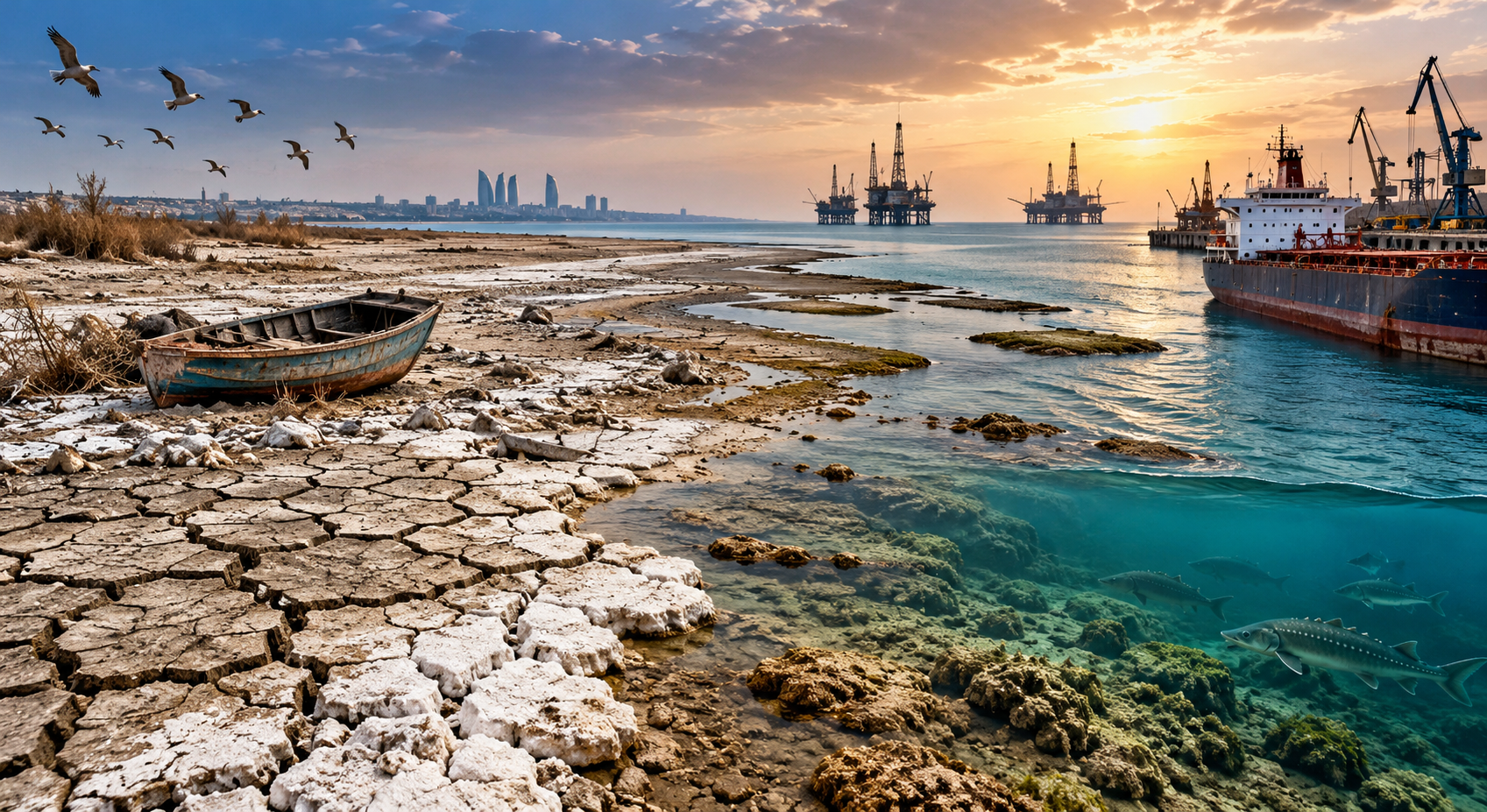
The decline in the level of the Caspian Sea is becoming an increasingly critical ecological and economic challenge for the region. The retreat of the sea is not only altering the landscape of coastal zones but also severely impacting biodiversity, commercial shipping, and energy infrastructure.
Sea-news.az presents Oxu.Az’s publication of an interview given to Kaspi newspaper by Said Safarov, Head of the ‘Geography of the Caspian Sea’ Laboratory at the Institute of Geography:

- What do the latest monitoring results conducted by your laboratory reveal regarding the current level of the Caspian Sea and the criticality of the situation?
- In the 20th century, the Caspian Sea reached its lowest recorded level in 1977, standing at 29 meters below global ocean level. Forty-eight years later, this negative record has been broken. Currently, the level of the Caspian Sea has dropped to 29.1–29.2 meters below ocean level. Heavy spring rainfall temporarily slowed the decline between March and June. However, starting in June, the drop resumed. According to data from several marine observation stations, the level of the Caspian has now fallen below the 29-meter mark, marking the lowest point in 48 years.
- Why is the Caspian Sea retreating?
- There are multiple drivers, primary among which are anthropogenic factors. Because the Caspian is a closed basin, its level depends fundamentally on its water balance—the difference between total water inflow and loss. At present, waters from the Volga and other tributary rivers are heavily diverted for agricultural and industrial uses. Furthermore, numerous large reservoirs operate along these river basins, particularly on the Volga, spanning a total surface area exceeding 36,000 square kilometers. Maintaining mandatory water storage thresholds to ensure normal hydroelectric power plant operations limits downstream discharge, reducing the volume of water the Volga delivers to the Caspian. Climatic factors also play a major role. Global warming and rising temperatures accelerate evaporation rates from the sea surface. Higher temperature increases in the northern sectors of the Volga basin exacerbate summer evaporation. While rainfall has a minor direct impact on the Caspian’s water balance, river discharge volumes and sea surface evaporation remain the decisive factors. Climate change simultaneously boosts evaporation and depletes river supplies, disrupting the sea’s water balance and causing a steady draw-down.
“The Pollution of the Caspian is Also Deepening”
- How does demographic growth impact the sea’s water balance and environmental health?
- Population growth is a major contributing factor. Coastal cities around the Caspian Sea continue to expand rapidy. For instance, the urban footprint of Baku has expanded significantly compared to 30–40 years ago. Coastal municipalities in Turkmenistan, Russia, and Kazakhstan are similarly expanding, accompanied by rising population numbers and surging water demand. Consequently, larger volumes of water are extracted from river systems for municipal supplies, curtailing the net inflow reaching the Caspian. Furthermore, demographic expansion and economic intensification aggravate marine pollution. Discharging untreated municipal sewage and industrial effluents directly into the sea causes severe water quality degradation.
- Does this decline pose a direct threat to Caspian marine life?
- Yes. Imagine dropping a sugar cube into a glass of water, then pouring out half the water and adding another sugar cube—the concentration of sugar in the remaining liquid becomes significantly higher. Replacing sugar with environmental pollutants yields the exact same dynamic. As the Caspian’s water level drops, its total volume shrinks. Mixing the same mass of contaminants into a reduced volume elevates toxicity concentrations, intensifying adverse impacts on marine organisms. The Caspian hosts diverse fish species, plankton, seals, and aquatic flora. Sensitivity varies across species; while certain fish adapt to moderate pollution to maintain populations, identical pollutant levels prove fatal to others. The status of sturgeon species is especially alarming, as wild populations have suffered severe declines. To rebuild stocks, fish raised in hatcheries are systematically released into natural waters. However, the exact efficacy of these releases in restoring wild populations requires rigorous evaluation. The sturgeon life cycle depends strictly on specific ecological conditions. For example, estuarine zones where freshwater rivers mix with saline marine waters create unique hydrochemical environments vital for spawning. Over-extraction from rivers alters these critical habitats, disrupting spawning and natural reproduction. Releasing hatchery-bred fish cannot fully solve the crisis without suitable habitats, as water pollution, habitat alteration, and broader environmental shifts continue to impair their survival rates.
- Which geographic areas suffer the highest levels of Caspian pollution?
- Baku Bay represents one of the primary pollution hot spots, receiving a portion of Baku’s municipal wastewater and industrial discharges. Historical waste from oil refineries has also contributed heavily; even where facility relocations have occurred, residual contamination persists. Even if new discharges into Baku Bay are halted, legacy pollutants trapped in benthic sediments remain a long-term problem, as wave action continuously resuspends toxic compounds into the water column. Limited water exchange within the bay further hinders pollutant dispersion. The Volga River serves as another major pollution vector, draining vast agricultural and industrial hubs across Russia and carrying substantial pollutant loads into the Caspian. Optimizing municipal and industrial wastewater treatment infrastructure across the basin is imperative. Domestic waste, including chemical detergents, also harms aquatic ecosystems. A high volume of river discharge does not guarantee water purity; rather, the Volga brings massive quantities of both water and contaminants into the Caspian. The Kura River similarly transports significant pollutant loads, complemented by agricultural drainage returned to the sea via the Mil-Mughan and Shirvan collectors, which carry elevated salinities and chemical residues. Coastal regions near Aktau in Kazakhstan and coastal sectors in Turkmenistan face environmental risks linked to offshore oil extraction and refining. In comparison, environmental conditions in the southern Caspian, including the Lankaran sector, remain relatively favorable.
- Which coastal zones show the most pronounced shore retreat?
- Shoreline retreat is most severe in the Neftchala district and adjacent coastal areas. In shallow marine zones, incremental drops in water level result in substantial horizontal shoreline retreat. Field measurements conducted along beaches in Astara and Lankaran revealed that the shoreline has retreated approximately 35 meters in Astara and 45 meters in Lankaran. Coastal topography plays a vital role here; on flatter, low-gradient shores, the retreat spans vastly wider land areas.
- How could the retreat of the Caspian alter the future of the region?
- The decline of the Caspian Sea is already reshaping both its geography and coastal ecology. As noted by the President, the sea’s retreat has exposed approximately 30,000 hectares of land. While this represents newly exposed land area, its agricultural viability requires detailed scientific assessment. Shoreline retreat directly impacts coastal infrastructure, commercial navigation, and environmental stability. Outfall infrastructure presents another critical vulnerability: as water levels fall, submerged municipal sewage and industrial discharge pipes become exposed or improperly positioned relative to the new waterline. When outfalls fail to discharge at designed depths, effluent impacts on coastal environments worsen, generating foul odors and public health hazards—a phenomenon occasionally observable along sections of the Baku Boulevard. Regarding long-term projections, climate models evaluate potential future Caspian sea-level fluctuations. Incorporating CMIP6 climate modeling scenarios—ranging from full compliance with Paris Agreement targets to unmitigated emissions trajectories—projections indicate that even if Paris Agreement targets are fully met, the Caspian Sea level is projected to fall by 8–9 meters by the end of the century. Should global climate commitments fail, the drop could reach 18–19 meters. Under such extreme scenarios, the consequences for the Caspian Sea and littoral states would be catastrophic.
- What scenario would the region face if the worst-case forecast materializes?
- Consider the reality of an 18–19 meter drop in sea level. Under those conditions, the Baku Boulevard shoreline could be displaced 20–30 kilometers away from the current waterfront. Such dramatic retreat would necessitate constructing completely new coastal infrastructure at enormous financial expense. Commercial shipping and maritime transport would face severe disruption. The Northern Caspian currently averages only 5 meters in depth, reaching 20–22 meters in its deepest channels. Navigational challenges already exist in these shallow waters. A further 18–19 meter decline would cause large parts of the Northern Caspian to dry up entirely, effectively severing maritime connectivity with the Volga River. Although the river would continue entering the sea through fragmented channels, deep-draft vessel navigation would become impossible. The Caspian is also a strategic energy basin supporting offshore oil and gas production. Existing extraction and transport infrastructure was designed around specific water levels and operational depths. Severe level drops would impair production and pipeline logistics, complicating current operational systems. Addressing these disruptions would demand alternative technical solutions, new project designs, and substantial capital investment for replacement infrastructure.
- How should river water management be balanced between energy production and Caspian water requirements?
- River resources flowing into the Caspian must be managed with far greater efficiency and conservation. During my address at the summit in Astana in April, I proposed re-evaluating the operational regimes of Russian hydroelectric power stations. The contribution of these facilities to the national energy grid should be weighed against the broader hydrological impacts of their reservoir operations. Given Russia’s abundant natural gas reserves, temporarily substituting hydroelectric generation with gas-fired thermal power generation could be explored under specific conditions. This approach would reduce the operational requirement to maintain fixed reservoir levels for continuous hydro generation. Protecting water resources within one basin should not compromise the hydrological stability of connected basins. This principle applies equally to Azerbaijan, where minimizing transmission and operational losses in Kura River agricultural irrigation is paramount. Inefficient water use depletes river reserves while inducing soil salinization. Adopting modern irrigation technologies and upgrading water distribution infrastructure are critical steps forward.