



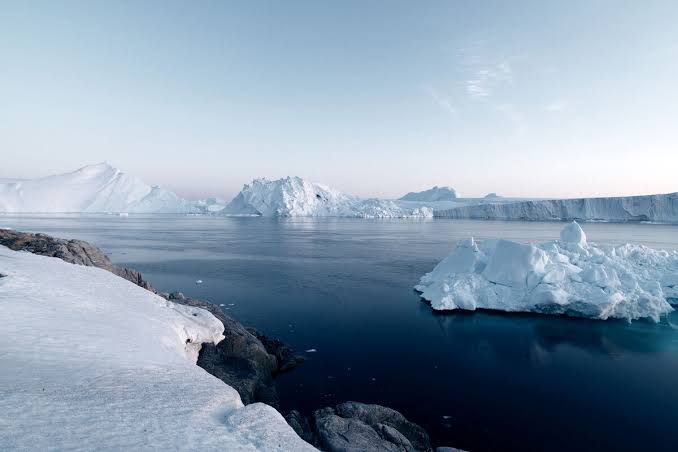
According to a new report published on Wednesday by the Copernicus Atmosphere Monitoring Service (CAMS), operating under the European Centre for Medium-Range Weather Forecasts (ECMWF), the Arctic region is undergoing rapid transformation amidst record-breaking marine heatwaves across European seas.
Sea-news.az reports that rising ocean temperatures are driving significant shifts in global seas, with far-reaching consequences for marine ecosystems, coastal communities, and economies.
The report highlights the Arctic as one of the regions experiencing the most severe changes. According to the data, between 1979 and 2025, Arctic sea ice extent declined by approximately 490,000 square kilometers per decade — an area nearly equivalent to the size of Spain.
It is noted that the reduction in sea ice has led to increased wind and wave activity, leaving roughly 60 percent of Arctic coastal infrastructure vulnerable to erosion and rising sea levels.
The report also draws attention to abnormally high temperatures recorded across European seas. In 2024, record marine heatwaves were observed in the Mediterranean and Black Seas, where temperatures spiked up to 4.6 degrees Celsius above normal levels.
Concurrently, global sea level rise continues unabated, with the average rate of increase reaching approximately 4.2 millimeters per year since 2012.



