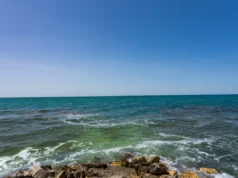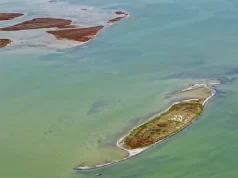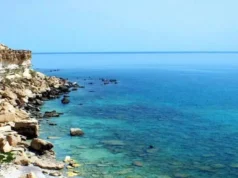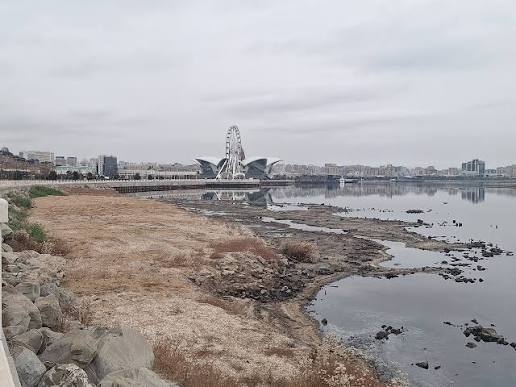
The drop in the Caspian Sea water level is noticeably affecting the visual appearance of the Baku Boulevard, with patches of dry land emerging in various sections of the area.
Sea-news.az reports citing a comprehensive interview given by Khanlar Agalarov, Chairman of the Board of the Seaside Boulevard Administration, to Report Information Agency and ARB TV, that the decline in the water level of the Caspian Sea over the past few years has been discussed across various platforms.

According to him, the falling water levels have become a visible process on Baku Boulevard, presenting new challenges regarding local infrastructure and future development plans alongside ecological impacts.
“Approaching the issue step by step, the drop in water levels first affected navigation, the operation of excursion vessels, and the docking infrastructure along the boulevard,” Khanlar Aghalarov noted.
The chairman added that the receding Caspian waters are also altering the area’s visual appeal. He explained that while previously a vertical decrease was observed due to sufficient depth in the part of the Baku Bay along the boulevard, recent years have seen horizontal retreat of water, revealing exposed patches of land in certain spots.
Khanlar Aghalarov stated that this situation brings coastal management, landscape adaptation, and the integration of dried-up areas into the overall landscape design of Baku Boulevard to the forefront.
He further noted that the declining water level directly or indirectly impacts the ecological state of the Baku Bay.
“Given the unique shape of Baku Bay, various observations are being made regarding inflow current dynamics, water movement, microbial balance, and the growth of algae masses. As you know, the current shallow depth also impacts cleaning operations in the area,” he emphasized.
Speaking about future plans for the Seaside Boulevard Department, Khanlar Aghalarov mentioned that the institution bases its strategy not only on managing the current coastline, but also on an approach that considers water level dynamics across ongoing and planned projects.
According to him, adaptive architectural solutions and infrastructure are planned for design and implementation based on various scenarios to proactively mitigate the potential impacts of water level fluctuations.