Sometimes, a person’s life trajectory is defined by far more than just a chosen profession. Childhood conversations, enduring family traditions, the ambient rhythm of a seaside city, and life’s defining crossroads can all alter the direction of one’s destiny. In this light, the scientific and pedagogical career of Natalya Fatyanova resembles a sturdy bridge built firmly between science and the open sea.
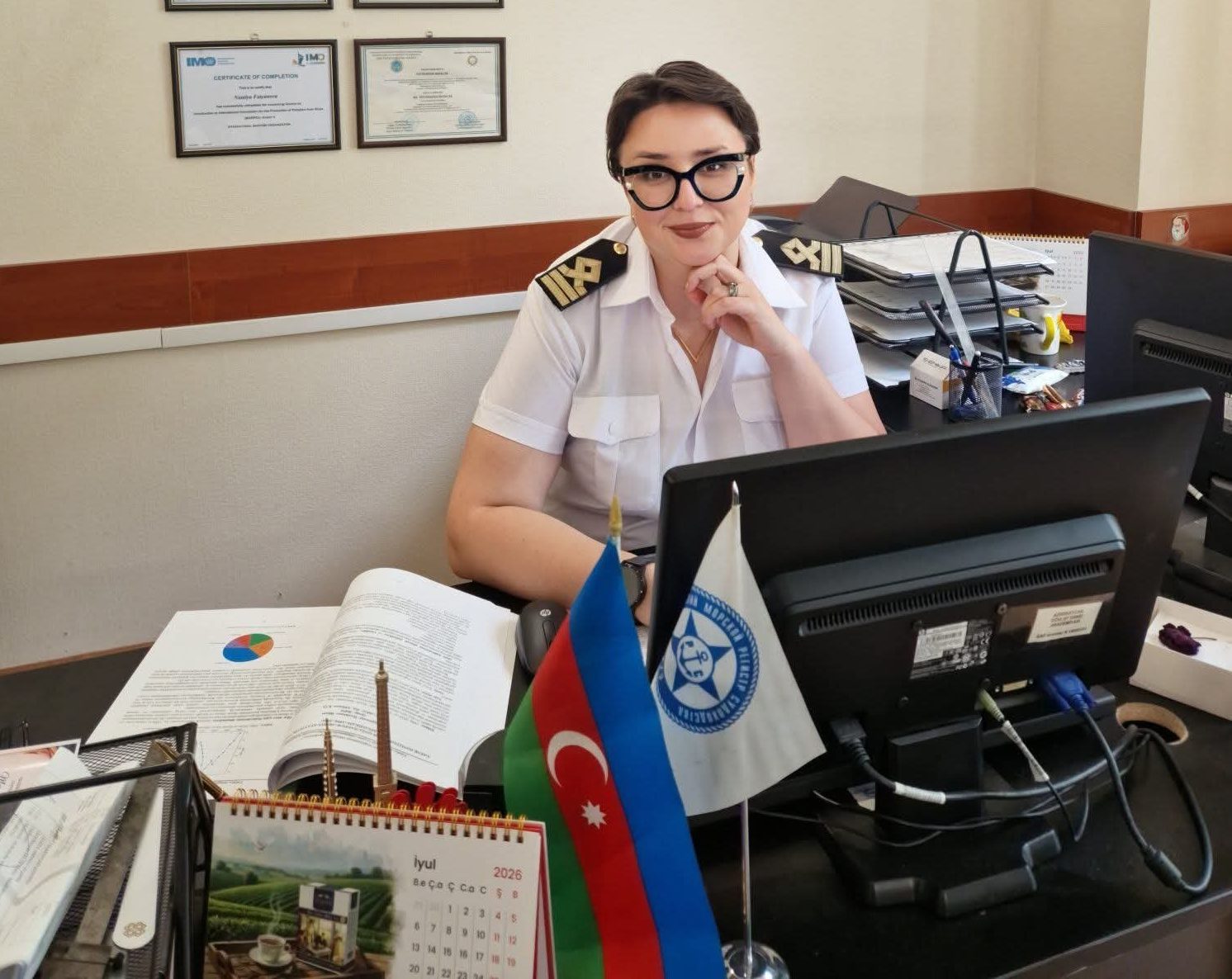
Sea-news.az reports citing rezonans.az, that Baku is fundamentally a city of the sea. Here, the Caspian is not merely a scenic blue coastline stretching into the horizon; it is a living space that subtly shapes human character, professional choices, and mindset. The sea consistently calls upon individuals to cultivate patience, high responsibility, and vigilance—qualities that are vividly reflected in Natalya Fatyanova’s career. As a senior lecturer and PhD in Technical Sciences at the Azerbaijan State Maritime Academy (ASMA), she continues to make invaluable contributions to maritime education and advanced scientific research.
One of the primary focal points of her research is the protection of ship hulls against corrosion. At first glance, this topic might appear to be a narrow technical niche. In reality, corrosion represents a severe threat to maritime safety, economic efficiency, and environmental preservation. Saline water, humidity, thermal variations, and long-term operational stress gradually degrade metallic structures. Ship hull wear translates not only into high repair overhead but also into structural vulnerabilities that compromise maritime reliability.
This is precisely why Natalya Fatyanova’s research carries profound relevance. Her work investigates enhancing the corrosion resistance of ship hulls through the application of nanofillers in paint and coating systems. Simply put, the objective is to make protective coatings more durable, efficient, and resilient against harsh marine environments. Such research unites materials science, chemistry, and shipbuilding into a single cohesive discipline.
Nanotechnology stands out as one of the most dynamic frontiers in modern science. Working at a scale invisible to the naked human eye, engineered nanoparticles can fundamentally alter the mechanical and chemical properties of conventional materials, rendering them stronger, lighter, and vastly more resistant to external degradation. Fatyanova’s research bridges these advanced capabilities with the operational demands of the modern maritime sector, translating laboratory breakthroughs into extended vessel lifespans, optimized maintenance expenditures, and enhanced environmental protection for marine ecosystems.
Her 2025 PhD dissertation directly explored this frontier: Enhancing the corrosion resistance of ship hulls through the application of nanofillers in paint and coating systems. Beyond its theoretical depth, the study holds immense industrial applicability, ensuring that vessels operate with greater structural integrity, safety, and efficiency.
Fatyanova’s scholarly output is equally remarkable, with 39 scientific publications cataloged on the ASMA science portal covering corrosion mitigation, marine coatings, nanocomposites, and shipbuilding technologies. Her inventive contributions extend to patented innovations, such as research involving pentaftal enamels formulated with nano-chalk additives—a prime example of translating theoretical academic concepts into practical industrial applications.
Beyond her research laboratory, Fatyanova serves as an inspiring educator at ASMA, instilling a culture of inquiry, precision, and discipline in aspiring maritime engineers. Her academic leadership was further recognized on the global stage in 2026 when she was appointed to the editorial board of the prestigious Applied Chemical Engineering journal. This milestone not only honors her individual expertise but also elevates the visibility of Azerbaijani science in international academic circles, reinforcing the nation’s strategic contributions to global maritime engineering.