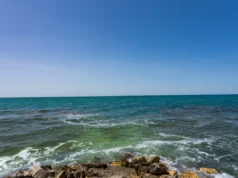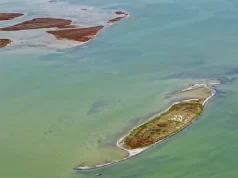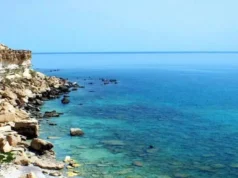

The increase in drowning incidents since the beginning of the beach season has become a cause for concern. Beyond the human factor, the geological structure of the seabed, coastal topography, and hydrodynamic conditions play a significant role in these incidents.
According to sea-news.az that these observations were shared with AZERTAG by Allahverdi Tagiyev, a geologist and senior lecturer at the Department of Hydrogeology and Engineering Geology at Baku State University.
According to him, one of the primary risk factors along the Azerbaijani coast of the Caspian Sea is the uneven relief of the seabed. In particular, areas with sudden drops in depth, underwater sandbars and the channels between them, underwater depressions, and rip currents forming perpendicular to the shore pose a serious threat to people. Such currents can pull a person away from the shore in a short time, significantly increasing the risk of drowning due to panic.
“In recent years, the drop in the Caspian Sea level due to climate change has also impacted coastal geomorphological processes. As the sea retreats, new shallow areas, sandbars, underwater depressions, and uneven relief forms are created, and the existing seabed is constantly changing. These changes affect wave-breaking characteristics and the direction of coastal currents, increasing the probability of rip currents forming in certain areas. Therefore, even areas previously considered safe can change their hydrodynamic conditions over time. This is why regular geological and hydrodynamic monitoring of the coastline is of great importance,” the geologist explained.
He noted that in the Azerbaijani section of the Caspian, areas such as Shikh, Sahil, Pirshaghi, Bilgah, Buzovna, Mardakan, and Novkhani beaches require particular caution. “For example, in the Shikh area, the slope of the seabed is steeper in some parts, causing sudden increases in depth. In the waters off Pirshaghi and Buzovna, rip currents can form due to underwater sandbars. In the direction of Bilgah and Mardakan, the intensity of waves and currents increases, especially during strong northern winds. Along the Novkhani coast, there are sections where the depth increases rapidly after a wide shallow area. Furthermore, areas near river mouths and various hydraulic structures have more complex flow regimes, making them areas where caution must be exercised,” Tagiyev added.
The expert also notes that these areas are not always considered dangerous. The level of risk increases or decreases depending on the current hydrometeorological conditions of the sea, wind direction and speed, wave height, and seasonal changes in the seabed.
“Most drownings in the Caspian are not solely due to poor swimming ability. The relief of the seabed, areas with sudden depth changes, rip currents formed between sandbars, and the wave regime created by the wind significantly heighten the danger. For this reason, even an area that appears calm can be risky from a hydrodynamic perspective.
My recommendation to citizens is to use only officially operating beaches equipped with lifeguards, strictly observe warning signs, and avoid entering the water in areas where the bottom structure is unknown. To ensure safety in the sea, taking natural-geological features, hydrodynamic conditions, and weather forecasts into account is at least as important as good swimming skills,” said Allahverdi Tagiyev.