



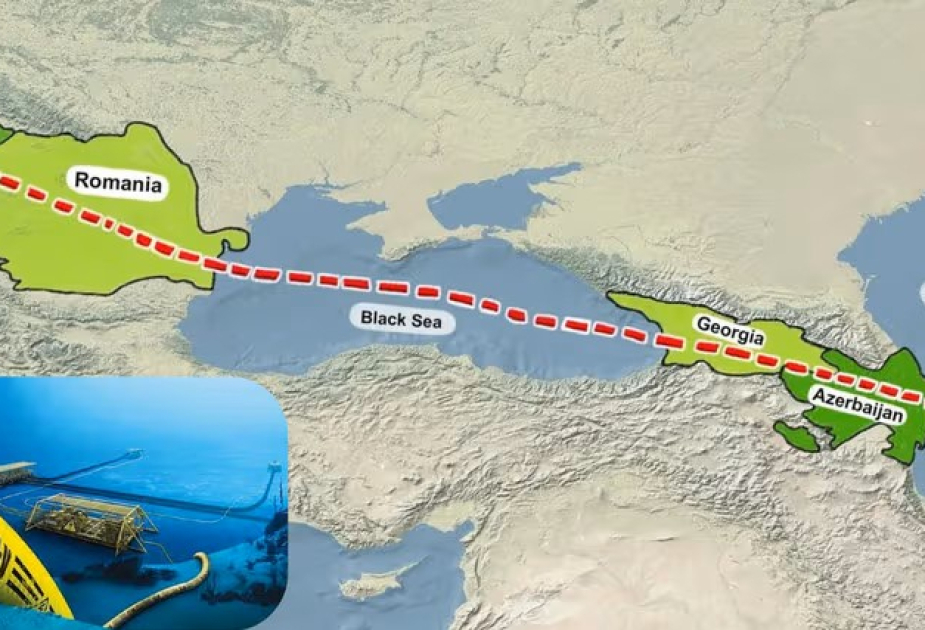
Energy cooperation between Azerbaijan and the European Union (EU) is no longer limited to the export of crude oil and natural gas. Azerbaijans strategic geographical location and its transit capabilities have captured the attention of EU officials, with new projects expected to be realized in the near future.
According to sea-news.az that the energy supply challenges faced by Europe over the past year have compelled Brussels to seek new partners and opportunities to meet rising energy demand. Through the Southern Gas Corridor, Azerbaijan plays a vital role in the continent’s energy security by supplying natural gas to ten EU member states. Furthermore, Azerbaijan’s transit capabilities have not gone unnoticed by the EU, and the steps taken by official Baku to implement new projects are receiving full support—most notably regarding the Caspian-Black Sea-Europe “Green Energy Corridor.”
The successes of President Ilham Aliyev’s energy policy demonstrate a positive impact on the country’s economic development and reflect the international support Azerbaijan receives in global political processes. In a statement to the press on July 1, European Commission President Ursula von der Leyen noted: “Azerbaijan is investing in the energy of the future. You have plans to produce wind energy in the Caspian Sea. You have both the plan and the potential to become a clean electricity hub. This aligns perfectly with the European Union’s own transition to clean energy. Thus, we see enormous potential to deepen our cooperation in areas such as renewable energy sources, electricity interconnection, and regional energy networks. We welcome your plans to build a ‘Green Energy Corridor’ connecting Azerbaijan with the European Union. Producing more renewable energy can save more gas for export and strengthen regional energy security by sharing it with neighbors.” This support includes the EU’s backing and financial commitment to projects initiated by the Azerbaijani President. Delivering alternative energy produced in Central Asia and Azerbaijan to Europe will yield both economic dividends and political stability for the region.
As early as November 13, 2024, during a trilateral meeting between the presidents of Azerbaijan, Kazakhstan, and Uzbekistan—Ilham Aliyev, Kassym-Jomart Tokayev, and Shavkat Mirziyoyev—an “Agreement on Strategic Partnership in the Field of Development and Transmission of Green Energy” was signed. The document outlines prospects for transporting “clean” electricity generated from solar and wind power plants in Central Asia to Europe via Azerbaijan. The agreement envisions the transport of over 500 GW of wind energy potential from the Caspian Sea to Europe through Azerbaijan. The Caspian Sea currently possesses the largest reserves for renewable energy sources; the Azerbaijani sector alone has a potential capacity of approximately 157 GW for wind energy production. Similarly, the Kazakhstani sector is rich in resources for solar and wind stations, where infrastructure is currently being developed. Kazakhstan’s wind potential exceeds 1.82 trillion kWh per year, and its solar potential stands at 1 trillion kWh. Meanwhile, Uzbekistan possesses vast resources in its steppes, with a wind potential of 520 GW and a solar potential of 2.058 trillion kWh. This presents a massive opportunity to mobilize green energy capacity between Central Asia and the Caspian region. Utilizing this potential to transport energy to Europe serves the national interests of regional states from both economic and political perspectives.
As demonstrated, both Central Asia and Azerbaijan possess immense potential for alternative energy production. While this potential has always existed, only a leader deeply committed to his nation, such as President Ilham Aliyev, could advance the idea of leveraging it to enter the global energy market. The issue lies not merely in proposing an idea, but in the capability to realize it. Today, Azerbaijan’s multi-vector foreign policy is evidenced by European leaders visiting the country to express their gratitude to President Ilham Aliyev.
The President of Azerbaijan has already taken progressive steps in this direction. Initiated by the head of state, the Absheron Battery Energy Storage Center, with a total capacity of 250 megawatts, was commissioned this past March—the first of its kind in Azerbaijan. This center enhances the stability of the “Azerenerji” grid by regulating renewable energy. A similar center is also planned for the Aghdash district.
Based on signed contracts, a total of 8 gigawatts of wind and solar power plants will be constructed by 2032 (6 GW by 2030). Over the past five years, nearly 40 small hydroelectric power plants have been built in Karabakh and Eastern Zangezur at the state’s expense, with a total potential exceeding 300 megawatts.
With such significant production and transit potential, Azerbaijan is increasingly capturing Europe’s attention and expanding cooperation. The realization of the “Green Energy Corridor” promises to lay the foundation for a new stage of development in Azerbaijan-Europe relations.



