
The initiative of European Commission President Ursula von der Leyen to hold a Regional Conference on Investment for Transport Connectivity in Baku is a significant indicator of Azerbaijan’s growing importance as a regional transport and logistics hub.
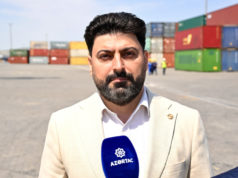
According to sea-news.az transport and logistics expert Rauf Agamirzayev shared these views in a statement to Day.Az.

According to the expert, holding the conference in Baku could provide additional impetus to attracting new investments in transport, logistics, energy, and digital connectivity, expanding cooperation between Europe, the South Caucasus, and Central Asia, developing the Middle Corridor, and fostering the geoeconomic integration of the region.
Agamirzayev stated that the choice of Baku for this event demonstrates the importance the European Union places on Azerbaijan’s strategic role in developing regional transport infrastructure and sustainable transport routes. He believes this platform will create broad opportunities for building new partnerships between states, international financial institutions, and the private sector.
The expert emphasized that the search for new transport links between Europe and Asia is not a new process. Most of the projects currently being implemented are a continuation of the TRACECA (Transport Corridor Europe-Caucasus-Asia) program, adopted in 1993 based on the Brussels Declaration. That program was established with the participation of Azerbaijan, Armenia, Georgia, Kazakhstan, Kyrgyzstan, Tajikistan, Turkmenistan, and Uzbekistan, with Iran, Turkey, Romania, Bulgaria, and other countries later joining.
He recalled that in 1998, with the support of the U.S., an agreement was reached to create a transport corridor—combining rail, maritime, air, and road links—connecting China and Mongolia to Europe via the South Caucasus and Central Asia. This route later became known as the East-West corridor, or the Middle Corridor.
Agamirzayev noted that the main goal of the TRACECA program was to connect the Baltic, Caspian, Black, and Mediterranean Seas, as well as the Persian Gulf, into a unified transport network. The projects currently underway are various parts of that concept. The Trans-Caspian International Transport Route (Middle Corridor) is one of the main branches of this network, with current focus heavily directed toward this direction. Another important branch is being developed along the China-Kyrgyzstan-Uzbekistan-Turkmenistan route.
The expert added that in the future, the Middle Corridor will be integrated with the Via Carpatia highway, which extends from the Port of Gdansk in Poland to the Turkish border. Unlike the earlier “Intermarium” initiative, Via Carpatia is currently under active construction and will connect Bulgaria, Romania, Hungary, Slovakia, and Poland.
Addressing Ukraine’s strategic position, Agamirzayev stated that the war has severely limited the country’s logistics potential. As a result, cargo and passenger flows are being redirected toward Poland, Moldova, Romania, Slovakia, and Hungary. Currently, the main export hubs are the ports of Reni and Izmail on the Danube River, with logistics primarily tied to the ports of Constanta (Romania) and Gdansk (Poland).
The expert recalled that significant agreements in the field of transport and logistics were reached during the URC2026 – Ukraine Recovery Conference held in Gdansk. One of these is the long-term concession of ferry, container, and other terminals at the Port of Chornomorsk.
In his view, Azerbaijan should closely monitor these processes, as their results could positively impact the competitiveness of the Middle Corridor.
Rauf Agamirzayev noted that traditional transport and logistics routes are changing rapidly. The roads being built in the South Caucasus and Anatolia are integral parts of a unified logistics system. Turkey is already expanding its reach toward the Middle East, ties with Balkan countries are strengthening, and at the same time, the Lapis-Lazuli corridor passing through Afghanistan is operational.
According to the expert, the main strategic projects being implemented in the region include:
- Development Road – A multimodal route that will connect Iraq’s Port of Al-Faw with Turkey and Europe;
- Hejaz Railway – A historical railway line whose restoration is being discussed by Turkey, Syria, and Jordan;
- Via Carpatia highway;
- Transport corridors connecting China, Pakistan, Central Asia, Turkey, and Southern Europe within the framework of the CAREC (Central Asia Regional Economic Cooperation) program.
Agamirzayev believes that all these projects, taken together, are shaping a new transport architecture in the Eurasian space and further strengthening economic integration between regions.