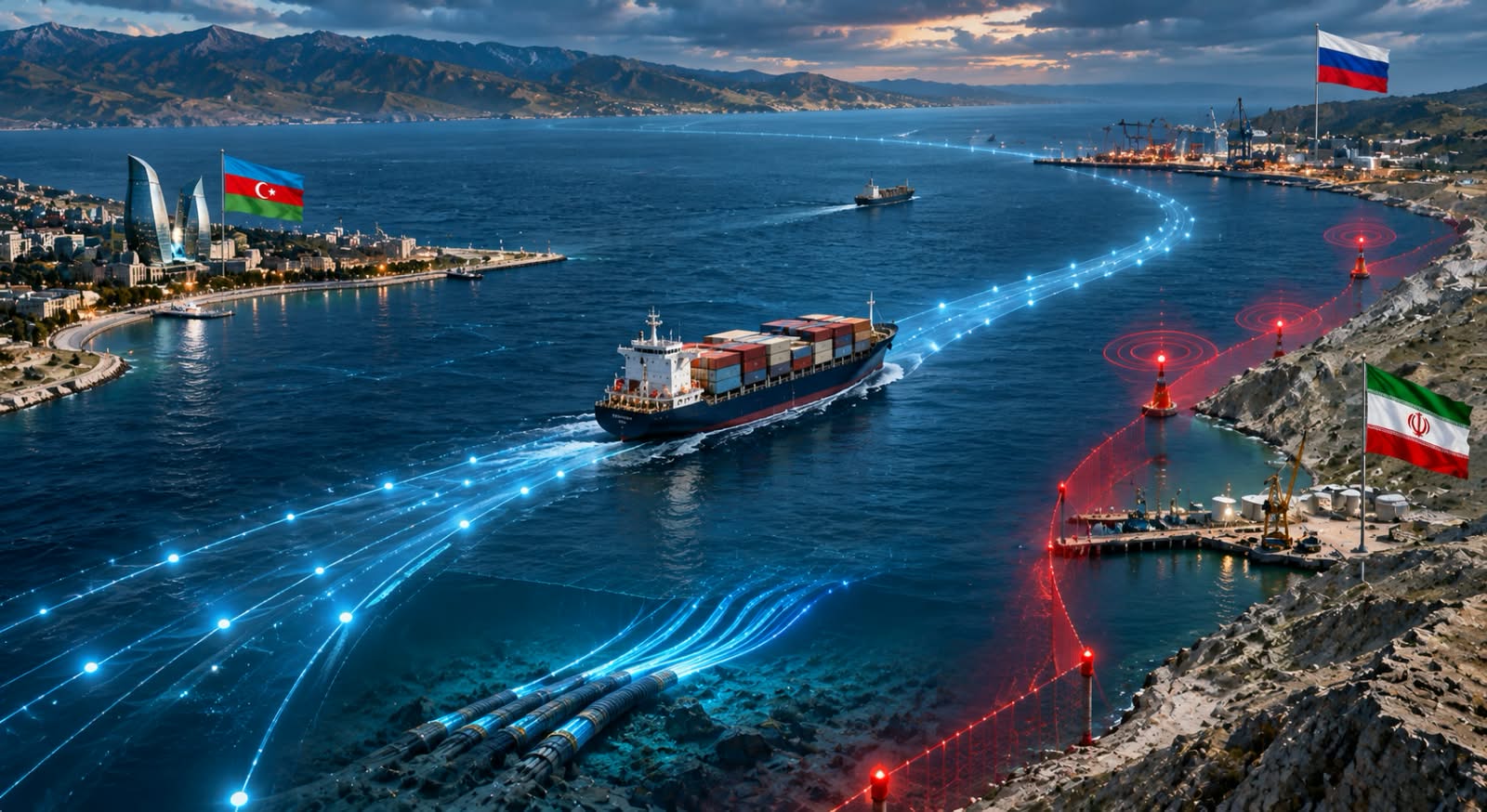
The expansion of the US pressure policy against Iran has brought the Caspian Sea into the international security agenda. Among the operational focus areas of the newly established US initiative, “Task Force Iron Gate,” is the restriction of the transit of weapon systems, dual-use technologies, and sanctioned materials across Iran’s land borders and the Caspian Sea.
A notable aspect of this new initiative is the lack of a direct US military presence in the Caspian Sea, raising critical questions regarding the mechanisms Washington intends to employ to enforce these restrictions. Furthermore, as the Caspian serves as a vital corridor for trade and transport links between Iran and Russia, potential disruptions could impact broader regional economic and geopolitical dynamics.
For Azerbaijan, the issue carries strategic weight from both security and transport perspectives. The operation of the International North–South Transport Corridor (INSTC), existing rail connections, and maritime shipping across the Caspian are deeply intertwined with the country’s position as a regional logistics hub. Consequently, the potential implications of the new US plan extend far beyond Iran alone.
Sea-news.az reports citing 247press.media that examined the strategic objectives of the “Iron Gate” initiative, its potential impact on Russia–Iran relations, alternative transport routes, and potential risks for Azerbaijan from political and transport angles.
Ali Zulfugaroglu, board member of the Justice, Rights, and Democracy (ƏHD) Party and political analyst, attributes the new US initiative to the trajectory of the military confrontation with Iran and the outcomes of Washington’s previous economic and diplomatic pressure mechanisms.
According to his assessment, US and Israeli military actions against Iran failed to achieve their initial political objectives. The analyst notes that targeting Iranian leadership did not trigger widespread domestic uprisings or regime change.
“The United States and Israel failed to achieve their target goals through attacks on Iran; namely, the elimination of top leadership did not result in a popular uprising or regime change in Iran.”
Zulfugaroglu observes that the prolonged nature of the conflict has broadened its scope. He highlights that Russia and China have provided Iran with intelligence and technological support, while Tehran has leveraged asymmetric capabilities to expand the geographic reach of the confrontation.
The analyst believes this dynamic has directly impacted US regional interests, noting that Iran’s effective control over the Strait of Hormuz has influenced global oil prices and American public opinion.
He states that ahead of the midterm elections, the Trump administration attempted to resolve rising tensions through diplomatic negotiations. However, internal divisions arose within the Republican Party regarding the continuation of military action, exacerbating friction between the Pentagon and the White House and leading to high-profile resignations.
Furthermore, Zulfugaroglu argues that the financial blockade initiated under US Treasury Secretary Scott Bessent failed to yield expected results.
“The United States has been unable to effectively disrupt Iran’s shadow economy.”
He attributes this to trade networks cultivated by Iran over decades of operating under international sanctions. Despite the blockade, Iranian oil exports persist, preventing Washington from fully shutting down Tehran’s alternative revenue streams.
Consequently, he suggests the US is leaning toward targeted strikes and intensified economic isolation rather than large-scale military escalation.
Zulfugaroglu emphasizes that Iran’s geography provides strategic flexibility. In addition to maintaining maritime ties with Russia, Tehran can utilize transit corridors passing through Armenia, Turkmenistan, Turkey, Afghanistan, and Pakistan.
He connects the strategy to domestic US political timelines, noting that the Trump administration faces a two-year window to resolve the Iranian conflict to avoid harming Republican prospects in the 2028 presidential elections. He also links the Democratic victory in the midterms to public dissatisfaction over the handling of the conflict.
Under these circumstances, Iran’s access to the Caspian Sea remains a focal point for Washington. By targeting Caspian transit routes, the US seeks to systematically constrain Iran’s economic and logistics capacity.
Potential Implications for Russia
Regarding Russia, Zulfugaroglu notes that Moscow views the US initiative with concern. Given the economic ties between Russia and Iran and the importance of the Caspian route for bilateral trade, Washington’s containment strategy runs counter to Kremlin interests.
However, the analyst suggests that Moscow retains leverage over the Trump administration, drawing parallels to diplomatic negotiations surrounding Ukraine prior to the recent US elections.
Despite the strategy, Zulfugaroglu remains skeptical about the practical implementation of US enforced measures in the Caspian region, citing the lack of direct US naval access.
“At present, physical enforcement by the US in the Caspian appears to be an unrealistic scenario.”
He stresses that without a military footprint in the Caspian basin, enforcing physical blockades remains unfeasible.
Furthermore, he warns that expanding military operations or escalating maritime tension in the Caspian could destabilize both the Middle East and the South Caucasus security architecture.
“A US-led containment scenario in the Caspian region could generate serious security challenges for South Caucasus nations and Russia alike.”
Will Commercial Trade Routes Shift?
The economic fallout of new US restrictions hinges on Iran’s existing transport infrastructure and alternative transit capacities. Potential constraints on Trans-Caspian shipping bring the throughput capacity of land-based INSTC branches into focus.
Transport expert Rauf Agamirzayev points out that Iran’s overland infrastructure faces capacity constraints when handling heavy freight volumes:
“Overall, Iran’s land transport network has limited throughput capacity for handling massive cargo flows. A key factor remains the status of border transport interconnections with neighboring states.”
Agamirzayev notes that historical and regional conflicts have impacted Iran’s transport links with Azerbaijan and neighboring countries.
He references the Yerevan–Ulukhanlu–Julfa–Tabriz railway line, originally opened in 1908, noting that decades of regional conflict restricted its full operational deployment.
While current freight volumes along this axis remain below historic potential, Agamirzayev suggests that regional peace initiatives could unlock future capacity.
“The future opening of the Zangezur corridor could significantly reactivate transit volumes along this route.”
Evaluating Iran’s rail infrastructure, Agamirzayev also points to the Alat–Julfa and Alat–Astara lines built during the Lend-Lease era.
He notes that the missing 162-kilometer Rasht–Astara rail link continues to disrupt seamless rail transport along the Western INSTC branch, forcing logistics operators to rely on multimodal sea, rail, and road transit while engineering surveys continue.
As an alternative, Agamirzayev highlights Iran’s Eastern rail connections through Turkmenistan.
The Sarakhs rail link between Iran and Turkmenistan was established in May 1996, followed by the Kazakhstan–Turkmenistan–Iran line via Incheh Borun in 2014.
While combined capacity along these Eastern routes was expanded from 2 million to 3 million tons annually with long-term targets of 15 million tons, current practical throughput remains constrained.
Risks to Trans-Caspian Iran–Russia Trade
Regarding direct maritime transit between Iran and Russia, Agamirzayev views the Trans-Caspian maritime route as carrying elevated operational risks.
“From a risk perspective, the Trans-Caspian maritime route between Iran and Russia has experienced targeted security incidents over the past year.”
He cites recorded strikes against maritime infrastructure in the Caspian basin, including strikes on Iran’s Anzali Port and reported drone incidents targeting Iranian-flagged cargo vessels near northern Caspian waters.
Consequently, Agamirzayev expects the Trans-Caspian maritime segment of the INSTC to face greater operational disruption compared to land routes.
On land corridors, non-sanctioned commercial cargo can continue to move in controlled quantities. Having operated under international sanctions for 47 years, Iran maintains established workarounds, though scaling up large-volume international freight under tightened oversight remains challenging.
Meanwhile, Russia continues to pursue strategic INSTC expansion targets, aiming for 15 million tons of freight capacity per direction, or 30 million tons in total volume.
Achieving these targets remains contingent on completing key infrastructure projects, including internal Russian transport upgrades, the completion of the Rasht–Astara line, and modernizing rail networks across northern Iran.
Ultimately, the future volume of international cargo transit along the corridor will depend on the regional security environment and the pace of infrastructure development.
Real-World Impact of “Task Force Iron Gate”
The overall impact of the “Task Force Iron Gate” initiative will depend on the specific enforcement mechanisms deployed by the US and its allies. Implementing economic, financial, and logistical restrictions requires a different operational approach than direct naval interdiction in closed sea basins like the Caspian.
Iran’s alternative overland routes, its strategic ties with Russia, and regional infrastructure limits will define the boundaries of potential trade disruption. Increased pressure on maritime shipping may drive demand for land transit, though existing rail and road networks may face operational bottlenecks.
For Azerbaijan, maintaining regional security, transit stability, and uninterrupted commercial transport connections remains the top priority as geopolitical developments unfold across the region.