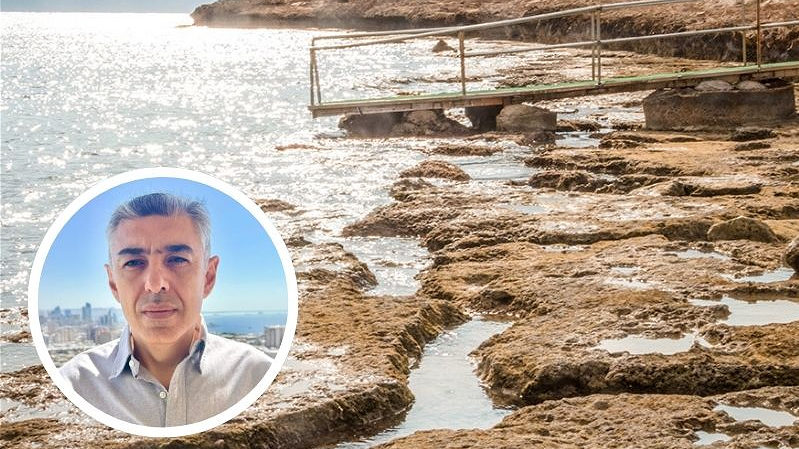
The Caspian Sea continues to recede, fundamentally altering its geography. Shallow areas are giving birth to new landmasses, coastlines are shifting, littoral zones are shrinking, and former shallows are transforming into islands. Recently, one such island—Ribachy Island—was discovered off the coast of Kazakhstan.
Last summer, the Shirshov Institute of Oceanology of the Russian Academy of Sciences announced the emergence of a new island southwest of Maly Zhemchuzhny Island. NASA satellites have likewise documented similar processes. The birth of these new islands is merely one of the most striking visual indicators of how the Caspian Sea is changing. For years, scientists have recorded retreating shorelines and drying shallows, placing the Caspian in an increasingly vulnerable state—spawning grounds are degrading, bird migration routes are disrupted, and unique natural ecosystems are gradually shifting. Rising temperatures, reduced river inflow, and intensifying water consumption further amplify the pressure on the marine ecosystem.
Sea-news.az reports citing 1news.az that However, the root causes of these phenomena may run much deeper than commonly recognized. Azerbaijani researcher and environmental engineering expert Yusif Alasgarov highlighted critical aspects of this issue in an interview.

— In recent years, discussions surrounding the declining level of the Caspian Sea have grown increasingly frequent. Is there a scientific consensus today regarding the causes of this drop?
— Yes. The primary cause is an imbalance in the water budget: a decrease in incoming water volume where evaporation outpaces runoff. In the past, speculative hypotheses were floated regarding a hypothetical connection between the Aral and Caspian seas, historical cyclical epochs, and other theories. However, while historical fluctuations in sea level have indeed occurred, an analysis of data from the past century points unmistakably to the anthropogenic factor as the main driver.
— How specifically has human activity impacted the level of the Caspian Sea?
— In the late 1930s, large-scale industrialization aimed at boosting electricity generation in the USSR led to the construction of numerous reservoirs along major rivers, including the Volga, which supplies the bulk of the Caspian’s inflow.
Between the 1930s and 1970s, the gradual commissioning of the Volga-Kama cascade of hydroelectric power stations (12 HPS units) altered the Volga’s hydrological regime and subsequently triggered a decline in the sea level. By 1977, the Caspian level dropped to –29 meters, reaching a 400-year minimum.
Significantly increasing water inflow from the Volga appears unrealistic given the critical importance of this cascade to the Russian economy. The Volga remains a vital transport artery and a primary source of drinking water for major cities, including Moscow. Furthermore, its hydroelectric cascade provides 45 percent of the country’s industrial and agricultural output.
Aside from reduced river inflow, the changing seasonality of the Volga’s flow is also a major factor. Previously, the majority of the Volga’s water entered the Caspian during the spring flood period in April, May, and June, which kept water temperatures lower during the summer and suppressed evaporation. Following dam construction, however, a significant portion of floodwaters is retained in reservoirs, and water enters the Caspian more evenly throughout the year. This has raised average water temperatures and accelerated evaporation rates.
The Kara-Bogaz-Gol factor and evaporation
Since the early 1980s, a rise in the Caspian’s level was observed, closely linked to the Kara-Bogaz-Gol bay in Turkmenistan. This bay is a shallow lagoon connected to the Caspian by a narrow channel 200–300 meters wide. Due to the hot climate and shallow depth, Kara-Bogaz-Gol acts as a powerful evaporator.
- Research shows that average annual evaporation across the Caspian stands at 100–120 cubic kilometers, while Kara-Bogaz-Gol loses approximately 18 cubic kilometers of water annually.
- A 1-meter drop in the Caspian Sea level corresponds to roughly 371 cubic kilometers of water.
- Thus, although Kara-Bogaz-Gol accounts for a mere 5 percent of the Caspian’s total surface area, it is responsible for 15 percent of total evaporation.
In the late 1970s, realizing the problem, the Soviet Union decided to dam the channel between the Caspian and the bay to halt water inflow. This caused a sharp rise in the Caspian level, but created a new ecological disaster: by 1983, the isolated lagoon dried up completely, and winds swept toxic salts from its exposed bed onto surrounding agricultural lands, destroying crops and livestock. Following public and official concern, the independent government of Turkmenistan breached the dam in the early 1990s, allowing water to rush back into the bay—whereupon the Caspian level resumed its downward trend.
Are there ways to reduce water losses?
Since increasing river inflow is difficult, the primary viable solution is reducing evaporation—though this must be done without repeating the mistakes of the Soviet era. Experience from other countries shows that covering water bodies with modern technologies can significantly curb evaporation:
- Plastic spheres (“shade balls”): Can reduce evaporation by up to 80 percent.
- Floating membranes and organic films: Create an impermeable barrier against water loss.
- Floating solar panels: Simultaneously generate electricity while suppressing evaporation.
For Kara-Bogaz-Gol, which lacks flora and fauna, implementing such measures would not trigger ecological issues. Covering the bay’s water surface with one of these methods could stabilize and potentially help restore the Caspian’s level.
If current trends continue…
The expert warns that if the process goes unchecked, severe consequences await us in the future:
- Economic and logistical challenges: All coastal ports will either have to be relocated or require continuous dredging of approach channels and basins. Additional operational costs will hit the oil sector and maritime shipping.
- Disruption of a unique ecosystem: Shifts in salinity and temperature heighten extinction risks for numerous endemic species.
- Microclimatic shifts: The moderating influence of the Caspian on humidity, cloud cover, precipitation, and wind regimes will weaken.
- Infrastructure challenges: Coastal cities’ sewage systems and future seawater desalination projects will face obstacles, requiring intake facilities to be pushed further out to sea.
- Geographical changes: For instance, the Baku Bay could undergo radical alterations, and a land bridge could theoretically form between Baku and Zira Island, granting dry-land access to the island.
Where should Caspian littoral states begin?
Yusif Alasgarov believes that Azerbaijan, Iran, Kazakhstan, Russia, and Turkmenistan must pool their efforts. Key steps include:
- Creating a regulated hydraulic engineering system on the channel connecting the Caspian Sea to Kara-Bogaz-Gol to precisely control the volume of water entering the bay.
- Holding an international engineering competition to develop technologies for reducing evaporation over vast water surfaces, followed by testing pilot projects on small-scale sites.
“Frankly, the grounds for optimism are rather slim. The region has already lost a great deal of time. The Caspian’s level has been dropping for a long time, but this issue only entered the interstate agenda over the past few years. If we begin taking action right now, we might perhaps slow down the decline. In any case, the time for half-measures has passed. Decisive steps must be taken as quickly as possible to rectify the situation.”