



In recent years, Armenia has been implementing large-scale road infrastructure projects within the framework of the North-South International Transport Corridor.
According to sea-news.az construction on the Agarak–Kajaran section (32 km) began on February 5, 2024. The project includes the construction of tunnels with a total length of 7.2 km, and the work is planned to be completed by 2032. The contractors are Iran’s Abad Rahan Pars International Group and Tunnel Sadd Ariana.
These same companies also built the new 4-lane Friendship Bridge over the Debeda River at the Sadakhlo–Bagratashen border crossing on the Georgia-Armenia border in 2022. The 160-meter bridge, built with 7.4 million euros of financial support from the EBRD, has approximately doubled the capacity of the border crossing point.
In 2026, the implementation of the next stage of the Sisian–Kajaran highway began. The new road, approximately 60 km long, will include 9 tunnels (with a total length of 12.5 km), 27 bridges (4.7 km in total length), and the country’s longest—the 8.6 km Bargushat tunnel. The project is valued at 858 million euros and will be carried out by a consortium of the French companies VINCI Construction Grands Projets and Razel-Bec.
The Washington Declaration of August 8, 2025, and the TRIPP (Trump Route for International Peace and Prosperity) initiative proposed within its framework, lay the foundation for a new phase on the logistics map of the South Caucasus. Construction of the transport infrastructure for this project is planned to begin this year.
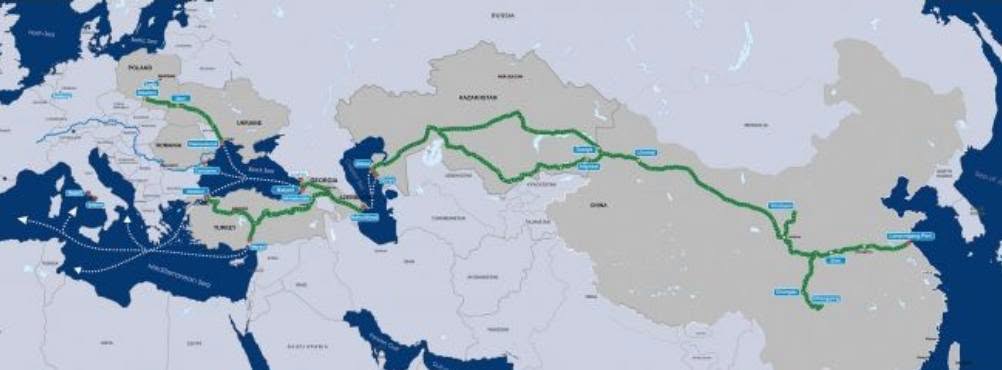
The TRIPP project could contribute to the development of transport links between the main part of Azerbaijan and Nakhchivan, the integration of Armenia into the regional transit network, and the expansion of cargo transportation between Europe and Central Asia via Turkey. This initiative will further strengthen the mutual integration of international logistics routes forming along the North-South, East-West, Middle Corridor, and the Araz River.
Over the past five years, Azerbaijan has also been rapidly implementing large-scale infrastructure projects in the liberated territories and along international transport corridors.
- The Agbend–Kalala road bridge over the Araz River has been commissioned, and a new border crossing and customs complex is under construction.
- The majority of the 56.4 km long four-lane Khudaferin–Gubadli–Lachin highway has been completed, with construction continuing on the remaining sections.
- Numerous tunnels, overpasses, and other complex engineering structures are being built on the 75.8 km long Lachin–Kalbajar highway.
- Construction work on the Murovdag tunnel project is proceeding intensively.
Simultaneously, the Alat–Agbend railway in the direction of Zangezur, new highways, transport infrastructure toward Nakhchivan, as well as the Kars–Igdir–Aralik–Dilucu railway project in Turkey are accelerating the transformation of the Araz corridor into a unified international logistics system.
All these projects demonstrate that the transport corridor forming along the Araz River is becoming more than just regional; it is turning into one of Eurasia’s key geo-economic spaces. Every new highway, railway, bridge, and tunnel built in this strategic strip, located between the Caspian Sea, the Black Sea, and the Persian Gulf, will define the direction of future international cargo flows.
It is here that international transport routes—North-South, East-West, Middle Corridor, and South-West—complement one another. Therefore, the projects implemented by the countries of the region are considered not only national infrastructure but also key pillars of economic integration between Europe, the Caucasus, Central Asia, and the Middle East.
Azerbaijan maintains its role as a locomotive in this geo-economic competition. The international seaport, modern road and rail network, international airports, and advanced logistics infrastructure created in recent years have turned the country into one of the region’s strongest transport hubs. The projects being implemented along the Araz River further consolidate this advantage, strengthening Azerbaijan’s strategic position in the Eurasian transport system.



