Although the development of the Middle Corridor is usually evaluated through the prism of cargo volume growth and transit indicators, the efficiency of the route is not measured solely by millions of tons of cargo. Sometimes, cargoes that have relatively small volumes but require high-value and complex logistical solutions bring greater revenue to the regional economy.
According to sea-news.az transport expert Rauf Agamirzayev stated that the transportation of out-of-gauge industrial equipment, power plants, turbines, and dangerous goods (project cargo) could create new and highly profitable sources of revenue for the Middle Corridor. According to the expert, certain specific cargoes generate high added value and provide more economic benefits to the countries located along the route.
Stating that there is already successful experience in this field, R. Agamirzayev cited the transportation of oversized parts for a tunnel boring machine (TBM) from China via Georgia’s Poti port a few years ago, as well as the delivery of industrial equipment to Uzbekistan and Azerbaijan via China and Kazakhstan, as examples.

The expert believes that for such shipments to become regular, infrastructure constraints such as bridges, power lines, and other bottlenecks along the route must be removed, and dedicated logistics routes must be established. Azerbaijan, Georgia, Türkiye, and Central Asian countries must work together toward creating special corridors that ensure access to Black Sea and Mediterranean ports. Even in the future, when implementing new projects like the Zangezur corridor, the technical parameters required for the transportation of oversized and dangerous goods should be taken into account in advance.
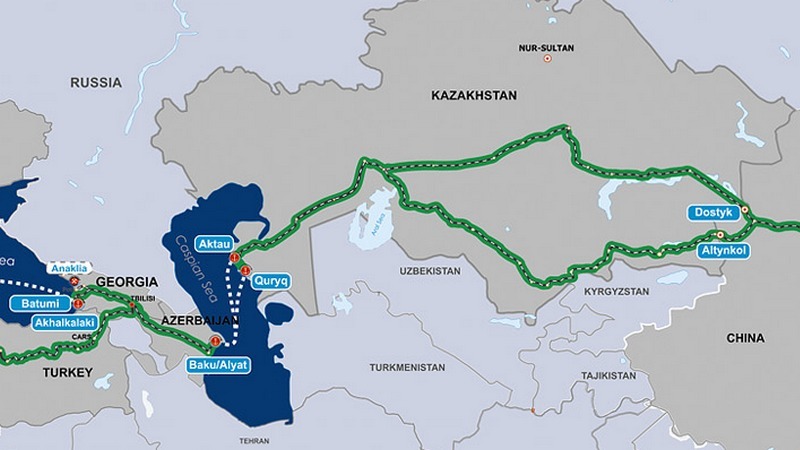
Emphasizing that the corridor is not limited to the Kazakhstan route alone, the expert noted that the southern branch forming along the China–Kyrgyzstan–Uzbekistan–Turkmenistan line also holds strategic importance. According to him, new road and railway projects connecting the ports of Kuryk, Aktau, and Turkmenbashi serve to form a unified transport network in the Caspian region and reduce logistics risks.
In conclusion, R. Agamirzayev added that competing for project cargo is sometimes more profitable than increasing regular cargo tonnage. This is because this type of multimodal transportation ensures high profit margins for ports, railways, road carriers, and logistics companies. In the next stage, the main goal is to bring this complex process to a level as seamless and predictable as regular commercial cargo by coordinating the operations of the transit countries.