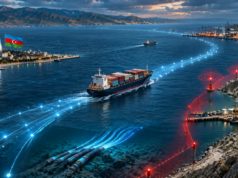

Azerbaijan’s advantageous geographical location, expanding transport infrastructure, and participation in international transport corridors are steadily increasing the country’s role in regional and global logistics systems. Today, the transit of East-West and North-South transport routes through Azerbaijani territory holds substantial economic and strategic significance for numerous countries.
Sea-news.az reports that transport expert Rauf Aghamirzayev stated this in an interview with AZERTAC.
The expert noted that China, European countries, Türkiye, Russia, Iran, and Central Asian states currently show particular interest in transport links passing through Azerbaijan.
“The North-South International Transport Corridor, the Middle Corridor, and planned connections in the Zangezur direction create new opportunities in terms of diversifying cargo transportation in the region. Through these routes, various alternatives are emerging for organizing freight shipments from Russia to Türkiye, from Central Asia to Black Sea ports, as well as from Asia to Europe. Iran’s interest in linking routes passing through its territory with Black Sea ports further enhances the significance of this transport network. It would be incorrect to evaluate the importance of transport corridors solely by the total volume of transported cargo. Although freight volumes on certain routes are smaller compared to traditional pathways, these directions play a vital role in the timely delivery of specific goods and strategically important cargo to their destinations,” the expert emphasized.
According to R. Aghamirzayev, one of Azerbaijan’s key advantages is its multimodal transport capabilities: “Alongside railways, highways, seaports, and cargo fleets, air transport infrastructure is also being developed in our country. The interconnection of these modes of transport enables more flexible cargo movement, optimization of the supply chain, and the creation of added value. Azerbaijan acts as a crucial connecting link for Central Asian countries accessing global markets via the Caspian Sea. Access routes through the Caspian to the Black Sea and Mediterranean basins, the delivery of energy resources to international markets, as well as the development of railways and highways strengthen our country’s standing in the regional economic system.”
The expert added that projects implemented in recent years to modernize and diversify Azerbaijan’s transport infrastructure are expanding the nation’s transit capacities. The modernization of railways, advancement of port and logistics infrastructure, and establishment of new transport links pave the way for Azerbaijan to emerge not only as a transit country, but also as a major hub for the storage, processing, and redistribution of goods.
He noted that a favorable geographical position does not generate an economic advantage on its own. Realizing this advantage requires modern, diversified infrastructure that integrates multiple modes of transport. Through the projects it implements, Azerbaijan is turning its geographical position into an economic opportunity.
Rauf Aghamirzayev stressed that in this process, Azerbaijan both reaps economic dividends for itself and contributes to the expansion of international trade relations for other countries.