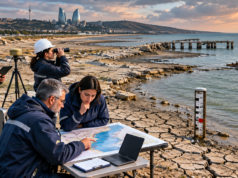

Caspian Sea researchers, who categorize the sea’s water level fluctuations into cycles lasting 30 to 35 years, have concluded that these variations may be linked to Earth-Sun interactions.
Sea-news.az reports that Hasan Nabiyev, Chief Researcher at the Climate Department of the Institute of Geography under the Ministry of Science and Education and PhD in Geography, told AZERTAC that 11-year solar activity cycles do not fully explain the Caspian’s average 30-to-35-year fluctuation patterns. However, short-term rises and falls observed during these broader spans can be correlated with the rising and falling phases of 11-year solar activity cycles. Several studies conducted in this domain have yielded positive findings.
“The results obtained while analyzing the causes of severe torrential downpours and mudflow events in Azerbaijan are also of vital importance for examining this issue and achieving the intended research goals,” the scholar stated.
Discussing the outcomes of his research, H. Nabiyev noted that the average duration of atmospheric circulation epochs closely aligns with the mean cycle period of solar activity — 11.1 years. Nevertheless, weak correlational links between types of atmospheric circulation and solar activity necessitate further investigation. The primary driver behind this remains the complex mechanism through which solar activity influences atmospheric circulation, alongside details of the process that are not yet fully understood. Current research findings do not yet fully or unequivocally confirm the direct relationship between solar activity and atmospheric circulation patterns.