
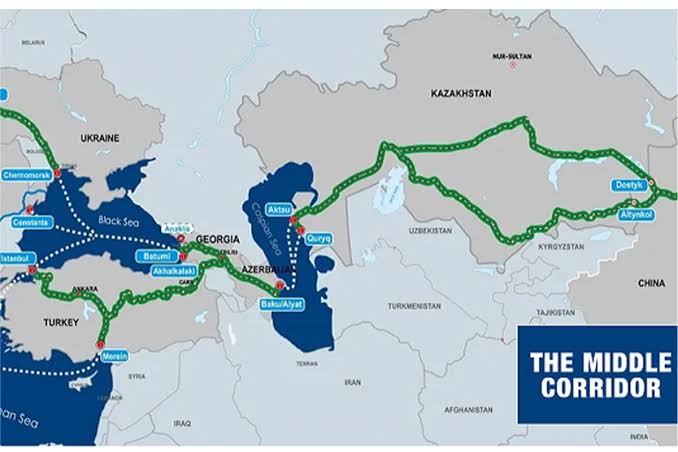
The National Union of Road Hauliers of Romania (UNTRR) has published a comprehensive report examining international initiatives aimed at advancing the Trans-Caspian International Transport Route (Middle Corridor) passing through Azerbaijan, investments in logistics infrastructure, and prospects for broadening trade connections between Central Asia and Europe.
Sea-news.az reports citing UNTRR — one of the leading professional transport organizations in Romania — that during the United Nations Special Programme for the Economies of Central Asia (SPECA) 2026 events in Bishkek, participating states approved new frameworks for modernizing multimodal transport corridors.
According to the United Nations Economic Commission for Europe (UNECE), the Bishkek Declaration was officially adopted, approving financing for three new regional initiatives. A core strategic project targets enhancing the efficiency and competitiveness of SPECA multimodal transport corridors, specifically including the Trans-Caspian route traversing Azerbaijan.
Project coordination will be overseen by UNECE in collaboration with the United Nations Economic and Social Commission for Asia and the Pacific (ESCAP) and the United Nations Conference on Trade and Development (UNCTAD).
The Romanian publication highlights that the Middle Corridor, connecting China and Central Asia to Türkiye and Europe via the Caspian Sea, Azerbaijan, and Georgia, is fast becoming a paramount alternative route for global trade. Integrating rail, road, and maritime logistics, the corridor facilitates the expansion of cargo geography, diversifies supply chains, and optimizes transit operations.
Citing a World Bank report published in September this year, UNTRR notes that targeted investments in Trans-Caspian infrastructure and logistics services could triple trade volumes and cut cargo transit times in half by 2040.
However, realizing these targets remains contingent on modernizing port and railway infrastructure, eliminating border-crossing bottlenecks, and harmonizing transit procedures among participating nations.
A key highlight concerning Azerbaijan involves the digitalization of international road transport. It is reported that in July this year, customs authorities of Azerbaijan, Turkmenistan, Uzbekistan, and Tajikistan successfully conducted six transport operations utilizing the eTIR procedure, five of which involved crossing the Caspian Sea.
One notable operation spanned over 1,200 kilometers, combining road and maritime transport seamlessly under a single electronic transit framework.
UNTRR underscores that the eTIR system simplifies documentation through electronic exchanges of customs data and guarantees, mitigating administrative errors and reducing border wait times. Pilot operations across the Caspian Sea demonstrate the vast scalability of this digital technology for multimodal logistics.
Romanian hauliers also view the evolution of the Middle Corridor within the broader context of emerging trade networks connecting Europe, Türkiye, and the Middle East. The article identifies Türkiye as a pivotal bridge linking both the Trans-Caspian route into Central Asia and international road freight corridors extending into Iraq, Syria, and the Gulf states.
According to the publication, implementation of the TIR system commenced in Iraq in April 2025, followed by the official resumption of international TIR transport from Türkiye through Syria to Gulf nations in December of the same year.
Citing International Road Transport Union (IRU) data, over 5,000 TIR carnets were issued for the Iraqi route by September 2026, alongside an additional 5,000-plus along the Syrian corridor following its reopening. Trial runs through Iraq demonstrated that cargo could be delivered from Gaziantep, Türkiye to Riyadh, Saudi Arabia in just four days.
UNTRR emphasizes that while these auxiliary routes are not directly part of SPECA’s multimodal project, their concurrent expansion fosters a more comprehensive transport network bridging Europe, Central Asia, and the Middle East.
The Romanian organization notes that the progress of the Trans-Caspian corridor unlocks valuable opportunities for the European Union’s transport sector. Romania and Bulgaria, in particular, are positioned as key entry gateways to the EU market via Black Sea maritime routes and overland pathways through Türkiye.
The report notes that extending these connections will drive demand for international road freight, logistics services, multimodal transport operations, and regional distribution hubs.
Nevertheless, Romanian transport specialists stress that optimizing permit allocations, customs clearance efficiency, infrastructure capacity, and transit predictability remains critical to fully realizing this potential.
According to UNTRR’s evaluation, the significance of the Bishkek-approved initiatives extends far beyond building physical infrastructure; the primary objective is to evolve existing transport links into a more efficient, flexible, and fully integrated component of global supply chains.
Ultimately, the heightened focus of Romania’s transport sector on the Middle Corridor via Azerbaijan demonstrates that the route is recognized not merely as a transit bridge between Asia and Europe, but as a vital pillar of the broader international logistics grid.