



Military conflicts in the south and north continue to impact global oil supplies. The closure of the Strait of Hormuz amid the US-Iran confrontation, alongside the Russia-Ukraine war, creates significant challenges for oil transportation via the Black Sea.
Sea-news.az reports that a number of major oil companies operating in Kazakhstan are expressing concerns regarding the security of oil exports through the Caspian Pipeline Consortium (CPC), which passes through Russian territory. Consequently, they are considering transporting oil across the Caspian Sea to Azerbaijan and onwards to global markets as an alternative route.
The Turkish newspaper “Türkiye Today” reports that Russian drones are launching missile strikes against oil tankers in the Black Sea. Companies such as Chevron, ExxonMobil, Eni, Shell, and TotalEnergies are reviewing two primary options for delivering Kazakh oil to world markets via Azerbaijan.
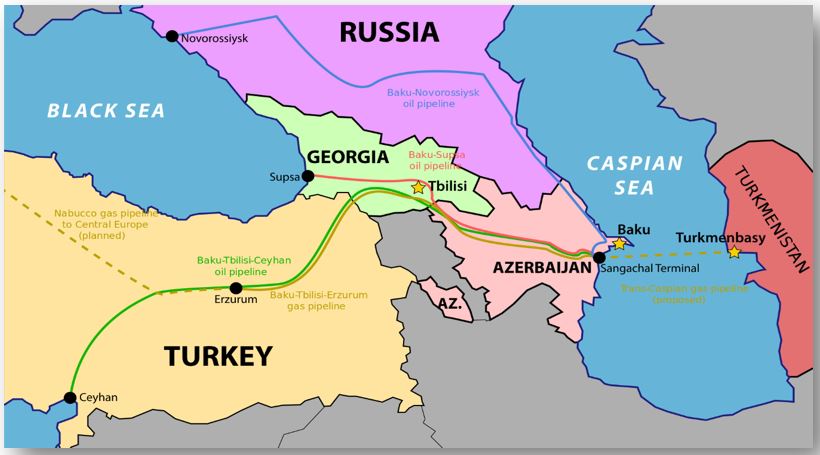
One option involves constructing a pipeline along the seabed of the Caspian Sea, while the other entails transporting oil by tankers to the Port of Baku for further distribution to international markets.
Currently, approximately 80 percent of the oil produced in Kazakhstan is exported through the CPC. Following a $48 billion investment in Kazakhstan’s oil industry, Chevron has reportedly initiated efforts to find alternative transport routes.
It should be noted that Kazakhstan currently exports approximately 1.3 million tons of oil annually via the Baku-Tbilisi-Ceyhan pipeline, with efforts underway to increase this volume to 1.8 million tons. However, given that Kazakhstan exports around 60 million tons of oil per year through the CPC, this alternative remains limited compared to the main route passing through Russia.
The construction of the Trans-Caspian pipeline, an initiative in which Azerbaijan is also interested, has been under serious discussion since 2000. However, geopolitical risks have continuously hindered the project’s execution.
In recent years, escalating disruptions in the Strait of Hormuz driven by Middle Eastern conflicts, combined with heightened security risks for Black Sea oil transit due to the Russia-Ukraine war, have brought the Trans-Caspian pipeline project back to the forefront.
Reports indicate that the matter is also being discussed in Washington. Oil companies operating in Kazakhstan are actively working to develop alternative transit routes to safeguard large-scale investments.
If constructed, the Trans-Caspian pipeline could serve not only Kazakhstan but Uzbekistan as well. The implementation of this project would enhance Azerbaijan’s transit capabilities and significantly boost revenues generated from the transit sector.



