



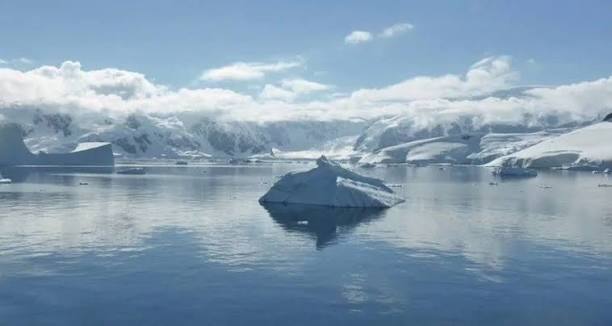
Greenland and Antarctica have lost over 12 trillion tons of ice mass over the past 47 years. As a result, global sea levels have risen by approximately 31.4 millimeters. Research indicates that the main cause of ice loss is not surface melting, but the warming of ocean waters.
Sea-news.az reports that the findings of the study were published in the journal Scientific Data.
Led by British scientists, the research involved 58 scientists from various countries around the world. The researchers combined 42 different datasets obtained from 27 satellite missions spanning from 1979 to 2026. These data provided a comprehensive picture of the changes taking place in polar ice sheets over nearly half a century.
The study revealed that approximately 84 percent of the lost ice mass did not melt on the surface of the ice sheets. This ice mass entered the sea as glaciers accelerated and moved toward the ocean. Only 16 percent of the loss was attributed to atmospheric processes, including surface melting and changes in snowfall.
According to scientists, the results highlight the critical role of warm ocean waters, which melt the underside of glaciers and cause them to flow faster toward the ocean.
Distinguishing these mechanisms is essential for future climate projections. While attention was previously focused mainly on surface melting caused by warm air, the new study shows that ocean warming is also a vital factor in ice loss.
The reduction of ice mass in Greenland and Antarctica directly affects global sea level rise. This, in turn, can lead to increased risks of flooding and storm surges, particularly in coastal cities and settlements.
The authors of the study emphasized that long-term satellite observations are a vital tool for tracking gradual changes occurring in ice sheets.
It is noted that the majority of Earth’s freshwater resources are stored in the ice sheets of Greenland and Antarctica. A complete melting of these ice sheets could cause global sea levels to rise by tens of meters. Currently, such a scenario is not expected to happen in the near future. Nevertheless, present-day ice loss continues to contribute to sea level rise and elevates flood risks in coastal regions.
The authors stated that the collected data could help establish a unified database for more accurately tracking changes in polar ice sheets and developing future climate predictions.



