



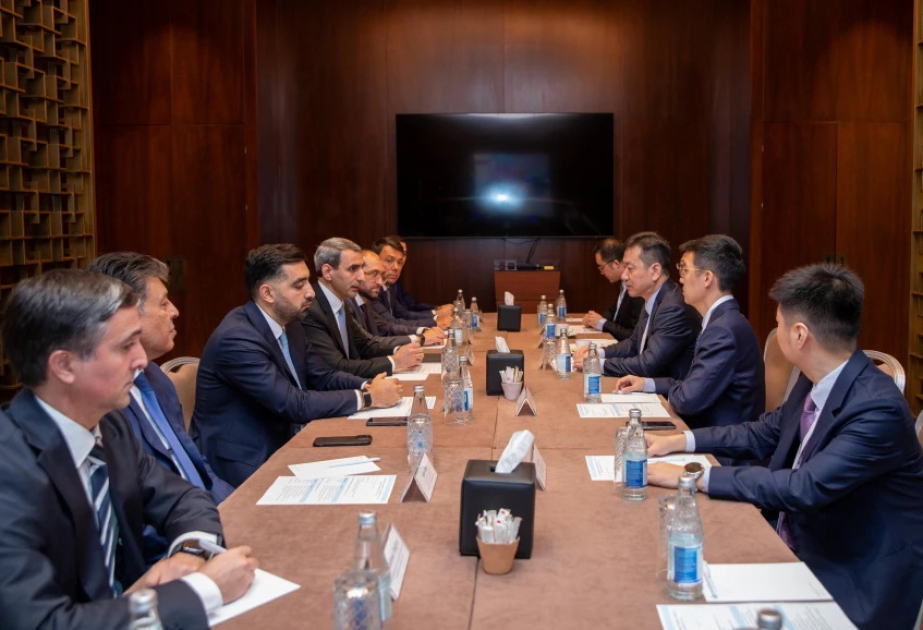
New cooperation opportunities focused on developing the Middle Corridor, scaling up freight volumes, and expanding integrated logistics capabilities have been reviewed between Azerbaijan Railways (ADY) and key Chinese partners.
Sea-news.az reports that on the sidelines of the CICA Port Heads Conference held in Baku, ADY Chairman Rovshan Rustamov held high-level meetings with delegations from leading Chinese port authorities and technology institutions.
Discussions centered on deepening transport and logistics ties between Azerbaijan and China, accelerating cargo flows along the Trans-Caspian International Transport Route (Middle Corridor), and advancing the digitalization of port and railway operations.
During his meeting with representatives from the Shanghai International Port Group (SIPG) and the technology firm NIZE Tech, Rovshan Rustamov explored strategies to increase regular containerized shipping via the Middle Corridor. The parties underscored the importance of identifying and capturing cargo movements originating from Shanghai and transiting through Kazakhstan, the Caspian Sea, and Azerbaijan toward European markets.
The talks also addressed the implementation of smart port solutions and the digitalization of terminal operations. Potential areas of technical cooperation included terminal management systems, intelligent cargo intake and processing solutions, automated freight yard management, data integration, and seamless digital coordination between port and railway nodes. The necessity of maintaining ongoing trilateral collaboration between ADY, SIPG, and NIZE Tech to advance the Middle Corridor was strongly emphasized.
Furthermore, during a separate meeting with a delegation from Lianyungang Port JSC, the ADY Chairman discussed ways to further develop the Lianyungang–Baku route, expand the scheduling of block trains along the Middle Corridor, and attract higher volumes of westbound cargo destined for Europe.
Both sides highlighted the strategic value of existing cooperation between ADY and Lianyungang Port. They noted that strengthening real-time data exchange regarding cargo flows, train timetables, and logistical requirements will significantly enhance the operational efficiency, transit velocity, and overall competitiveness of the Lianyungang–Baku corridor.
Concluding the meetings, the parties agreed to continue their joint efforts toward advancing the Middle Corridor, growing cargo volumes along the China–Azerbaijan–Europe axis, streamlining logistics workflows, and deploying innovative technological solutions.



