



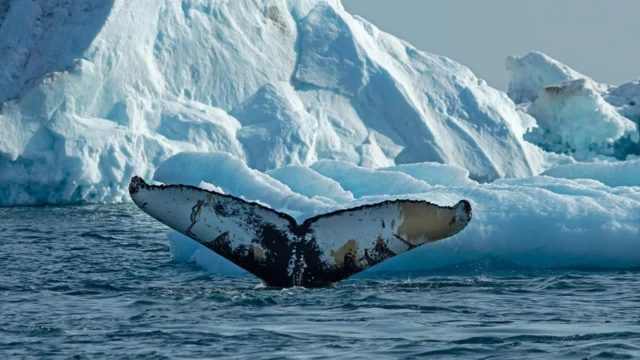
Driven by climate change, the warming of seas and the reduction of ice cover in Greenland are creating new habitats for large whale species that previously rarely reached the region, leading to significant shifts in the marine ecosystem.
Sea-news.az reports that an international research team investigated changes in sea temperatures and glacier conditions in Greenland over the past 20 years.
As a result of their studies, scientists determined that humpback whales, sei whales, and minke whales—whose access to Greenland’s eastern waters was once restricted due to dense ice cover—are appearing in the region much more frequently due to rising water temperatures and melting glaciers.
Researchers stated that the region is turning into a new habitat for these whale species. Their intensive feeding in these waters is considered one of the indicators of a large-scale transformation taking place in Greenland’s marine ecosystem.
Scientists noted that ecological changes driven by climate change are rapidly transforming Greenland’s marine ecosystem, significantly altering the food chain as well as predator-prey relationships.
Researchers also found that the fish species upon which whales feed are expanding toward the eastern coast of Greenland, resulting in the emergence of new food sources in the area.
The lead author of the study, Professor Mads Peter Heide-Jorgensen from the Greenland Institute of Natural Resources, described the increased presence of these whale species in the region as a “major ecological shift.”
Heide-Jorgensen noted that while whale species are adapting to the changing conditions, this does not apply to all Arctic wildlife.
“Climate change creates new opportunities for some species, while causing others to lose their habitats,” Heide-Jorgensen stated.
The results of the study were published in the journal Frontiers in Marine Science.



