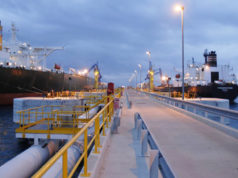

Global liquefaction and regasification capacity continued to grow in 2025.
According to sea-news.az citing the annual report of the International Group of Liquefied Natural Gas Importers (GIIGNL), the global LNG infrastructure expanded further over the past year.
The report states that global liquefaction capacity reached 524 million tonnes, supported by the commissioning of three new facilities and capacity expansions at existing plants. Meanwhile, regasification capacity increased to 1.247 billion tonnes following the launch of nine new terminals. These new installations and upgrades across Asia, Europe, and the Middle East contributed significantly to market growth.
In LNG shipping, the industry exceeded its 2024 delivery record of 67 vessels, with 79 new LNG carriers delivered in 2025. The average capacity of these vessels was 175,586 cubic meters. As a result, the global LNG carrier fleet expanded to 899 ships, marking an 8.8% year-on-year increase.
Total LNG transport capacity of the global fleet reached 136 million cubic meters, while the active fleet capacity stood at 131 million cubic meters by the end of the year.
The global LNG fleet also includes 54 floating storage and regasification units (FSRUs) and 82 smaller vessels with capacities around 30,000 cubic meters, reflecting the diversification of LNG logistics infrastructure worldwide.