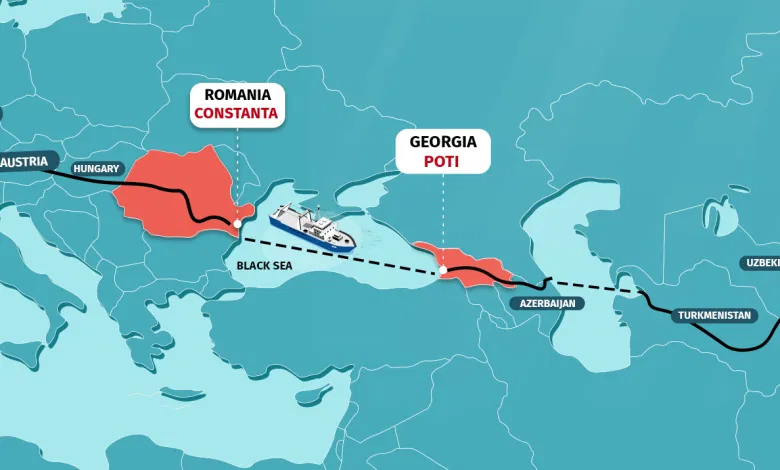
The development of the Caspian–Black Sea route is assuming an increasingly vital role in reinforcing transport connectivity between Central Asia and Europe. Intensifying diplomatic contacts, port infrastructure upgrades, and expanding freight volumes are laying the groundwork for a more integrated multimodal transport network linking the Caspian Sea, the South Caucasus, and the Black Sea basin.
Sea-news.az reports that these views were expressed to AZERTAC by Vusal Guliyev, Senior Advisor at the Center of Analysis of International Relations and Multiculturalism.
He noted that broadening cooperation among Turkmenistan, Azerbaijan, Georgia, and Romania has recently emerged as a top priority in this direction. Discussions surrounding the draft intergovernmental agreement on the establishment and operation of the Caspian–Black Sea international transport route, alongside regional security and trade initiatives, demonstrate the strong interest of participating states in expanding alternative trade channels. Transport and logistics links connecting Turkmenistan with Azerbaijan and Georgia—specifically negotiations regarding the potential setup of a Turkmen cargo terminal on Georgia’s Black Sea coast—represent key dimensions of this evolving process.
Recalling that a meeting held in Baku this September among representatives of the ports of Aktau, Kuryk, Turkmenbashi, Poti, and Batumi within the framework of the Conference of Interaction and Confidence Building Measures in Asia (CICA) Port Authorities Conference served as a practical milestone, the expert highlighted that deliberations covered inter-port coordination, enhancing freight efficiency and predictability, as well as driving tighter integration between maritime and overland logistics networks across the Caspian and Black Sea basins.
Demand for Transport Services Along the Middle Corridor Surges
“Furthermore, ongoing infrastructure initiatives complement broader diplomatic efforts. The maiden arrival of Turkmenistan’s first domestically built dry cargo vessel at the Baku International Sea Trade Port in May 2026, followed by the delivery of the Azerbaijani-constructed tanker ‘Dostlug’ to Turkmenistan in June, illustrates the expanding maritime transport collaboration between the two nations. Concurrently, routine consultations among delegates from Aktau, Kuryk, Turkmenbashi, Poti, and Batumi bring the importance of synchronized port operations in both sea basins to the fore. Commercial indicators further substantiate the route’s rising prominence. On September 15 of this year, during the working group meeting of the Trans-Caspian International Transport Route held in Bulgaria, performance results for the first eight months of the year were presented. Container transit volume along the corridor surged by 58 percent during this period to reach 44,200 TEUs. Meanwhile, the number of container trains dispatched from China climbed by 84 percent to 419. These figures clearly reflect escalating demand for logistics services along the Middle Corridor,” the expert emphasized.
According to him, the long-term efficiency of the route will not rely solely on physical infrastructure expansion. Harmonizing vessel operating schedules across borders, implementing digital cargo tracking systems, expanding paperless electronic documentation, streamlining customs clearances, and solidifying intermodal integration between rail and sea transport remain critical priorities.
“These measures can minimize transit delays and make supply chain operations considerably more predictable. If progress is sustained across these strategic domains, the Caspian–Black Sea route can evolve into a pivotal southern artery of the Middle Corridor, seamlessly linking Central Asia to European markets via the Caspian Sea, the South Caucasus, and Türkiye. This will contribute to deepening regional economic integration, enhancing the resilience of Trans-Eurasian supply chains, and diversifying global trade corridors,” V. Guliyev added.