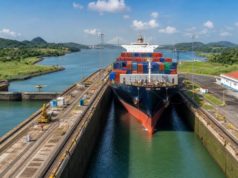
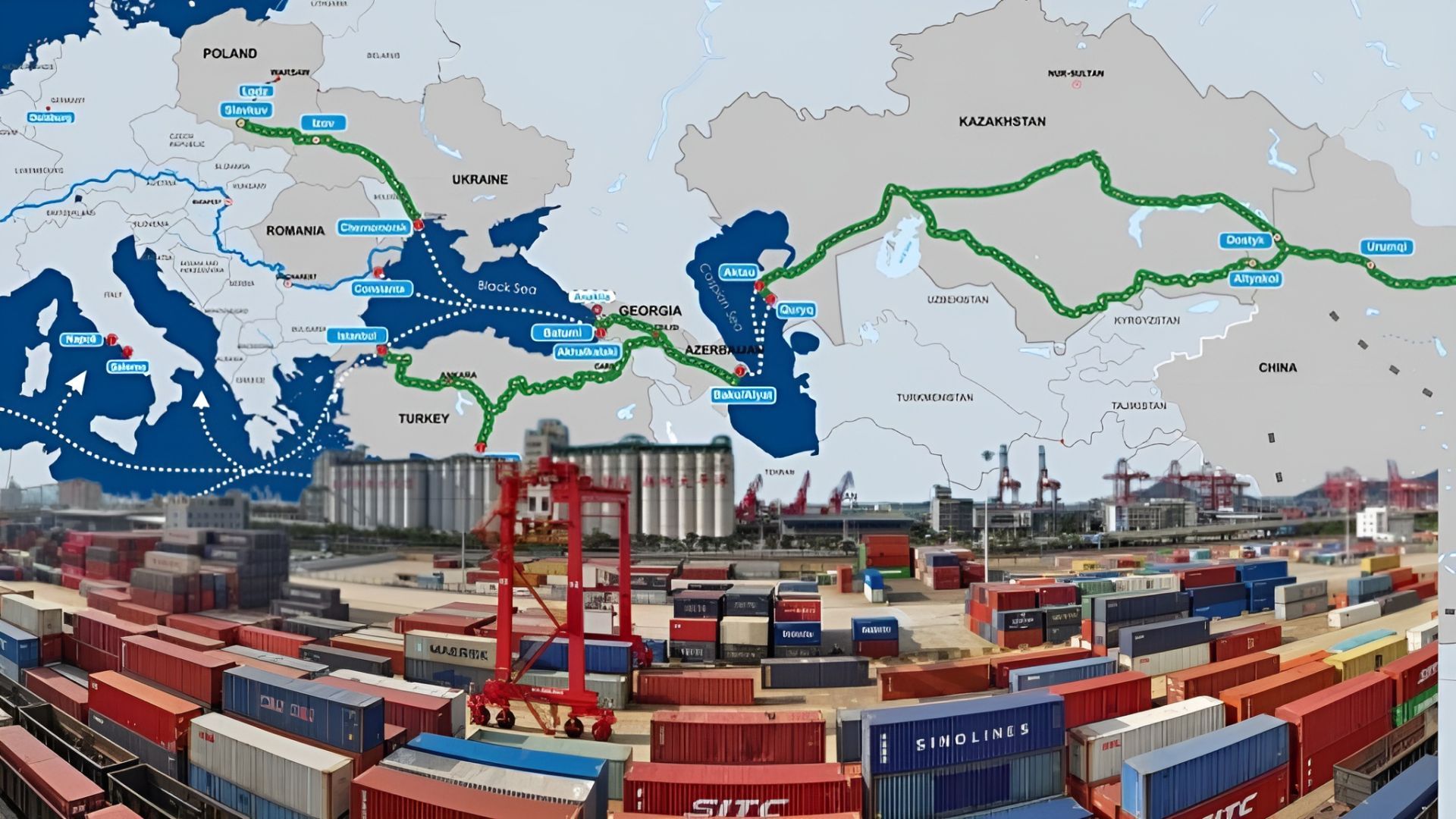
Railways, Caspian shipping and port infrastructure are central to the Middle Corridor’s development as a China–Europe freight route. Editorial illustration.
Sea-news.az reports that For most of this year, anyone moving goods between China and Europe has been short of good options. The Strait of Hormuz has been in turmoil since the US and Israeli strikes on Iran on 28 February, and eight months later ships are still being attacked there. Tehran says the strait will stay closed until Washington accepts its conditions. The Houthis also resumed attacks on shipping in the Red Sea. Container lines have started drifting back through Bab el-Mandeb, but nobody expects normal traffic before early next year.
The northern rail route through Russia never stopped running. For many European companies, though, it now comes with sanctions exposure and reputational costs they would rather not carry. Ships can still go the long way around the Cape of Good Hope, at the price of several extra weeks at sea.
So the Middle Corridor, officially the Trans-Caspian International Transport Route, has become something close to the only overland option that avoids Russia, the Gulf and the Red Sea all at once. The route runs by rail across Kazakhstan, by ship across the Caspian, and on through Azerbaijan, Georgia and Türkiye. Traffic has grown accordingly: from around 1.5 million tonnes of cargo in 2022 to roughly 5.2 million tonnes last year, with container volumes up 36% in 2025 alone, to 76,900 TEU. Kazakhstan now talks about reaching 10 million tonnes, perhaps as early as 2027.
Growth has never really been the corridor’s problem, though. The harder question, one that has hung over it for years, is how to turn a string of national railways, ports and ferry lines into something a shipper can actually buy as a single service. That is why the plans announced by the German logistics group Rhenus this autumn are worth a close look. They are also a good occasion to talk about the physical limits that no amount of good management will make go away.
The Rhenus plan
On 30 September, at the Kazakhstan–Germany Business Forum in Berlin, Rhenus signed an agreement with the Port of Aktau to move ahead with a new trimodal container terminal, with Kazakhstan’s state railway KTZ as a partner. The terminal would sit on at least 30 hectares, connect ships, trains and trucks, and add at least 150,000 TEU of annual capacity. There is talk of eventually doubling that to 300,000 TEU.
None of this happened overnight. Rhenus first signed a letter of intent with Aktau back in September 2024, when Olaf Scholz was touring Central Asia as chancellor. It is also worth being clear that the project is still at an early stage: its technical and economic feasibility has not yet been assessed.
What makes Aktau interesting is what surrounds it. Rhenus chief executive Tobias Bartz has said the company wants to build up to 14 terminals along the corridor, from Uzbekistan through Kazakhstan and Azerbaijan to Türkiye, and link them to its existing network in Europe. Some of the pieces are already in place. In January Rhenus bought its first rail terminal, in Kazakhstan’s Almaty region, and in Uzbekistan it plans to spend about €11 million with the state railway upgrading a terminal in Andijan, which should handle around 200,000 TEU a year once the first phase is done.
The ambition, in other words, goes well beyond adding cranes. Rhenus wants to tie terminals, container depots, rail, shipping and freight forwarding together into one system.
Why Rhenus is different
Rhenus is an old company by logistics standards. It was founded in Germany in 1912 and today reports revenue of about €8.2 billion, some 39,000 staff and more than 1,300 locations in over
70 countries. It does a bit of everything, from warehousing and customs clearance to rail, road, sea and air freight.
Its real advantage here is in Europe. The company says it runs 23 container ports and around 70 port facilities there, including terminals in Duisburg, Europe’s biggest inland port, as well as sites in Hamburg and Rotterdam. It already moves freight between China and Europe, and it has been working in Kazakhstan for about 30 years.
This matters because new terminals on the corridor would not be starting from zero. They would be connected to infrastructure that already works and to customers who already ship with Rhenus. A route that comes with its own cargo base is a very different proposition from one that has to go out and find one.
Others came first
Rhenus is hardly the first big international name in the region. APM Terminals, DP World, COSCO Shipping and AD Ports Group, among others, have all put money into ports and logistics along the route.
The trouble is that a strong operator in one port does not make the whole trip work. Shippers have to think about all of it: getting the container to the railhead, the border crossings, the transfer from train to ship, the Caspian crossing, the run through the Caucasus and Türkiye, and the final delivery somewhere in Europe. Each extra company, contract and timetable in that chain is another place where things can stall or get more expensive.
This is where Rhenus might change things. It does not need to own every railway, port or ship to offer an integrated service; it can coordinate the journey over national infrastructure and its partners’ assets. For the customer, the difference is having one company to deal with from origin to destination, instead of a dozen.
What integration could bring
If Rhenus pulls this off, shippers would gain a few things the corridor has never offered them. One is proper end-to-end tracking, so a container can be followed across every leg of the journey. No such corridor-wide system exists today, and building one will take real work.
Another is accountability. If Rhenus can sell a single through-contract, the shipper knows exactly who is organizing the move and who answers when it goes wrong. Rhenus can also put the route in front of its existing China–Europe customers, many of whom are looking for ways to spread their risk across more than one route. And with terminals, railways and ships coordinated by one party, transit times should become easier to predict, which is often what shippers care about most.
Ports on both shores
Rhenus is not building in a vacuum. Ports on the Caspian and Black Seas are expanding fast.
• Kuryk, Kazakhstan. China’s Guoyou Materials Industry Group is involved in a
multipurpose port with an automated container terminal and a rail connection. The
announced investment is around 470 billion tenge, spread over phases to 2032.
• Alat, Azerbaijan. The Port of Baku handles about 150,000 TEU a year now and
expects to reach 260,000. Longer-term plans go as high as 500,000 TEU, though that is
a goal rather than today’s throughput.
• Poti and Batumi, Georgia. APM Terminals, part of Maersk, runs the container
terminal at Poti, and the Philippine group ICTSI operates the one in Batumi.
• Anaklia, Georgia. The long-planned deep-water port is not operating yet, but once
built it could add a lot of Black Sea capacity.
More terminals do not, by themselves, fix the problem described above. Ports can be modern and railways efficient within their own borders while the shipper is still stuck juggling contracts, schedules and paperwork. That gap is the one Rhenus says it wants to close.
The Caspian Sea is shrinking
There is one constraint that no logistics company can negotiate with. The Caspian Sea is getting smaller, and any port or terminal built on its shores has to be designed with that in mind.
The sea has fallen by about two meters since the mid-2000s and is now lower than at any time since instrumental measurements began. Azerbaijani officials put the drop at 0.93 meters over the past five years, 1.5 meters over ten and 2.5 meters over thirty. At Aktau, the port authority has recorded a fall of 1.7 meters in 18 years.
The effects are already showing up in shipping. Dry cargo ships leaving Aktau are sailing 600 to
1,300 tonnes below capacity, and tankers are carrying 2,000 to 2,500 tonnes less than they could. Approach channels at Aktau and Kuryk were recently measured at 4.9 meters deep, well short of the 6.11-meter standard. Kazakhstan has set aside about $84.5 million to dredge Aktau, and Baku is dealing with the same thing.
Where the water goes from here is anyone’s guess. Long-range models suggest the sea could drop another 9 to 18 meters by 2100, and up to 21 meters if emissions stay high. At the same time, recent monitoring shows the yearly decline slowing, from 25–30 cm to about 15–17 cm. In practice, nobody can say with any confidence where the shoreline will be in twenty years.
That uncertainty hits hardest exactly where Rhenus wants to invest. Aktau and Kuryk are on the northeastern Caspian, the shallow side, where a 10-meter drop could leave the water up to 89 km farther from today’s coastal settlements. A terminal built for the current waterline could end up stranded well before it has paid for itself.
Our view is that anyone building on the Caspian today should be designing for the sea of 2050. In practice that means berths that can be extended seaward, a dredging budget that is permanent rather than one-off, and feasibility studies that treat water levels as a central question. None of this is cheap. Building a port that ends up on dry land would cost far more.
Old ships for a deeper sea
A terminal is only as useful as the ships calling at it, and the Caspian fleet is old. Most of the cargo vessels working the sea were built in Russia more than 15 years ago, and some are much older than that.
Azerbaijan’s state shipping company ASCO runs the biggest commercial fleet on the Caspian: 22 tankers, 15 ferries, 14 dry cargo ships, two Ro-Ro and two Ro-Pax vessels, and two Handysize bulkers. Two of those dry cargo ships were built in the Soviet Union in 1977, two in Portugal in
1988, and the rest in Russia, the newest of them in 2010. Its two Ro-Ro ships date from the mid-1980s. By ASCO’s own count, only 35 new vessels have joined the fleet since 2013.
On the Kazakh side, the state carrier Kazmortransflot has just three container ships, all delivered in 2019, each able to carry 350 TEU. Container traffic is growing quickly (ASCO alone tripled its container volumes to 22,030 TEU in 2025), but the fleet carrying it remains small.
New ships are coming, and several are being designed around the falling water:
| Owner | Vessels | Capacity per vessel | Builder | Status |
|---|---|---|---|---|
| AD Ports Group | 2 shallow-draft container ships, 4.5 m draft | 780 TEU, 9,400 t | Baku Shipyard | Keels laid June 2026; delivery end-2027 |
| KTZ (Kazakhstan) | 6 cargo ships | up to 537 TEU, 9,900 dwt | Baku Shipyard (2), Jiangsu Haizhongzhou (4) | Contracts signed April 2026 |
| Turkmenistan | 2 dry cargo ships | 240 TEU (Gadamly) | Balkan Shipyard | First delivered May 2026 |
| ASCO (Azerbaijan) | 10 Ro-Ro vessels | n/a | Baku Shipyard | Planned by end-2026 |
The AD Ports ships are a good example of where design is heading. Their designers describe them as the largest dry cargo ships that can work the Caspian at a 4.5-meter draft, with hulls shaped around today’s depth limits. If the sea keeps dropping, the next generation will probably need to be shallower still, which means wider, flatter container carriers that give up draft for beam. Shipyards and naval architects should be working on that now rather than waiting for the next meter to disappear.
The long road to the border
The third problem starts in China itself. Decades of export-led growth put most Chinese manufacturing in the coastal provinces, right next to the ports that ship it overseas. The Middle Corridor starts at the other end of the country.
Khorgos, the main rail crossing into Kazakhstan, is close to the point on Earth that lies farthest from any ocean. COSCO’s dry port there is roughly 1,600 miles, or about 2,600 km, from the sea. Goods made in the Yangtze or Pearl River delta have to travel thousands of kilometers inland before the corridor even begins, and at Khorgos the containers must then be moved from Chinese standard-gauge track onto the wider gauge used in Kazakhstan.
The connections are there. Trains already run through Khorgos from Jinhua in Zhejiang province and from Guangzhou, heading for the Caspian and Europe. What remains uncertain is scale: whether China’s rail network, the border crossings and the transfer yards can handle anything like the volumes that container ships carry. Part of the answer depends on where China makes things in the future. As the coast has become richer, more production has moved inland, to cities such as Chongqing, Chengdu and Xi’an that are organizing their logistics around rail rather than ports. The first container train of 2026 made it from Xi’an to Baku in 11 days. The more manufacturing moves west, the better the corridor’s economics look.
For Rhenus, the lesson is that a network starting at the Kazakh border only covers part of the journey. Doing this properly will mean working with Chinese rail operators and inland hubs, so that the first leg of the trip gets as much attention as the last.
Open questions
Several things are still unclear. We do not yet know whether Rhenus will run its own shipping on the Caspian and the Black Sea, charter or buy ships, or rely on long-term contracts with existing lines. Nor is it clear whether it can offer a single through-contract with guaranteed transit times, or how liability for delays would be shared among the many parties involved.
There are bigger questions too. Will its terminals and feasibility studies take seriously a sea that may fall several more meters during their working life? How far into China will its network reach, and with whom?
And perhaps the most important one: will the cargo stay once Hormuz and the Red Sea settle down? So far, every jump in corridor traffic has been driven by trouble somewhere else. A network of terminals does not guarantee that freight will move over for good.
Is it a game changer?
The Middle Corridor has been decades in the making. The countries along it have laid track and expanded ports, and plenty of global companies have tried the route. What it needs now is less about new concrete and more about making the route convenient, predictable and worth paying for.
Rhenus has a real chance to deliver that. It could connect the infrastructure of several countries to the network of an operator that already works between China and Europe, and if it manages to combine terminals, rail, shipping, tracking and sales into one service, the corridor would be a very different product.
Integration alone will not be enough, however. The route also needs ports built for a falling sea, a modern fleet that can work in shallower water, and a way of getting Chinese goods to the border in volume. If those problems are solved alongside the network, the Middle Corridor could stop being an emergency detour and become a route that wins Asia–Europe freight on its own merits.