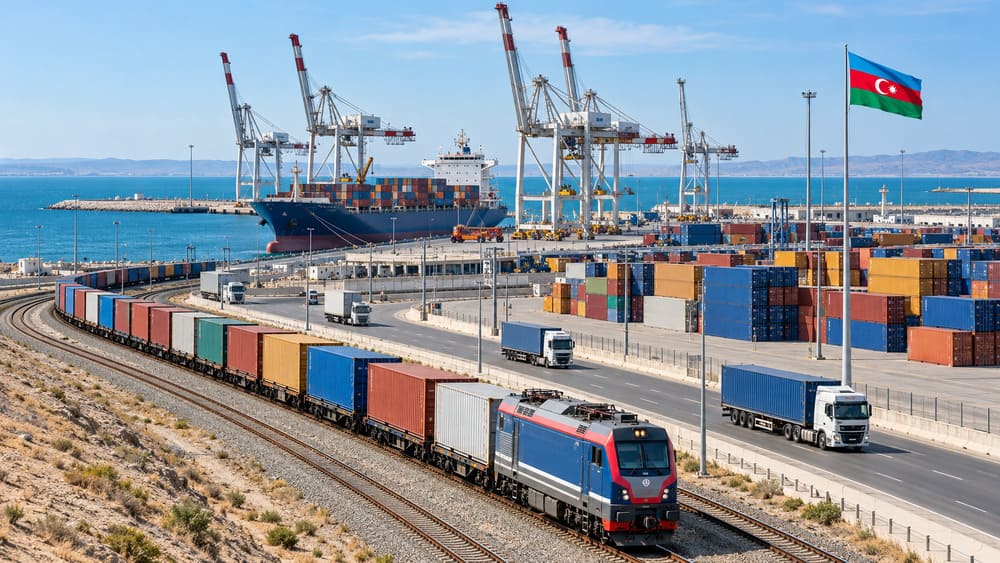
The growth of transit cargo transportation through Azerbaijan continues into 2026. To support this momentum, AZCON Holding is implementing consistent measures to strengthen integration between rail, port, and maritime transport, advance logistics infrastructure, and enhance freight efficiency. These initiatives serve to bolster the nation’s competitiveness along international transport corridors and expand its overall transit potential.
Sea-news.az reports that speaking at the VIII Congress of the New Azerbaijan Party on October 2, 2026, President Ilham Aliyev stated: “This year, the expected volume of transit cargo passing through Azerbaijan will reach 16 million tons.”
Highlighting the ongoing efforts to enhance the commercial attractiveness of both the Middle Corridor and the North–South Corridor, the Head of State also disclosed a medium-term target of raising transit cargo volumes through Azerbaijan to 30 million tons.
Rising transit freight volumes open new horizons for expanding logistics services, solidifying Azerbaijan’s position within global supply chains, and generating added value for the national economy. In this context, the expansion of transit flows creates additional opportunities for both the development of the transport sector and the diversification of the non-oil economy.
Scope and Economic Significance of Transit Freight Growth
In January–September 2026, transit cargo volumes traversing Azerbaijan exceeded 12 million tons. This 14.5 percent increase compared to the corresponding period of last year stands as one of the highest figures recorded for the nine-month period over the past decade.
The growth in freight volumes occurs against the backdrop of shifting demand among international logistics providers for established routes, heightened interest in alternative transport corridors, and the restructuring of regional supply chain links.
During the first nine months of this year, 4.1 million tons of cargo were transported through Azerbaijan via the Middle Corridor. Marking a 20 percent increase over the same period last year, this represents the highest figure in five years and underscores the growing commercial appeal of the route.
The fact that growth along the Middle Corridor outpaces overall transit performance underscores the need for targeted focus on this route’s development trajectory. The corridor’s competitiveness depends not merely on standalone infrastructure established within individual countries, but on the seamless operation of all route segments as a unified system. Consequently, advancing the Middle Corridor requires not only physical infrastructure investments, but also unified tariff structures, digital information exchange, and operational coordination across borders.
Over the past five years, transit cargo volumes through Azerbaijan have nearly doubled. This indicator reflects the country’s expanding footprint within international transport networks and the broadening of its transit capabilities.
This positive development trajectory is supported by ongoing measures to upgrade transport infrastructure, enhance intermodal coordination between railways, ports, and maritime fleets, and optimize logistics workflows. These initiatives are designed to elevate transport efficiency, maximize the utilization of existing assets, and fortify Azerbaijan’s standing as a regional logistics hub.
Nearly 30 Percent Increase in Container Shipping
During the first nine months of 2026, the Port of Baku handled 100,000 TEU containers. Compared to 77.3 thousand TEU handled during the same period in 2025, this represents a 29 percent growth.
Containerized shipping facilitates the transfer of goods between rail, road, and maritime transport while broadening planning and tracking capabilities. Sustaining this growth at the Port of Baku will depend on terminal operational speeds, vessel voyage frequency, and the seamless alignment of transport infrastructure.
The Port of Baku’s annual container throughput capacity stood at 100,000 TEU when operations commenced, subsequently rising to 160,000 TEU through operational enhancements.
The actual throughput volume of 100,000 TEU recorded in the first nine months of this year indicates a higher operational intensity relative to the port’s initial nominal annual capacity. Current metrics show that the terminal is operating under expanding demand, highlighting the imperative of maintaining asset efficiency alongside constructing additional capacity in the next phase.
The observed rise in container handling creates fresh opportunities for developing warehousing, sorting, customs clearance, and freight forwarding services. Expanding physical infrastructure and refining associated logistics offerings remain crucial for the future growth of the Port of Baku.
The Next Horizon: 25 Million Tons
The target is to raise annual transit cargo throughput via Azerbaijan to 25 million tons by 2030. Achieving this goal mandates expanding infrastructure, integrating transport modes, and agilely managing logistics operations.
Transitioning from the expected 16 million tons to the 2030 benchmark of 25 million tons requires sustained expansion across the transit domain. Seasonal fluctuations in cargo flows, infrastructure readiness in neighboring states, border processing speeds, and route selections by international shipping lines will all influence the ultimate outcome. Therefore, alongside physical infrastructure projects, forecasting freight volumes and aligning existing capacities with real-time demand remain central management imperatives.
To this end, several major infrastructure projects are currently underway.
A flagship project involves establishing a new transport link to Türkiye via Nakhchivan. This route will provide additional connectivity and regional throughput capacity facing west.
The new link promises to diversify the national transport network and distribute cargo traffic across multiple corridors. Economic returns, however, will hinge on route readiness, technical alignment with neighboring grids, tariff policies, and the competitive advantages offered to carriers.
Under Phase Two of the Port of Baku’s development, total annual cargo throughput capacity is planned to reach 25 million tons, with container handling capacity expanding to 500,000 TEU. This expansion aims to meet surging demand and alleviate operational bottlenecks in cargo handling.
Expanding port capacity represents a cornerstone infrastructure milestone within Azerbaijan’s overarching transit strategy. Alongside port expansion, the development of railway connections, storage yards, and cargo processing services must be pursued in parallel.
Expanding Transport Capabilities in the Caspian Sea
Surging cargo volumes along the Middle Corridor necessitate fleet modernization and enhanced shipping efficiency across the Caspian Sea. The corridor’s overall throughput capacity depends not only on terrestrial infrastructure, but also on vessel capacity, sailing frequency, and inter-port coordination.
The Caspian Sea serves as a crucial connective segment of the Middle Corridor. Expanding maritime transit capabilities in line with growing freight traffic enhances both route throughput and operational efficiency. In this regard, strengthening the fleet contributes to the seamless function of the entire logistics chain and boosts the Middle Corridor’s transit potential.
Currently, four new cargo vessels are under construction at the Baku Shipyard based on international contracts.
Two of these are container ships with a capacity of 780 TEU each, commissioned for “AD Ports Group”. Pursuant to the contract signed on September 16, 2025, construction is scheduled for completion by 2028.
The remaining two vessels are being constructed under a contract signed with “KTZ Express Shipping” in May 2026. Each vessel features a container capacity of 537 TEU and a deadweight capacity of approximately 9,900 tons.
These orders showcase the expanding international cooperation of Azerbaijan’s shipbuilding industry and the strengthening of domestic manufacturing capabilities. Project execution will contribute to non-oil GDP growth, industrial advancement, the adoption of modern manufacturing expertise, and the creation of new partnership avenues.
Furthermore, plans encompass acquiring larger next-generation ferries, expanding Ro-Ro transport, executing joint projects with private investors, and undertaking phased fleet renewals.
Implementing these initiatives will generate additional shipping capacity across the Caspian crossing and ensure more efficient management of rising cargo volumes. Ultimately, this aims to elevate throughput capacity and overall operational resilience along the maritime segment of the Middle Corridor.
Expanding maritime transport is also vital for maintaining service quality across the Middle Corridor. A route’s competitiveness is defined by total transit time from origin to destination, transportation costs, and service predictability. Therefore, introducing new vessel capacity must be complemented by port throughput capabilities, railway transport organization, and close coordination among international logistics operators.
Translating Transit Growth into Sustainable Economic Outcomes
The primary challenge lies in converting rising transit cargo volumes into enduring economic advantages. Achieving this requires developing logistics, warehousing, cargo processing, and freight forwarding services, generating new employment opportunities, and integrating local enterprises into global supply chains. Economic impact must be evaluated not merely by volume moved, but by the added value created around the cargo flow.
Infrastructure investments must be planned based on long-term traffic forecasts, real-time demand, operational costs, and economic efficiency. Digitalization, streamlined customs procedures, rapid data exchange, and seamless modal coordination are equally essential.
The core priorities for the upcoming phase include expanding the Port of Baku, constructing new transport links, reinforcing the Caspian fleet, and maximizing operational efficiency.
Concurrently, modernization of the electrification system and signaling infrastructure along the Baku–Alat–Boyuk Kesik railway line will be carried out. This serves to adapt the Middle Corridor to growing freight flows and expand the operational scope of the corridor.
Comprehensive work continues across all primary pillars of transport and logistics infrastructure—maritime transport, ports, railways, and adjacent sectors. The growth in transit freight underscores Azerbaijan’s expanding role within the regional transport ecosystem. To realize established targets, alongside physical infrastructure, end-to-end corridor coordination, competitive tariffs, reliable service, and precise freight forecasting remain indispensable. Long-term economic benefits will depend on the harmonious integration of these factors.