The Caspian Sea plays an increasingly vital role in the functioning of the Middle Corridor, which links China to Europe via Kazakhstan, Azerbaijan, Georgia, and Türkiye. Against the backdrop of surging freight traffic, Kazakhstan and Azerbaijan are expanding their maritime fleets, modernizing ports, and developing bilateral shipbuilding cooperation. What measures are being undertaken to boost the route’s throughput capacity, and what challenges lie ahead?
Sea-news.az reports that these questions are addressed in a material by Kazinform’s special correspondent in Baku.
Cargo Traffic Grows, Fleets Expand
According to the Ministry of Transport of Kazakhstan, transit volumes along the Trans-Caspian International Transport Route (TITR / Middle Corridor) have expanded from 0.8 million tons to 4.5 million tons over the past five years. Nevertheless, in 2025, the throughput stood at 4.1 million tons, representing an 8.9% decrease compared to the preceding year.
In 2026, transit growth resumed momentum. According to official Kazakh data, cargo transport along the TITR surged by 30% in January–September, while west-bound transit container traffic originating from China jumped by 64%.
This dynamic raises requirements for the maritime segment of the corridor, necessitating seamless and regular cargo transport and transshipment between Kazakh and Azerbaijani ports. Beyond mere vessel counts, aligning maritime transit schedules with railway operations remains critical. Port bottlenecks and uncoordinated scheduling prolong delivery times and escalate carrier expenses.
Kazakhstan Broadens Its Commercial Fleet
A principal player in Kazakhstan’s maritime shipping sector is Kazmortransflot (KMTF), a subsidiary of NC KazMunayGas JSC.
Official data shows that the company’s fleet comprises 15 vessels. Two of these—the Aframax-class tankers “Altay” and “Alatau”—operate outside the Caspian Basin. The fleet also encompasses five tankers (“TK Aktau”, “Astana”, “Almaty”, “Taraz”, and “Liva”), two dry cargo vessels (“Turkestan” and “Beket Ata”), three container ships (“Berkut”, “Sunkar”, and “Barys”), and three tugboats (“Irgiz”, “Emba”, and “Talas”).
Thus, the company’s fleet caters not only to crude oil transportation, but also to containerized and dry bulk cargo handling—assets that hold key potential for expanding Middle Corridor operations.
Kazakhstan aims to expand its maritime transport capacity, including through new shipbuilding orders executed in Azerbaijan. At the Baku Shipyard, four vessels are currently under construction across two distinct projects involving partners from the United Arab Emirates and Kazakhstan.
The first project entails constructing two container ships with a capacity of 780 TEU each, while the second project involves two multi-purpose dry cargo vessels for Kazakhstan’s KTZ Express Shipping.
On October 15, 2026, Samruk-Kazyna Fund released details regarding the construction of dry cargo vessels for Kazakhstan. The new ships are slated for deployment along the Middle Corridor connecting China and Central Asian nations with Europe via the Caspian Sea and the South Caucasus.
Commissioning these new dry cargo vessels will bolster the operational resilience of the maritime segment, unlock additional capacity to attract international freight flows, and reinforce Kazakhstan’s overall transit potential.
Azerbaijan’s Caspian Fleet Boosts Freight Operations
Azerbaijan Caspian Shipping Closed Joint Stock Company (ASCO) plays a cornerstone role in executing freight transit across the Caspian Basin.
The company’s commercial fleet consists of 56 vessels, including 23 tankers, 13 ferries, 16 dry cargo ships, two Ro-Ro vessels, and two Ro-Pax ferries.
In addition, ASCO maintains a specialized offshore fleet of 200 vessels, primarily servicing offshore oil and gas projects and performing marine support services.
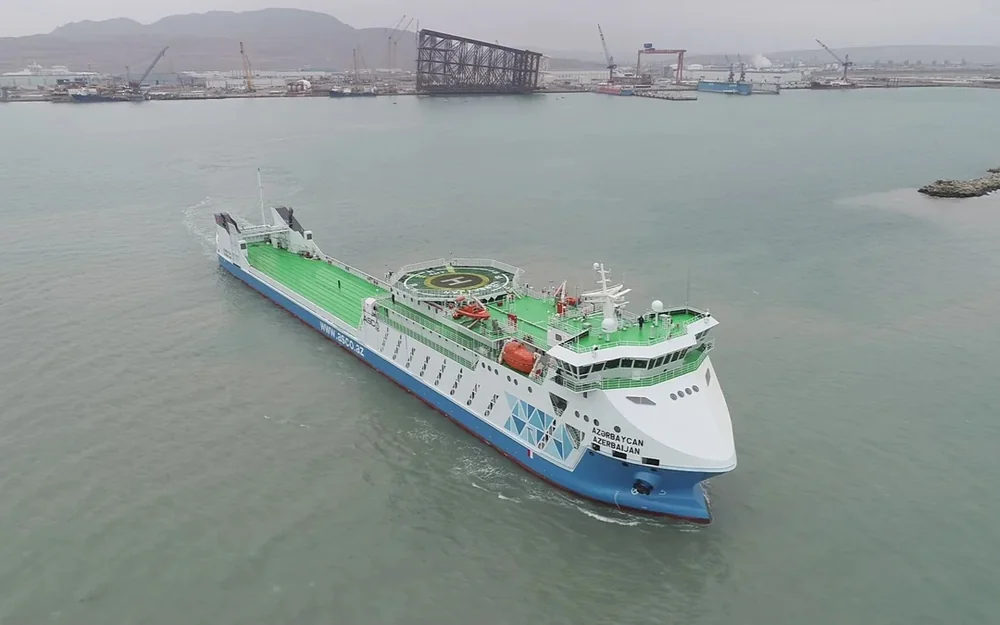
The Ro-Pax ferries “Azerbaijan” and “Zarifa Aliyeva” serve as essential links in maintaining freight and transport connections across Caspian ports. Each vessel features the capacity to transport 100 passengers, 56 tank cars, or 50 heavy trucks.
In January 2026, ASCO announced that the construction of a third Ro-Pax vessel of this class was entering its final phase.
According to ASCO metrics, the company’s vessels transported approximately 9.086 million tons of cargo in 2025, marking a 5.38% increase year-on-year. Dry cargo transport rose by over 45% to reach roughly 1.325 million tons, while container shipping volume climbed to 22,030 TEU—representing a 203% surge compared to 2024.
Shipbuilding Strengthens Bilateral Cooperation
Constructing vessels in Azerbaijan for Kazakh clients expands industrial cooperation between the two nations.
According to AZCON Holding data as of June 3, 2026, the Baku Shipyard order book stood at 17 vessels, with 11 under active construction and six in the engineering design phase.
While not all yard orders are designated exclusively for the Middle Corridor, constructing container ships and dry cargo carriers for Kazakhstan demonstrates that corridor expansion drives demand not only for transport services, but also for regional shipbuilding capabilities.
For Kazakhstan, this partnership provides an avenue to expand its fleet with regional support, while for Azerbaijan, it maximizes capacity utilization at Baku Shipyard and fosters industrial cooperation across the Caspian Basin.
Furthermore, last week in Baku, during the VII Summit of the Conference on Interaction and Confidence Building Measures in Asia (CICA), the Presidents of Azerbaijan and Kazakhstan witnessed the exchange of a signed intergovernmental agreement on cooperation for the development of the Trans-Caspian International Transport Route.
The document establishes a unified legal framework to ensure the sustainable operation and comprehensive development of the Middle Corridor amid the ongoing transformation of global trade and logistics chains.
The agreement facilitates coordinated infrastructure expansion, the elimination of bottlenecks across rail, road, and port facilities, and the joint development of dredging fleets and Caspian shipping operations.
Ports and Caspian Water Levels: Infrastructure Challenges
The throughput capacity of the route’s maritime segment does not depend solely on fleet sizing. Kazakh data indicates that the annual handling capacity of the Port of Aktau stands at 11.8 million tons, while the Port of Kuryk holds a capacity of 6 million tons.
However, the combined nominal capacity of 17.8 million tons across both ports does not automatically translate into guaranteed or actual cargo traffic along the Middle Corridor.
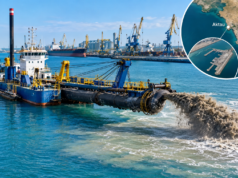
Another critical factor is the declining water level of the Caspian Sea. In 2026, Kazakhstan initiated dredging operations at the Port of Aktau. The project entails extracting approximately 1.3 million cubic meters of seabed soil to deepen the port’s basin to 6–7 meters, with completion scheduled by year-end.
According to Ministry of Transport of Kazakhstan estimates, the project could boost port throughput capacity and TITR cargo volumes by up to 30%, while reducing maritime freight costs by approximately 10–15%. These projections reflect expected outcomes upon project completion rather than current metrics.
Why Fleet Composition Matters for the Middle Corridor
According to Azerbaijani logistics expert Rauf Aghamirzayev, growing freight traffic along the Trans-Caspian International Transport Route boosts demand for maritime transit and accelerates fleet renewal.
However, beyond increasing vessel counts, addressing specialization is imperative. Transporting crude oil and petroleum products, grain, fertilizers, and containerized freight requires distinct vessel categories.
The expert noted two main directions: expanding overall vessel numbers and replacing aging fleet units. Certain vessels that have reached the end of their operational lifespan must be decommissioned for scrapping.
He emphasized that fleet expansion plans must align with shifting cargo structures. Beyond oil and refined products, the Caspian route carries wheat and fertilizers vital for food security, alongside containerized goods. Consequently, expanding transit capacity demands building diversified vessel types.
Aghamirzayev also viewed the growth in shipbuilding orders favorably, noting that firm orders originating from Kazakhstan, Azerbaijan, and the United Arab Emirates serve as a strong catalyst for sector growth.
Highlighting the broader economic impacts of Middle Corridor development, the expert noted that the route’s value extends beyond cargo transit alone. Logistics growth creates fresh opportunities for manufacturers and shippers, potentially influencing the geographic placement of new industrial facilities.
As transport distances shorten, transit costs and operational risks decrease accordingly.
Aghamirzayev also underscored the significance of expanding container ship capacities. While Kazmortransflot’s earlier container vessels carried up to 350 TEU, the new ships under construction in Azerbaijan feature a capacity of 780 TEU—representing a 2.2-fold increase in carrying capacity.
In the coming years, the expert anticipates that Baku Shipyard will broaden its production portfolio across multiple vessel classes, including tankers, dry bulk carriers, and container ships.
Aghamirzayev concluded that expanding shipbuilding cooperation between Azerbaijan and Kazakhstan and renewing their respective fleets creates strong momentum for raising Caspian freight traffic. Ultimately, the effectiveness of these measures will hinge not only on vessel numbers and tonnage, but on aligning fleet profiles with cargo structures, modernizing port infrastructure, and harmonizing transit operations across the entire length of the Middle Corridor.
It should be noted that on October 19, a conference dedicated to the development of the Trans-Caspian International Transport Route and the launch of direct flights between Tokyo and Almaty was held in Tokyo. Ambassador of Kazakhstan to Japan Erlan Baudarbek-Kozhatayev and Ambassador of Azerbaijan Farid Talibov presented their countries’ strategic plans to advance transport infrastructure, enhance transit efficiency, and deepen international cooperation.