



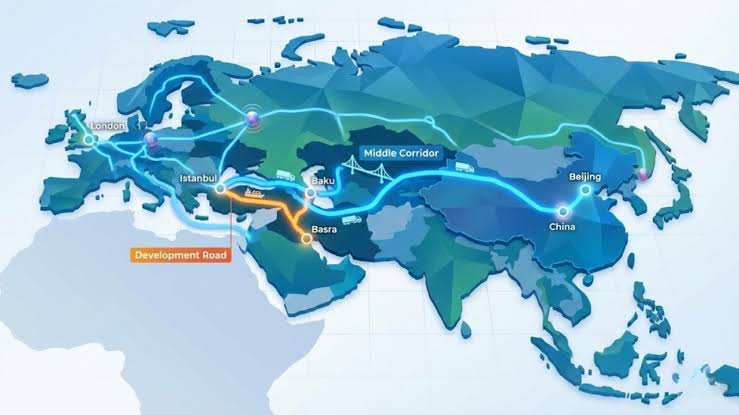
Another confirmation of the ever-increasing significance of the Middle Corridor for the international community was the fact that the topic of its development, prospects, and opportunities became a key focus at the recently held II International Conference of Leading National Analytical Centers of Turkic States in Baku.
Sea-news.az reports in particular, at this event, Kurshad Zorlu, Deputy Chairman of Turkey’s ruling Justice and Development Party, presented a package of constructive proposals that can be implemented in the very near future, stating that a project for a joint Turkic States Development Bank has been drafted to help develop the Middle Corridor as an investment platform.

“In order to have weight in the global financial market, it is necessary to create a joint Development Bank. By the instruction of our President, together with the Financial Office of the Presidential Administration, we have also prepared the corresponding project. We will present it to other Turkic States, as well as to the General Secretariat of our Organization,” he said, emphasizing that Turkey aims to open a new route from the Middle Corridor to the Persian Gulf.
“Our vision is not only to use the Caspian Sea as a transit route. We have signed a preliminary protocol of agreement with Iraq on the ‘Development Road’ project. This route will run through Turkey in the direction of the Persian Gulf,” Kurshad Zorlu stated.
So, in what specific aspect will the “Development Road” strengthen the potential of the Middle Corridor, and what overall benefits will the proposals voiced at the conference by the Turkish representative bring to the OTS member states? Caliber.Az put this question to Turkish and Kazakh analysts.
Thus, Goktug Chalıshkan, a specialist in international relations at the Ankara Center for Crisis and Policy Studies (ANKASAM), is confident that the topic of discussion at the II International Conference of Leading National Analytical Centers of Turkic States was a more comprehensive transport connection model than just the geography of the Middle Corridor.
“Until now, we have viewed the Middle Corridor mainly as an East-West line starting in China and Central Asia and passing through the Caspian Sea, Azerbaijan, Georgia, and Turkey into Europe. However, the Turkish project aims to integrate a strong component—the North-South vector—into the East-West system. Thus, cargo moving from Azerbaijan to Turkey via the Middle Corridor can be redirected south within the framework of Turkey’s transport network. Further, it is planned to be delivered to the Ovaköy border crossing through the major industrial and logistics hub of Gaziantep and the transit point of Şanlıurfa. From there, this route crosses Iraq from north to south via Mosul and Baghdad, ending in Basra and connecting the internal network with the capacities of Al-Faw, which is soon to become the largest deep-water port in the Middle East, from where cargo will gain access to the waterways of the Persian Gulf and the Indian Ocean.
Thus, this communication branch extending south from the Middle Corridor will operate as follows: cargo from Central Asia and the South Caucasus will be able to reach Iraq and the Persian Gulf via Turkey, and vice versa—cargo arriving at the port of Al-Faw from the Persian Gulf countries or the Indian Ocean basin will be delivered to Europe via Turkish territory or supplied to the markets of the South Caucasus and Central Asia. As a result, Ankara is strengthening its position as a logistics center where trade flows from east to west and from north to south intersect,” he emphasized.
The political scientist also noted the significance of the Kars–Iğdır–Dilucu railway project from the standpoint of strengthening transport links between Azerbaijan and Turkey in the context of the Middle Corridor and delivering cargo via alternative routes through Turkish territory to the Mediterranean, Europe, and southward to Iraq and the Persian Gulf.
“However, although the stated idea is quite clear from the perspective of policy and implementation, the final technical route and operational model for all logistics connections have not yet been approved. The financing of the ‘Development Road’ in Iraq, the connection to Ovaköy, and Turkey’s participation are among the critically important elements of the project and therefore must not be subject to disruption and postponements. In addition, the Middle Corridor itself has areas requiring attention, such as the shortage of shipping capacities in the Caspian Sea, railcars, containers, customs components, etc. These problems were highlighted particularly clearly during recent consultations on this topic in the capital of Azerbaijan.
A very important point, in my opinion, alongside the key theme of the Middle Corridor, is the proposal to create a joint Turkic States Development Bank. The Turkic Investment Fund already exists, but a broader financial mechanism is now being considered that could provide financing on international financial markets, issue loans, and support large infrastructure investments, especially such as the Middle Corridor. And if this idea is supported by the member states of the Organization, the continuation of economic cooperation within the OTS could become significantly more important. Thus, the main point that caught my attention at the Baku meeting is this: cooperation between Turkic states is increasingly acquiring a concrete economic dimension based on transport, customs, finance, digitalization, and joint investments,” G. Çalışkan stated.
Meanwhile, Farhad Kassenov, head of the A+Analytics research center and a Kazakh political scientist, noted that the “Development Road” on Iraqi territory, by connecting with Turkey’s logistics routes, will provide the opportunity to transport cargo via the Middle Corridor directly to the Persian Gulf and the Indian Ocean.

“Today, global logistics as a whole are undergoing major changes, and this is primarily due to the fact that, as the practice of recent military conflicts has shown, sea routes are subject to very serious risks, an example of which is the situation in the Strait of Hormuz. I believe the point is that maritime routes are quite narrow and relatively easy to block using missiles and warships, which is why land routes appear more reliable. In this case, we are talking about the construction of a new road that will help to some extent unblock transport flows or, let’s say, reduce dependence on maritime arteries, and will also serve as an additional route for delivering cargo from Persian Gulf countries to Europe while complementing the Middle Corridor,” he said.
The expert emphasized that the new route is of great importance for Iraq, since large ports a priori require corresponding cargo flows.
“The port of Al-Faw has been actively rebuilt; up to 100 million tons of cargo can pass through it, but it needs a load—that is, cargo that will arrive there and proceed further. Therefore, additional routes are very important for the Iraqi side.
As for Kazakhstan’s position, Astana proceeds from the following strategy: everything that makes the region more stable, increases the influence of friendly countries, and ensures additional cargo flows through the Middle Corridor is welcomed unconditionally. A separate aspect is that all this was voiced within the framework of the Organization of Turkic States, and this is by no means accidental. Ankara undoubtedly plays an important role in this matter, and the strengthening of Turkey and the expansion of its logistical capabilities benefit all countries of the Turkic world, because overall this increases the interest of world powers in our countries and expands our opportunities,” Farhad Kassenov summarized.



