



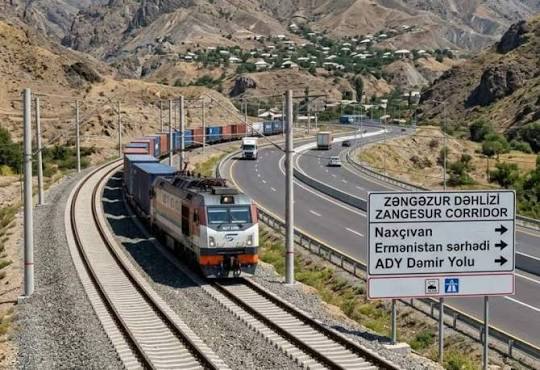
Following the Victory in the Second Karabakh War, Azerbaijan has begun taking consistent steps on the regional transport map. Starting with the restoration of the Horadiz–Aghbənd railway within the framework of the Zangezur corridor project, the process has expanded further in subsequent years.
Sea-news.az reports citing “Yeni Sabah,” that transport and logistics expert Rauf Aghamirzayev wrote about this on his Facebook page.

The expert noted that the statement made on September 17 by Iran’s Ambassador to Armenia, Mehdi Sobhani (referred to in reports as Khalil Shirgholami), is notable from the perspective of regional transport projects.
According to Aghamirzayev, the reconstruction of the Alat–Osmanli–Astara railway line began in 2024, with the first 60-kilometer phase planned for completion in 2027. At the same time, the renewal of the railway infrastructure in the Osmanli–Horadiz direction is underway.
The expert stated that in 2025, projects were launched for the Ordubad–Salammalik–Armenia border railway and the Kars–Iğdır–Aralık–Dilucu railway in Turkey. This year, major repairs of the railway infrastructure in Nakhchivan have also commenced. Meanwhile, initial engineering and survey work is being conducted in Armenia under the TRIPP project.
In addition, Azerbaijan has commissioned the Kalale–Aghbənd road bridge over the Araz River within the framework of the Araz corridor. Aghamirzayev assessed this as an important step toward diversifying regional transport connections.
According to him, the process is no longer limited solely to projects by Azerbaijan and Turkey. Active information has recently circulated regarding the Marand–Cheshmeh-Soraya–Aralık railway project in Iran. The expert expressed skepticism toward this project, emphasizing that the issue should be viewed not just as the construction of a new railway, but within the context of emerging competition between existing and historical routes.
Aghamirzayev also drew attention to the September 17 statement by the Iranian ambassador. While expressing Iran’s support for the “Crossroads of Peace,” the ambassador stated that the project must encompass both West–East and North–South movements.
According to the ambassador, Azerbaijan should ensure the possibility of a railway connection between Armenia and Iran via Nakhchivan. He noted that the Yeraskh–Julfa connection could transform Armenia into a transit hub linking the Persian Gulf to the Black Sea.
The expert emphasized that for Iran, the issue is not limited solely to the Azerbaijan–Nakhchivan connection. For Tehran, the route passing through Nakhchivan holds importance both in the direction of the Persian Gulf–Iran–Nakhchivan–Armenia–Black Sea and as an alternative connection providing access to Turkey while bypassing Lake Van.
He recalled that this route is not new. The Yerevan–Ulukhanlu–Noraşen–Julfa–Tabriz railway line has been operational since 1908. This historical line demonstrates the importance of Nakhchivan in the regional railway network.
In Aghamirzayev’s view, the construction of the Kars–Iğdır–Aralık–Dilucu line on Turkish territory and the Ordubad–Salammalik–border direction on the Azerbaijani side should not be evaluated merely as the creation of the Zangezur corridor. These projects mean the reintegration of the historical route passing through Nakhchivan into the regional transit system and the enhancement of its significance.
In this case, the Marand–Cheshmeh-Soraya–Aralık line should be considered not just as a new Iran–Turkey railway, but as a parallel connection potentially competing with the route forming via Nakhchivan.
The expert added that the ambassador’s statement shows Iran is interested in access from Nakhchivan toward Armenia and subsequently the Black Sea. If the goal is truly to create a new transit line connecting the Persian Gulf and the Black Sea, the potential of the Nakhchivan route must be evaluated separately.
According to Aghamirzayev, the core issue is no longer the question of “who is building which road?” Rather, it is about what capabilities alternative routes competing for the same cargo market will possess in terms of distance, time, tariffs, capacity, and border crossing. The expert believes that competition between corridors will intensify precisely based on these factors.



