Today, the Caspian Sea is primarily discussed in the context of cargo transportation as a key link in the Middle Corridor. However, history shows that the Caspian was once an important route not only for freight but also for intercity passenger transport.
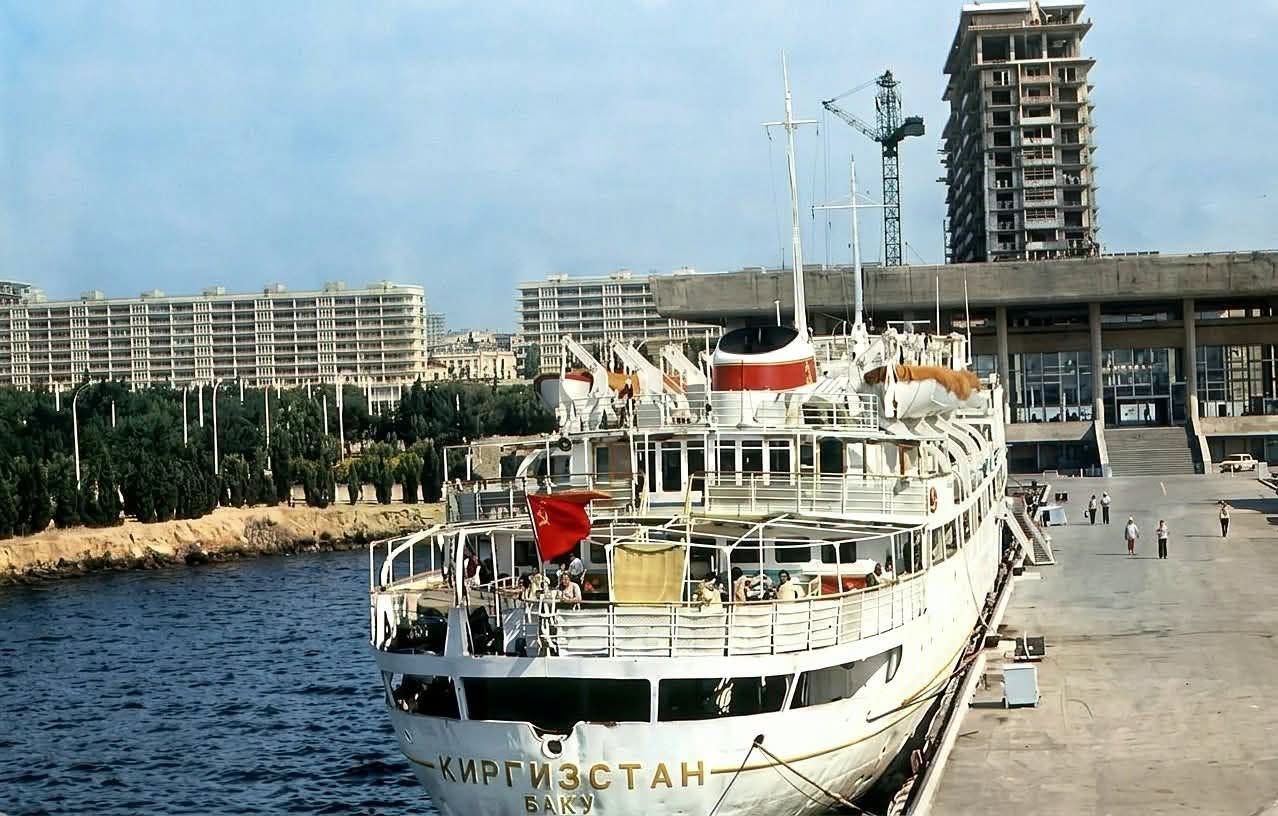
Sea-news.az notes that a photograph from the Soviet era at the Baku Marine Station, featuring the passenger ship Kyrgyzstan (“Кыргызстан”), serves as a reminder of this historical practice. The photograph is believed to date back to the early-to-mid 1970s. What kind of ship was the Kyrgyzstan? The Kyrgyzstan was a Project 592 passenger-cargo ship. Built at the A.A. Zhdanov Shipbuilding Plant in Leningrad, the vessel was commissioned on December 28, 1959.
The ship was approximately 101.3 meters long, 14.6 meters wide, and had a displacement of 3,219 tons. Its cabins could accommodate 250 passengers, with an additional 66 passengers accepted on deck. The crew consisted of about 58 people. The Kyrgyzstan was brought to the port of Baku in 1959 and operated as part of the Caspian Sea Shipping Company.
One of the ship’s main routes was the Baku-Astrakhan passenger line. According to available data, this route operated from 1959 to 1980. This point is particularly noteworthy: the Kyrgyzstan was not merely a tourist or cruise ship. It functioned as part of intercity public transport in the Caspian Sea. In the early 1960s, it was possible to travel from Baku to other shores of the Caspian using ships like the Kyrgyzstan and Tajikistan. In other words, maritime transport performed the function of intercity public transport to a certain extent.
What is the situation in the Caspian today?
Today, the Caspian once again holds strategic importance in Azerbaijan’s transport policy. However, the primary focus is on cargo transport.
The Baku International Sea Trade Port, Aktau, Kuryk, and Turkmenbashi ports have become vital elements of the Middle Corridor. International cargo flows across the Caspian are increasing due to the integration of rail, road, and maritime transport.
However, an important question arises here: Can the Middle Corridor become a transport corridor that carries not only cargo, but people as well? This direction warrants separate exploration.
Restoring passenger connections in the Caspian
In the future, the use of modern passenger and Ro-Pax (roll-on/roll-off passenger) vessels on routes such as Baku-Aktau, Baku-Turkmenbashi, and other suitable destinations could be considered.
This is not about restoring the past Kyrgyzstan model exactly as it was. A modern model could be part of an entirely different and multimodal transport system. Such a system could incorporate:
- Electronic and unified ticketing systems;
- Integration of rail-sea-road transport;
- Convenient transfer facilities at ports;
- Pre-established, fixed schedules;
- Modern Ro-Pax vessels;
- Comfortable services for passengers and vehicles;
- Tourism packages.
For example, after crossing to the other shore of the Caspian by ship from Baku, a passenger could continue their journey via railway or road transport. Thus, maritime transport would evolve from a standalone service into a core passenger component of the Middle Corridor.
What are the potential benefits?
The development of passenger transport across the Caspian could contribute to the expansion of tourism, business, and humanitarian ties between Azerbaijan, Kazakhstan, and Turkmenistan. Furthermore, creating an alternative transport option to aviation would serve to boost the tourism and economic potential of port cities situated along the Caspian coast.
The most crucial point is that the Middle Corridor should not be limited solely to cargo transit. Corridors are not just routes where containers move; they are transport systems that connect cities, economies, and people.
From historical experience to a modern model
The photo of the Kyrgyzstan docked at the Baku Marine Station shows us that regular passenger communication in the Caspian is not a new idea—this practice already existed.
Passenger transport between Baku and Astrakhan was carried out starting in 1959. The Kyrgyzstan was withdrawn from Baku in 1980, served in various ports in subsequent years, and was finally dismantled in Aliağa, Turkey, in 1997.
The ship is gone, but the transport model it represents remains a compelling example for today. Modern technologies, new-generation vessels, developing port infrastructure, and multimodal transport options create opportunities that did not exist in the past. Therefore, the goal is not to replicate the past as it was, but to adapt a successful historical model to contemporary demands.
A separate study of the economic, tourism, and transport potential of passenger traffic on the Baku-Aktau and Baku-Turkmenbashi routes could yield fascinating results from this perspective.
Perhaps when discussing the Middle Corridor, it is time to ask not only, “How much cargo passes through the Caspian?” but also, “How many people can we transport from one shore to the other via the Caspian?”
Restoring a forgotten practice does not mean returning to the past. It means leveraging historical experience to forge new passenger connections in the Caspian built on modern technology and transport capabilities. In this light, the photo of the Kyrgyzstan at the Baku Marine Station is much more than a nostalgic image—it is a message from history, prompting us to rethink the future of passenger transport in the Caspian.