



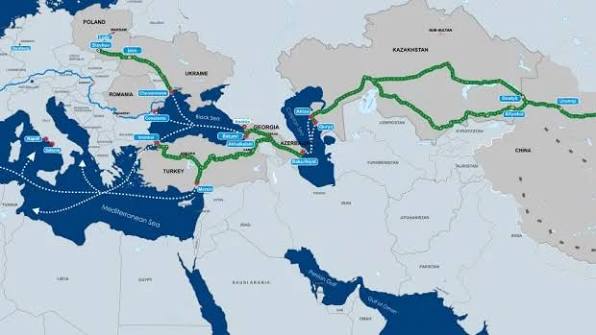
Amid geopolitical instability, growing risks for traditional trade routes, and businesses seeking to diversify supply chains, the strategic importance of the Trans-Caspian International Transport Route (Middle Corridor), which connects China, Central Asia, the South Caucasus, Turkey, and Europe, continues to grow. In this context, Azerbaijan, located at the intersection of the East-West and North-South transport corridors, views this route not only as a transit project, but also as a means of economic diversification, the development of the non-energy sector, and the strengthening of its position in Eurasian logistics.
Sea-news.az reports that these views were featured in an extensive analytical article published by China’s official “Xinhua” agency.
The article states that the growing interest in the Trans-Caspian International Transport Route is linked to Eurasia’s changing transport map. While previously the bulk of overland freight transport between Asia and Europe passed through Russia, and maritime freight transport through the Suez Canal and the Malacca Strait, the Ukraine crisis, tensions in the Middle East, and other factors have forced international businesses to actively seek alternative routes. The Middle Corridor starts from China, passes through Kazakhstan, the Caspian Sea, Azerbaijan, and Georgia, and then reaches Turkey and Europe. Compared to traditional maritime transport, it allows for shorter delivery times and, unlike the northern route, is not subject to sanctions.
Drawing attention to Azerbaijan’s important role in these processes, the agency noted: “For Azerbaijan, the development of the corridor structurally aligns with economic restructuring goals. The authorities hope to increase revenues derived not only from transit, but also from ports, warehousing, logistics, financial, and insurance services, as well as to stimulate the development of the processing industry. The Baku International Sea Trade Port and the Alat district, where the free economic zone is located, play a key role in this strategy. Thus, Azerbaijan aims to transform transit cargo flows into a source of industrial development and investment.”
The article notes that the development of transport infrastructure remains a priority of state policy. The handling capacity of the Baku International Sea Trade Port is 15 million tons of cargo and 100,000 TEUs per year. After the expansion program is completed, these figures can increase up to 25 million tons and 500,000 TEUs.
Reporting on Azerbaijan’s successes, the author writes: “The Baku-Tbilisi-Kars railway is a key element of the western part of the route. Having completed its modernization in June 2026, the handling capacity of this route has increased from 1 million tons to 5 million tons per year. Along with infrastructure development, Azerbaijan also focuses on improving the institutional framework of the route. The country actively participates in the coordination of the Trans-Caspian International Transport Route, bringing tariff policy, transport documents, customs procedures, and digital services into a unified framework, including the application of the single window mechanism.
Thus, Azerbaijan is striving to transition from a geographical corridor to a functional hub, becoming an organizer of transport processes and a service platform in the Eurasian transport chain.”
At the end of the article, it is noted that the prospects of the Middle Corridor will depend on the regional political situation, including the development of the peace process between Azerbaijan and Armenia, the Ukraine crisis, and the situation in pinching the Middle East. The author writes: “In the long-term perspective, the competitiveness of the route will be determined not only by the scale of infrastructure investments, but also by the ability of the states participating in the project to effectively coordinate their activities. Under these conditions, Azerbaijan is striving to strengthen its position as the main transport and logistics hub on the western coast of the Caspian Sea and an important coordinator in the Eurasian transport network.”



