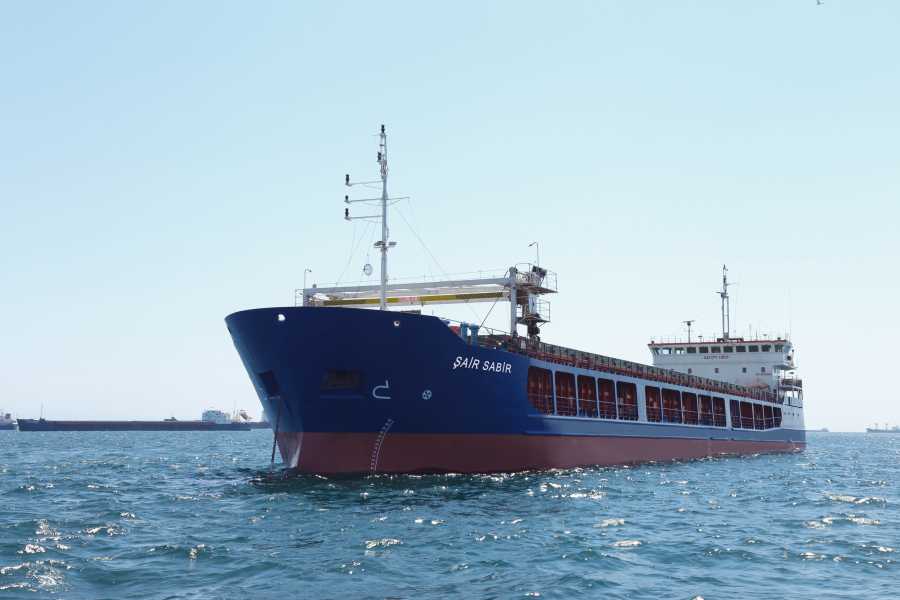
The construction of new vessels by ASCO and the phased withdrawal of more than 60 ships that have lost their operational efficiency from the fleet is an important step for the renewal of Azerbaijan’s maritime transport. However, in terms of meeting the growing cargo flow along the Middle Corridor, the main issue is not the total number of ships ASCO possesses, but how many of these vessels can be engaged in cargo transportations across the Caspian, along with their capacity, speed, and technical specifications.
According to sea-news.az that, according to the information provided by ASCO, the company’s fleet currently features 258 vessels of various purposes. Out of these, 56 are operated under the Maritime Transport Fleet, and 202 under the Caspian Sea Oil Fleet.
This distribution shows that it is incorrect to evaluate all 258 vessels as the transport capabilities of the Middle Corridor. The vessels of the Caspian Sea Oil Fleet are mainly engaged in offshore oil and gas operations, platform supply, diving, crane, towing, and other specialized services. From the perspective of international transit, the core significance lies in ferries, Ro-Pax vessels, tankers, and dry cargo ships belonging to the Maritime Transport Fleet.
Transport expert Rauf Agamirzeyev believes that although ASCO is the main carrier in the Caspian, there is a need to expand the transport fleet against the background of the expected cargo growth along the Middle Corridor.
According to him, “one of the weakest elements of the Middle Corridor is precisely the Caspian,” and as a stable cargo flow secured by contracts is formed, the number of new ship orders must also increase.
This assessment coincides with the results of World Bank studies regarding the Middle Corridor. The bank has cited the shortage of ships in the Caspian Sea and the low operating speed of existing vessels as one of the main constraints of the route.
The World Bank considers increasing vessel availability and port productivity at the Caspian and Black Sea crossings as a priority direction for the development of the corridor.
The fleet is being renewed, but how much is the transport capacity increasing? According to ASCO data, 40 new vessels have been added to the fleet over the past 12 years. Of these, 16 were built at the Baku Shipyard, and 24 were purchased from foreign markets. Currently, the construction of 11 more vessels continues at the shipyard by ASCO’s order.
At the same time, a decision has been made on the utilization of more than 60 ships with high operational costs and technical obsolescence.
This process should reduce the average age of the fleet, lower fuel consumption, and decrease repair costs. However, simply subtracting the figures of 60 retired ships and 11 newly built ones to conclude that the fleet is shrinking would also be incorrect. The purpose, capacity, and productivity of old and new vessels may differ.
A single new Ro-Pax or high-capacity tanker can replace several older vessels in terms of transport capability. Therefore, to evaluate the renewal of the fleet, it is necessary to disclose not only the number of ships, but also the total deadweight, wagon and truck capacity, number of voyages, waiting time of vessels at ports, and annual cargo turnover.
The planned use of the third Ro-Pax vessel in cargo and passenger transportations along the Middle Corridor is a step that directly addresses the needs of the corridor.
The shallowing of the Caspian Sea changes the design of new vessels The second serious risk for the marine section of the Middle Corridor is the drop in the water level of the Caspian Sea. This process complicates approach to ports, can hinder the full loading of vessels, and increase dredging costs.
Rauf Agamirzeyev notes that hydraulic mooring facilities that can rise and fall in accordance with the water level are used at the ferry terminals in Azerbaijan.
However, in his view, the shallowing of the Caspian must also be taken into account during the design of new vessels, and the hull structure and ship draft must be adapted to the new conditions.
Practical examples of this approach are already visible. The design of the new 8,000-deadweight-ton tankers being built for ASCO should allow them to enter shallow-water ports fully loaded.
Nevertheless, the problem cannot be solved solely through ship design. Dredging in port basins, adaptation of berths, maintenance of navigation channels, and technical coordination between the ports of Aktau, Turkmenbashi, and Baku must also be carried out in parallel.
The World Bank also states that the decline in the Caspian’s level affects port operations and that there is a need to increase mooring capabilities alongside appropriate equipment.
Methanol, electricity, or hydrogen? ASCO’s long-term strategy provides for the purchase or construction of methanol-powered and fully electric-powered vessels, as well as the adaptation of existing ships to new technologies. According to the company’s announced plan, measures in this direction should be implemented in the stage covering 2027–2030.
Rauf Agamirzeyev believes that the transition to methanol fuel should be carried out in coordination with SOCAR.
“Currently, we have no problems regarding the production and storage of diesel fuel. But methanol is a new type of fuel, and ensuring production in accordance with the number of ships and demand is a very important issue. Electric or hybrid variants are also a new type, they can be evaluated as a pilot project, and by seriously analyzing projects implemented globally and adapting them to the local environment, this issue can be resolved,” the expert stated.
According to Agamirzeyev, another issue is the use of hydrogen-based vessels.
“German and Kazakh manufacturers wanted to create a joint venture in Aktau. Having a diversified access to each new environmentally friendly type will lay the foundation for our competitive service,” Agamirzeyev noted.
DNV, an international classification and advisory company providing technical standards, certification, risk and safety assessment in the shipping, energy, and industry sectors, evaluates methanol technology as an option with a relatively high level of readiness for maritime transport, yet points to fuel prices and limited production volumes as the main barriers to widespread adoption.
According to DNV experts, building a ship capable of running on alternative fuel does not mean that the vessel will be operated economically. Fuel price, availability, bunkering infrastructure, and long-term supply contracts must be prepared simultaneously with the ship design.
DNV reports state that electrical and hybrid systems may be more suitable for ferries operating on short and fixed routes, port vessels, and auxiliary fleets. Although projects involving hydrogen- and ammonia-powered ships are expanding globally, safety regulations, fuel infrastructure, and commercial viability are still in the formation stage.
According to Rauf Agamirzeyev, as a country hosting COP, Azerbaijan must also take into account IMO’s (International Maritime Organization) strict requirement to reduce emissions by 2040.
“Globally, the sectors with the highest emissions are aviation and maritime transport. Since Azerbaijan is related to international transport, it must comply with these requirements—even though we call the Caspian closed, it should strive to renew the existing fleet and adapt the new ones to the requirements of the era,” the expert emphasized.
IMO’s 2023 strategy envisions reducing total greenhouse gas emissions from international shipping by at least 70%, aiming for 80% by 2040 compared to 2008 levels, and reaching net-zero emissions close to 2050.
Azerbaijan can also benefit from shipbuilding The renewal of the fleet is not merely a transport issue. Having the Baku Shipyard and ship repair facilities provides Azerbaijan with the opportunity to generate revenue from the Middle Corridor in two directions: both from cargo transportation and from the construction and repair of vessels serving the corridor.
In Rauf Agamirzeyev’s opinion, one of Azerbaijan’s main advantages is precisely this production base.
“The main limitation in the Middle Corridor is the low number of ships. Increasing the number of ships in the Caspian is already a demand of the era. I think that once there are contract-based cargoes, the number of these ships will also increase, and orders will grow in this direction. Azerbaijan’s main advantage is having both ship repair and shipbuilding yards. This will make it possible to earn from production as well as cargo transportation along the corridor, meaning to generate additional dividends,” the expert stated.
Can large-scale ship construction without a stable cargo base create the risk of the fleet remaining idle and extending the investment payback period?
Therefore, in the next phase of the renewal of ASCO’s fleet, the main question should not be “how many ships will be built?”, but rather “for which route, based on which cargo, and with what fuel infrastructure will they be built?”
To increase Azerbaijan’s competitiveness in the Middle Corridor, new vessels must be developed within a unified system framework alongside ports, railways, customs, and cargo planning. Otherwise, even though technical renewal of the fleet takes place, waiting times and logistics costs at the Caspian crossing may remain high.