



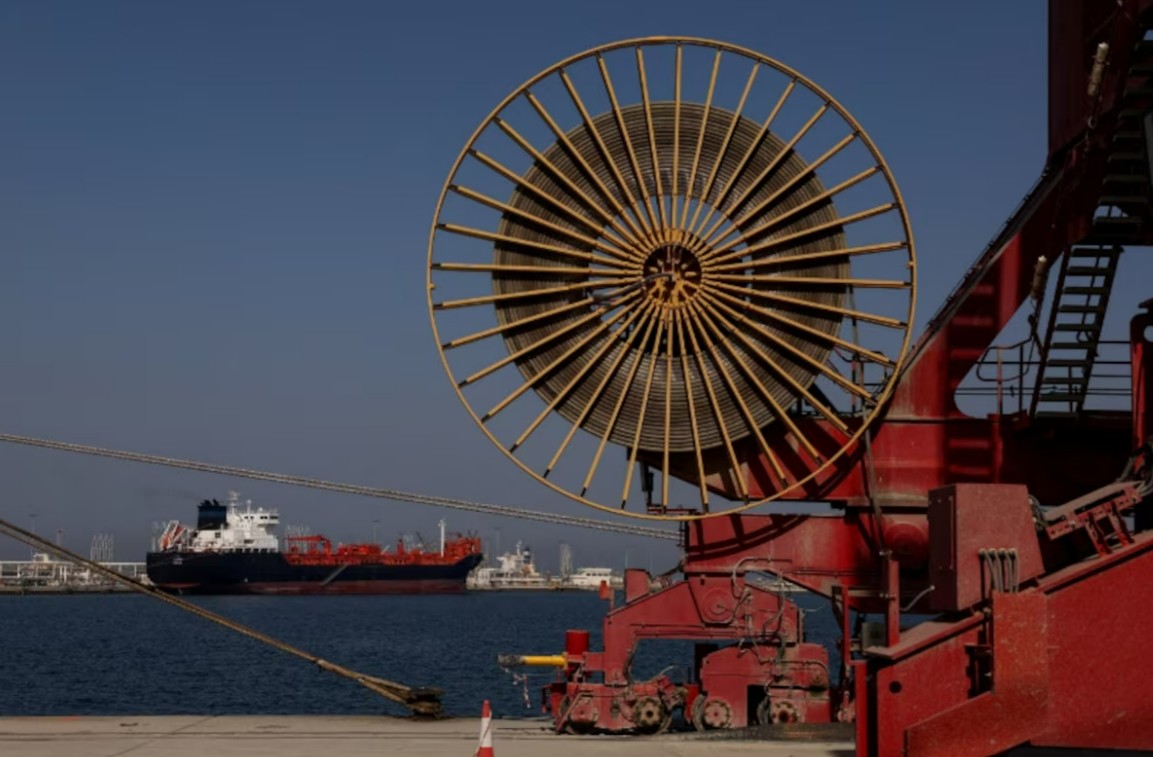
The suspension of the East-West Pipeline (“Petroline”), through which Saudi Arabia delivers oil to the international market without using the Strait of Hormuz, as a precautionary measure following attacks limits the country’s export alternatives and increases logistical pressure on oil shipments.
Sea-news.az reports that experts state that the long-term suspension of the pipeline’s operations and the continuation of restrictions in the Strait of Hormuz will jeopardize Saudi Arabia’s ability to export millions of barrels of oil.
According to data from the US Energy Information Administration (EIA), while the volume of crude oil and petroleum products passing through the Strait of Hormuz averaged 21.6 million barrels per day in the final quarter of 2025, this figure dropped to 4.9 million barrels per day in the second quarter of the current year. During the reporting period, oil flow through the Strait of Hormuz decreased by approximately 77 percent. This increased the importance of the East-West Pipeline, which transports Saudi oil to the port of Yanbu on the Red Sea coast, as an alternative export route. The suspension of the pipeline’s operation as a precautionary measure following the attacks on September 10 has created pressure on the country’s oil export routes to international markets.
Saudi oil transported by pipeline to the port of Yanbu was subsequently sent to various markets. Tankers heading north reached Mediterranean and European markets via the Suez Canal and the SUMED pipeline in Egypt.
Meanwhile, the Bab el-Mandeb Strait south of the Red Sea is considered crucial for shipments to Asia. According to the EIA, the volume of crude oil and petroleum products passing through Bab el-Mandeb was 5.4 million barrels per day in the final quarter of 2025. In the second quarter of this year, it rose to 8.1 million barrels per day. The increase in Bab el-Mandeb is related to the redirection of Saudi oil to Yanbu via the East-West pipeline instead of the Strait of Hormuz. The volume of oil transported via the Suez Canal and the SUMED pipeline reached 5.8 million barrels per day in the second quarter of the year.
Tanker tracking data also shows that shipments via Yanbu have increased due to restrictions in the Strait of Hormuz. According to data from Vortexa, crude oil and condensate loading in Yanbu rose from 3.2 million barrels per day in August to 3.7 million barrels per day in early September.
However, the closure of the East-West pipeline limits oil transit from eastern Saudi Arabia to Yanbu. The Suez Canal and the SUMED pipeline are not the only alternatives to replace the “Petroline” pipeline. In this situation, the option of using major export terminals in the Gulf and passing through the Strait of Hormuz as much as possible to deliver Saudi oil to international markets is becoming increasingly popular.
According to experts, Saudi Arabia has operational flexibility in the oil sector, but under current conditions, the main transition is increasingly shifting from production capacity to logistics capacity. The daily transport capacity of the East-West Pipeline is approximately 7 million barrels. About 2 million barrels of this volume are used in refineries on the west coast and in power generation. Theoretically, about 5 million barrels remain for export. The closure of the pipeline puts this volume at risk. If partial transit through the Strait of Hormuz continues and the interruption in the oil pipeline is short-term, the actual impact will be limited. However, if restrictions in the Strait of Hormuz persist and the pipeline remains closed for a long time, Saudi Arabia’s oil exports could face an actual decline of approximately 3-4 million barrels per day. The real impact will depend on how long shipments from the Strait of Hormuz continue.
It is reported that Saudi Arabia’s inventories in Asia, the Mediterranean, and Northwest Europe can support customer supplies in the short term. Ship-to-ship transfers, cargo redirection, and other logistical measures can provide additional relief. However, these will not be a permanent substitute for the main export corridor. If security risks in the Strait of Hormuz and Bab el-Mandeb and the closure of the “Petroline” pipeline continue for a long time, the main obstacle will be getting oil out to international markets rather than production itself. A long-term disruption of several million barrels could increase upward pressure on oil prices and market volatility.
Furthermore, the temporary interruption in the “Petroline” pipeline can be managed for a time thanks to inventories at Red Sea export terminals. Increasing exports from Gulf terminals to more than 3 million barrels per day creates logistical difficulties. This situation forces the national oil company “Saudi Aramco” to use a “shuttle” method to transport oil through the Strait of Hormuz with a limited number of tankers. The number of available tankers for these operations is also limited. Due to the scale of operations, logistical constraints have also increased off the coasts of Fujairah and Sohar. It is reported that Aramco could restart the East-West Pipeline at a lower capacity in a relatively short time. However, the main risk is the recurrence of attacks.
Analysts note that the port of Yanbu has remained Aramco’s most vital oil export route throughout the conflict in the Middle East. The East-West Pipeline is a significant alternative to restrictions in the Strait of Hormuz. Other options, including Suez and SUMED, cannot completely replace the pipeline. If new flows are not provided via the pipeline, existing oil reserves in Yanbu can last for about a week. In the event of prolonged interruptions and narrowing export opportunities, Saudi Arabia may be forced to further curtail production. In addition, growing security risks around Bab el-Mandeb and restrictions in the Strait of Hormuz could further increase tension in the physical oil market.



