



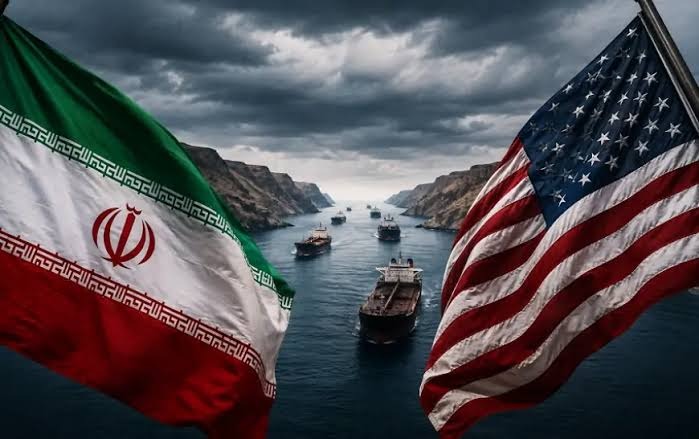
Recent developments around the Strait of Hormuz—specifically Oman’s withdrawal from the agreement reached with Iran—demonstrate that this is no longer just a matter of resolving navigation issues between Iran and Oman. The Hormuz crisis is gradually moving beyond bilateral relations, transforming into a complex geopolitical knot where the interests of the United States, Iran, Gulf states, and the global energy market collide.
Sea-news.az reports that while reaching certain understandings between Iran and Oman on restoring secure navigation in the strait could at first glance be assessed as a diplomatic success for Tehran, Oman announced on August 25 that negotiations were ongoing regarding the creation of a joint temporary navigation corridor with Iran, clearing the strait of mines, and eventually forming a permanent corridor.
However, the core issue is not the creation of the corridor itself, but who will manage it, under what legal framework, and according to which rules.
Iran’s approach reflects Tehran’s desire to strengthen its security and control capabilities over Hormuz. Conversely, the United States demands that the strait remain open for international shipping and that no state establish a unilateral control mechanism over passage here.
According to Washington’s stance, Hormuz is of vital importance for international shipping, and the imposition of mandatory fees or payment mechanisms for the transit of commercial vessels is unacceptable.
For this exact reason, any agreement reached by Oman with Tehran could not possibly be formed solely within the framework of Iranian interests. The issue of security and shipping in Hormuz has taken on an international rather than a regional character.
Oman faces an extremely complex diplomatic situation.
On one hand, Muscat, bordering Iran, has maintained special diplomatic channels with Tehran for many years. Oman has even played a mediating role in establishing dialogue between the US and Iran during various periods.
On the other hand, Oman is a regional partner of the United States, and acting without considering Washington’s interests in terms of economic, security, and strategic relations could create serious risks for Muscat.
From this perspective, Oman entering into certain understandings with Iran on technical and security matters did not automatically mean political distancing from the US. On the contrary, the diplomatic line Muscat has shaped over many years is built on maintaining dialogue with Iran while avoiding the disruption of strategic relations with the West.
However, when the issue shifted to the imposition of fees, revenue sharing, and a management mechanism over the strait, the situation changed. Such an agreement is no longer just a technical navigation matter; it turns into an issue of political and strategic influence over Hormuz.
At this precise stage, Oman’s withdrawal does not come as a surprise.
U.S. President Donald Trump’s firm stance further constricts Oman’s room for maneuver.
Trump issued severe warnings against Oman’s potential cooperation with Iran on joint control mechanisms over the Strait of Hormuz. On August 17, signals were sent indicating that Washington’s attitude toward this matter could become even harsher.
In such a political atmosphere, it was extremely difficult for Muscat to enter into a long-term agreement with Iran that could be deemed contrary to core U.S. strategic interests.
From this angle, Oman’s pullback should not be evaluated merely as a divergence in Tehran-Muscat relations. A broader geopolitical reality is at play here: the US-Iran confrontation turns every step taken in the Strait of Hormuz into a matter of regional and international security.
The significance of the Strait of Hormuz far exceeds its geographical dimensions.
Before the war, approximately one-fifth of the world’s oil passed through this strait. Therefore, any long-term restriction in Hormuz can directly impact energy prices, marine insurance, transportation costs, alternative routes, Asian economies, and, consequently, global inflation.
The security of energy flows passing through here is of vital importance not only for Iran and Oman, but also for countries such as Saudi Arabia, the United Arab Emirates, Qatar, Kuwait, Bahrain, and Iraq.
Furthermore, the military and strategic presence of the US in the region is not incidental. For Washington, Hormuz is not merely an energy route, but also one of the key elements of the balance of power in the Middle East.
The primary interest of European and Asian countries is simpler: the uninterrupted and secure operation of energy and trade routes.
Consequently, distinctly different yet closely intertwined interests collide on the Hormuz issue.
A resolution of the Hormuz crisis solely through a bilateral agreement between Tehran and Muscat does not appear realistic.
Iran’s security interests, Oman’s sovereignty and security priorities, the energy exports of Gulf states, the geopolitical and military interests of the US, and the energy security of Europe and Asia must all be factored into the same framework.
The main question is not just whether ships pass through the strait. A more fundamental question arises: Who will determine the future security and management model of one of the Middle East’s most critical energy arteries?
If a security mechanism in Hormuz is formed unilaterally, it may clash with the interests of other regional and international actors. Conversely, if a multilateral mechanism is established, its effectiveness will depend on all parties accepting this mechanism and guaranteeing freedom of international navigation.
Oman’s withdrawal from the agreement with Iran is not just a disagreement that arose between Muscat and Tehran. This event serves as another signal showing that the Hormuz crisis has evolved into a global geopolitical and energy security problem that regional actors cannot solve single-handedly.
At least at the present stage, one thing is clear: the future of Hormuz does not depend solely on the decisions of Iran and Oman. Achieving a sustainable agreement here will be exceedingly difficult without taking into account the position of the US, the security and energy interests of Gulf states, and the needs of the global trading system.
If the parties fail to reconcile these interests within a unified security framework, the Hormuz crisis will not remain merely a problem of safeguarding a single strait. It risks turning into a broader geopolitical crisis affecting global energy market stability and international maritime trade.



