



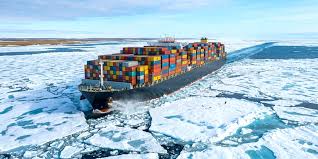
China’s shipping company Sea Legend has announced that it will launch regular container shipping operations between China and Europe via the Arctic. This decision follows a successful trial voyage in 2025, during which a container ship traveled from China’s eastern port of Ningbo-Zhoushan to the UK port of Felixstowe in 20 days.
Sea-news.az reports citing Seanews.az, that the Arctic’s Northern Sea Route can shorten the distance between Asia and Europe by up to 40 percent. While the route offers an alternative option amid rising security risks in the Red Sea, serious obstacles remain in the way of its large-scale utilization.
Shallow straits, floating ice, and volatile weather conditions along the route impose limitations on vessel sizes. Ships require reinforced hulls, specially trained crews, and specific permits. Russian icebreaker escorts are also mandatory along certain sections of the route.
Although climate change has led to a decrease in Arctic ice cover, the route currently remains navigable for only a limited period during late summer. Additionally, inadequate emergency infrastructure and high insurance costs represent major challenges.
China is one of the most active non-Arctic states in developing the Northern Sea Route. Beijing views this route both as an alternative trade path to Europe and as a means to reduce its dependence on the Malacca Strait, through which a significant portion of China’s imported oil passes.
South Korea and Japan are also exploring possibilities to use the route. However, geopolitical factors related to Russia, particularly among European nations, limit interest in the corridor. Therefore, it appears unlikely that the Northern Sea Route will become a full-scale alternative to the Suez Canal in the near future.



