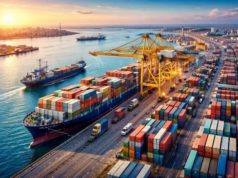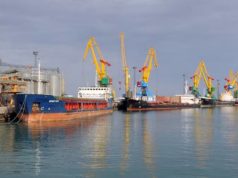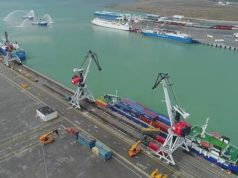

The construction project of the Anaklia deep-sea port, which was delayed for several years due to the failure to resolve the “strategic” investor issue, has now received a new impetus. Thus, a specialized vessel belonging to the Belgian company Jan De Nul has begun dredging operations in the water area of the port under construction and creating an access channel for receiving large-tonnage container ships.
Sea-news.az reports that in order to start port construction as soon as possible, taking into account the capabilities of the state budget, the Georgian government took steps this spring to optimize the contract with the company exercising construction supervision. As a result, the cost of the project was reduced by 25 percent, or $52.5 million.
In addition, it was decided to apply the “landlord” model. This model envisages retaining control over the main infrastructure by the Georgian state and developing the port within the framework of cooperation with several countries and companies.
Currently, construction works are financed from the state budget of Georgia. However, until recently, experts doubted whether the Georgian government could implement this project independently.
Yet, economic growth continuing at near-record paces globally in recent years has changed these opportunities. In the first half of 2026, Georgia’s real GDP increased by 7.9 percent compared to the same period last year. In the previous four years, economic growth ranged between 7.5 and 11 percent. As a result of economic growth and rising budget revenues, the implementation of the project at the expense of the state, which previously seemed impossible, has become feasible.
At the same time, there were doubts as to whether investors wishing to participate in the project would be attracted, provided that the landlord model is maintained. However, the situation currently appears to be the opposite: the selection among investors wishing to participate in the project will rather have to be made taking into account Georgia’s geopolitical interests.
The need for the Anaklia port is currently quite huge. Taking into account the situation created regarding transport in the Black Sea water area, this port should have been put into operation, literally, “yesterday.”
The need for an alternative to Novorossiysk grows
As is known, the sharp increase in military risks in the eastern part of the Black Sea has forced international maritime logistics to seek an alternative, primarily to Russia’s Novorossiysk port.
In addition, companies transporting cargo through Russian Black Sea ports have increased freight rates 3–4 times due to risks associated with unmanned aerial vehicle attacks on Russian vessels.
For instance, starting from August 4, the company NovoGlobe Line applied an additional fee of $1,000 per TEU for shipments in the direction of Novorossiysk, and $500 in the opposite direction.
For comparison, a few months ago the transportation cost of a 20-foot container (TEU) in this direction did not exceed $400.
“These surcharges apply to cargo heading to or coming from the already affected area, including containers currently located at transshipment hubs awaiting the loading process,” the official statement by NovoGlobe Line reads.
Alpha Shipping also announced the application of additional fees. The company established an additional charge of $1,000 per container in the direction of Novorossiysk, and $500 in the opposite direction.
Marmed Container Services applied an additional fee of $1,000 in both directions, and M-Line applied an additional fee of $750 per TEU for all cargo transported across the Black Sea.
In the event of a further worsening of the situation, maritime transport in the direction of Russian ports could be completely paralyzed.
For example, the FESCO transport group announced that it had temporarily suspended the acceptance of new transport orders across the Black Sea water area due to increasing risks. The reason for this was the sinking of the company’s vessel Yanina 130 miles away from Novorossiysk on the night of August 1.
Cargoes are redirected to Georgian ports
Thus, the escalation of the situation in the Black Sea forces market participants to seek an alternative to Novorossiysk.
As a result, demand for logistics services via Georgian ports is increasing sharply. However, the ports of Batumi and Poti are already operating almost at the limit of their capabilities.
A portion of Kazakh and Kyrgyz cargoes previously transported via Novorossiysk and subsequently through Russian territory is now being redirected to the ports of Batumi and Poti. Afterwards, these cargoes are transported via Georgia, Azerbaijan, and the Caspian Sea.
Against the backdrop of this situation, the Georgian government has begun to pay greater attention to ensuring the stable operation of port infrastructure.
On August 6, Georgian Prime Minister Irakli Kobakhidze, Minister of Economy Mariam Kvrivishvili, and Head of the Government of the Autonomous Republic of Adjara Zurab Pataradze visited the mineral fertilizers terminal and container terminal at the Port of Batumi.
Prime Minister Kobakhidze stated: “Cargo turnover at the Port of Batumi has reached a record figure. Based on the results of the first seven months, it can be said with confidence that the current year will be a record for the Batumi port in terms of cargo turnover. We must do everything so that our port infrastructure continues to develop as efficiently as possible. The Poti port is also very important. We are actively working on creating the infrastructure of the Anaklia port. It is planned to complete the reception of the first vessels and design work for the first stage at the Anaklia port by 2029.”
With this, the Prime Minister once again emphasized the strategic importance of implementing the project as soon as possible.
Can Batumi and Poti be a full alternative to Novorossiysk?
Nevertheless, the logistics capabilities of the Batumi and Poti ports are clearly limited.
The depth of the berths at the container terminal of the Batumi marine port is no more than 11.5 meters. At the main container terminal of the Poti port, this figure is even lower—only 8.5 meters.
For comparison, the depth of berths at the main container terminal of the Novorossiysk port is 15 meters.
From this perspective, only the Anaklia deep-sea port can play the role of a full-scale alternative to the Novorossiysk port.
In addition, the existence of such a port is one of the main conditions for the full-scale operation of the Middle Corridor.
The deep-water access of the Anaklia port will allow the reception of large-tonnage container ships and significantly expand Georgia’s logistics capabilities in the Black Sea.
Thus, changing security and logistics realities in the Black Sea bring the Anaklia project to the fore no longer just as an infrastructure project of Georgia, but as a project of strategic importance for the future transport architecture of the South Caucasus and the Middle Corridor.