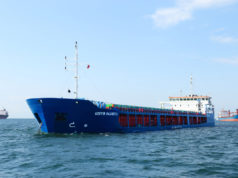

The number of vessels passing through the Straits of Hormuz and Bab el-Mandeb has decreased significantly compared to previous days.
Sea-news.az citing the Reuters agency, that shipping data has been released regarding this.
According to data from the maritime traffic monitoring platform “Kpler,” only 2 vessels passed through the Strait of Hormuz on Wednesday. Meanwhile, just a day earlier, this figure stood at 8 vessels.
For comparison, before the US-Iran war began, approximately 130–140 vessels passed through the strategically important Strait of Hormuz daily in February. According to “Kpler,” a sharp decline in vessel movement was also recorded in the Bab el-Mandeb Strait. Thus, only one cargo ship passed through the strait on Wednesday. That vessel, sailing under the flag of the Bahamas, was a bulk carrier. The previous day, 20 vessels had passed through the Bab el-Mandeb Strait. Consequently, within a single day, the number of vessel transits dropped from 8 to 2 in the Strait of Hormuz, and from 20 to 1 in Bab el-Mandeb.
Risks in shipping increase against the backdrop of the US-Iran confrontation
The latest tension in relations between the US and Iran began on July 8. On that day, following a memorandum signed between Washington and Tehran, the US Armed Forces stated that for the first time they were responding to an attack on a commercial vessel in the Strait of Hormuz, delivering a series of strikes on Iranian territory.
On the very same day, US President Donald Trump announced the termination of the ceasefire regime with Iran. In response, Tehran took steps regarding Bahrain, Jordan, Qatar, Kuwait, the United Arab Emirates, and Oman. The Straits of Hormuz and Bab el-Mandeb rank among the world’s most vital waterways in terms of global maritime trade and energy transportation. A sharp decline in vessel traffic along these routes can create serious risks for international freight transportation, energy markets, and supply chains.