



The Shusha Global Media Forum is not merely a platform that brings together representatives of international media. It is also a tribune from which Azerbaijan declares its new geopolitical realities in the region, the main strategic goals of official Baku, and its foreign policy course to the entire world.
According to sea-news.az that the remarks made by President Ilham Aliyev during the 4th Shusha Global Media Forum, held on July 13-14, and his answers to journalists’ questions, in fact, demonstrated the multi-vector nature of the country’s foreign and economic policy. It is clear from these statements that in this system of multi-vector foreign relations, the relationship with China and the Middle Corridor project are of special importance.
Being situated at a strategic point connecting East and West, deepening relations with China, and pursuing a balanced foreign policy enable official Baku to further strengthen its role as a guarantor of security and stability in the region. In parallel, thanks to this advantage, Azerbaijan is assuming a significant and indispensable role in redrawing global logistics maps, becoming a key partner. The statements also make it clear that Azerbaijan is proposing new models of cooperation on an intercontinental scale so that all states can benefit from them. This forms the basis of official Baku’s unchanging foreign and economic policy vector. However, it must not be forgotten that the foundation of this policy is, first and foremost, the material and moral interests of the country and its people.
It is no coincidence that, thanks to this policy and these relations, the ties between Azerbaijan and China have entered a new stage. President Ilham Aliyev’s state visit to China in 2025 and the signing of the Joint Statement on the establishment of comprehensive strategic partnership relations between the two countries gave a very strong impetus to the significant revitalization of mutual activities in all areas. At the Shusha Media Forum, the President drew special attention to this, stating: “Following my state visit to the People’s Republic of China last year and the signing of the declaration on comprehensive strategic partnership, steps began to be taken in many areas, including political, economic, transport, and all other spheres.”
This statement proves that relations between Baku and Beijing are based on deep political trust, not just on paper, but in reality. The signed Declaration is a direct indicator of the sincere and pragmatic dialogue between the two states. It is no coincidence that since this Declaration, a significant increase in the number of Chinese companies operating in Azerbaijan has been observed, joint projects in trade-economic, investment, and infrastructure spheres have been launched, and previous projects have been further expanded.
Undoubtedly, one of the most important branches of the partnership between Baku and Beijing manifests itself in the logistics sector, particularly within the framework of the Middle Corridor. Every passing day, an increase is observed in the volume of cargo transported from China to Azerbaijan and through our territory to the West. This shows that today, Azerbaijan has become an indispensable hub between the East and the West, not only geographically but also in terms of technology and infrastructure. The delivery of cargo from China to Azerbaijan and subsequently to Europe within a few days has sharply increased the competitiveness of the Middle Corridor. This means delivering cargo to its destination much cheaper and faster than other routes and paths. In short, for China, Azerbaijan is not just a part of the Middle Corridor. For Beijing, Baku is a reliable partner where geopolitical risks are minimal, which can cooperate with various power centers simultaneously, and which ensures the security of long-term logistics projects.
For the European Union, the Middle Corridor is primarily a means of diversifying energy and supply chains. The US, approaching this route from a broader geopolitical prism, is interested in reducing the Eurasian transport system’s dependence on Russia and Iran. Thus, even though China, Europe, and the US show interest in the same route for different purposes, Azerbaijan lies at the intersection point of all these interests. This demonstrates that official Baku, surpassing the status of a transit country, has turned into an important strategic actor that reconciles the economic interests of various global powers and promotes regional cooperation.
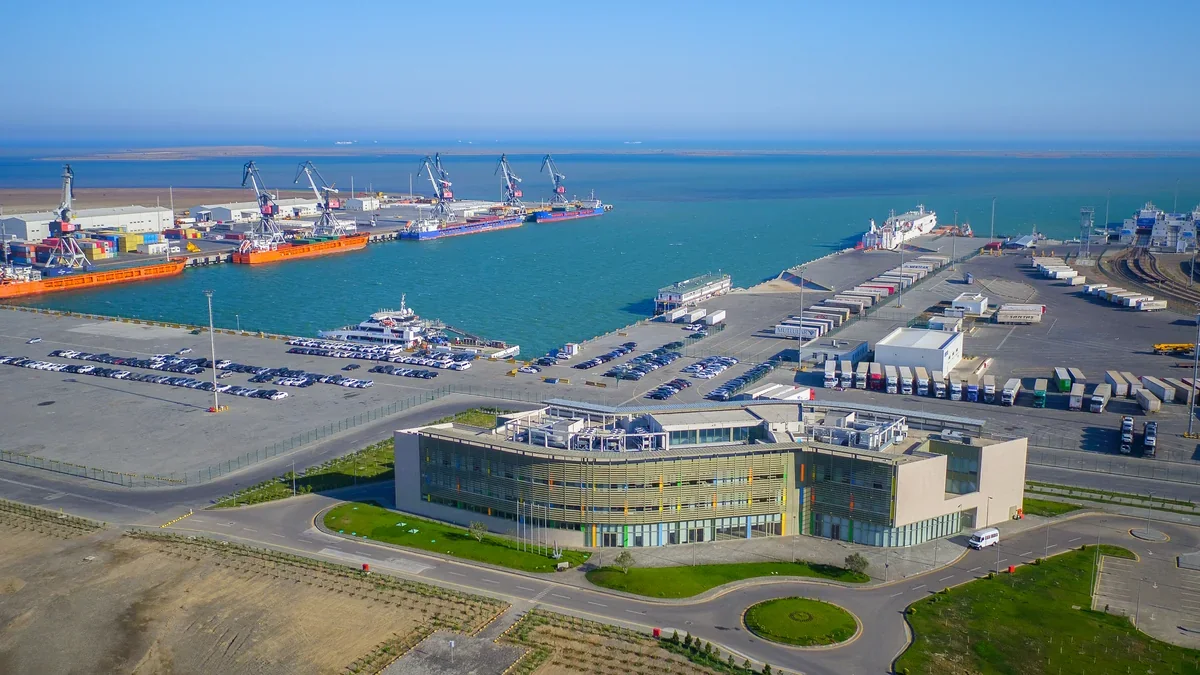
However, it should be taken into account that Azerbaijan has invested a huge amount of capital in the renewal of its transport-transit infrastructure to accept this cargo flow rapidly and smoothly and to transport it to the West. The annual handling capacity of the Baku International Sea Trade Port alone has been increased from 15 million tons to 25 million tons. This list also includes increasing the throughput capacity of the Baku-Tbilisi-Kars railway line and the work being carried out in the direction of the Zangezur Corridor. Azerbaijan is no longer content with existing transit opportunities; it is both digitalizing its internal transport network and fully adapting all logistics infrastructure to new challenges to further strengthen its place in the global trade chain in the coming years.
It should also be noted that this renewal and modernization is also connected to global geopolitical changes. In recent years, tensions in the Middle East, the rise in logistics problems against the background of the US-Israel-Iran confrontation, sanctions in the wake of the Russia-Ukraine war, and risks arising in the Northern and Southern corridors have increased the importance of the Middle Corridor. Against the backdrop of these clashes and conflicts occurring in the world today, Azerbaijan has turned into an island of peace and stability, making its logistics importance more attractive to international partners.
One of the main points to note here is that the success of global logistics projects depends on relations with regional partners. It is no coincidence that President Ilham Aliyev touched upon this issue in Shusha: “We are also increasing the volume of cargo transported from China, and Central Asian countries have also joined this process. In a word, there is a very good history of mutual relations. Multilateral cooperation is being developed with countries located along the Middle Corridor.”
This platform of cooperation mentioned by the President is not limited only to the economic interests of today but is also based on deep historical roots, common cultural and moral values, and unbreakable friendly ties between Azerbaijan and the peoples of Central Asia.
Today, there are also close political and economic ties between Azerbaijan and Central Asian countries within the framework of the Organization of Turkic States (OTS). It is thanks to this policy of official Baku that Central Asian countries have joined the Middle Corridor project with full force, turning this vast geography into a unified geopolitical and geo-economic space.
Azerbaijan is already a gateway to European and world markets for Central Asian countries. This increases our country’s transit importance and makes significant contributions to the development and integration of the region. Thus, the multilateral cooperation established along the Middle Corridor is not just the connection of railways and ports, but also a strategic and unified response of historical and ethnic brotherhood to modern global challenges. The cooperation and format emerging against this background are turning into a key power factor that defines the future map of geopolitical and geo-economic relations in Eurasia. Such power is considered a message to major power centers outside the region. That is, powers conducting strategic calculation and planning regarding this region will now have to reckon with this format, namely the Azerbaijan-Central Asia format.
We should also add that the unification of Azerbaijan and Central Asian countries in a single political and economic space also has a positive impact on energy, transport, and other projects. In parallel with a unified tariff policy and the digitalization of customs-border procedures, joint steps taken in the direction of “green energy” corridors can be added to this list. Today, Central Asian countries aim to enter the world market by combining their rich resources with Azerbaijan’s logistics route projects. The emergence of such a situation increases Azerbaijan’s importance for world and European countries, turning it into a significant and indispensable power in the future “green energy” market.
The close integration of Azerbaijan and Central Asian states on a unified platform, while ensuring the security and profitability of the East-West transit line, transforms both regions from mere observers of the global economy into a definitive power center that manages the international logistics chain.
Thus, the statements made by the President at the Shusha Global Media Forum and the goals oriented toward the future once again confirm that today, Azerbaijan possesses the power and strategic will to reshape the global logistics map…



