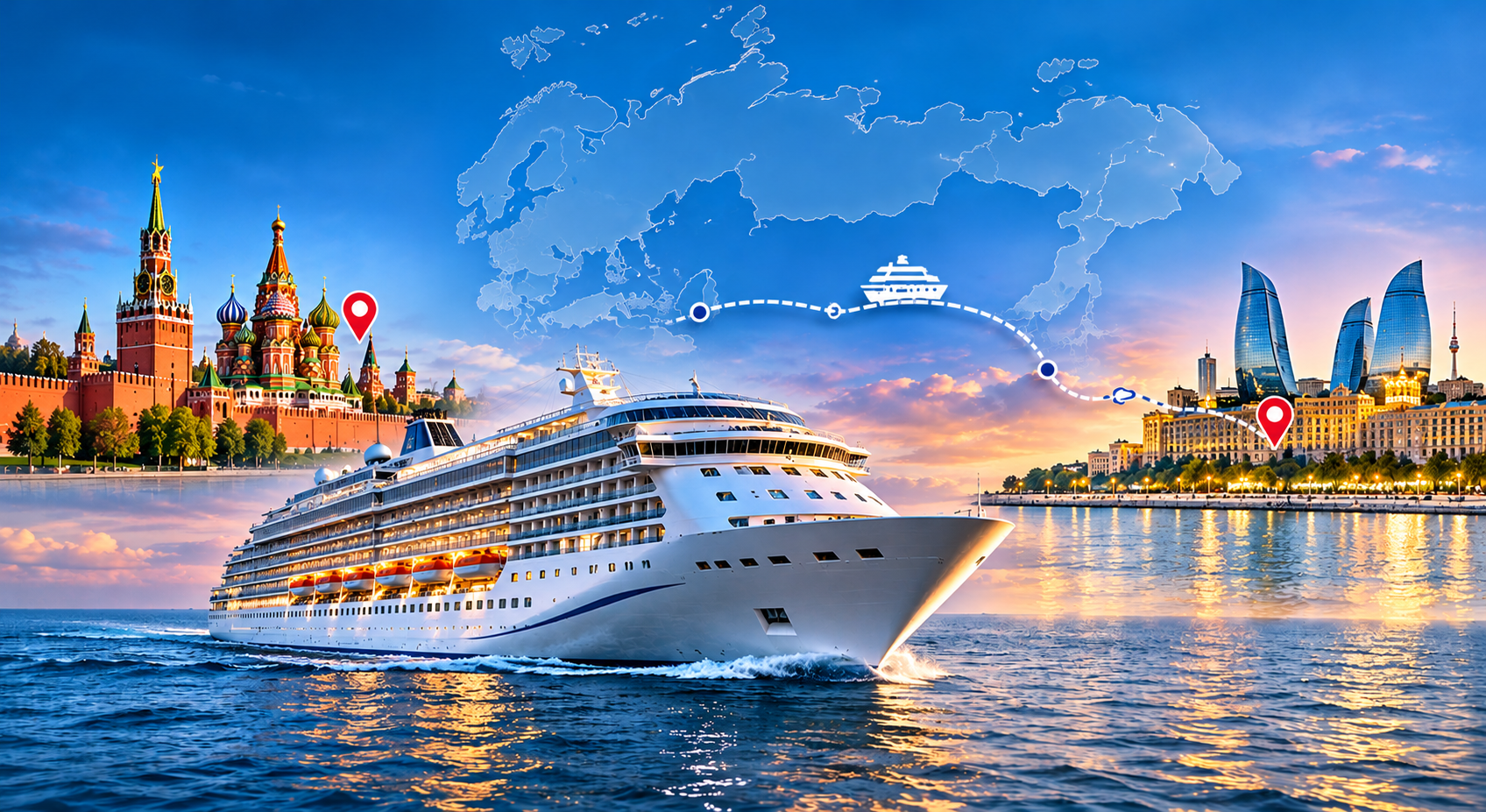
A few days ago, media outlets reported that cruise services between Moscow and Baku could be launched in the near future.
Sea-news.az reports that the information was announced by Adam Khakimov, Russia’s Trade Representative in Azerbaijan.
According to him, the journey would take an average of 14 days: seven days for the outbound trip and another seven for the return journey.
Khakimov noted that the project involves a luxury-class cruise ship and is expected to receive government support. In particular, the construction of the vessel is to be subsidised, primarily by Russia’s Ministry of Industry and Trade.
The announcement sparked widespread discussion on social media. While some users welcomed the prospect of such a trip with considerable interest, others questioned how a cruise ship could reach Moscow, arguing that the project might not be technically feasible.
We asked transport expert Rauf Aghamirzayev to assess the proposal.
Aghamirzayev recalled that similar reports emerged in 2019, when plans were discussed to operate cruise ships between the Caspian and Black Seas via the Volga–Don Canal, followed by voyages between Caspian coastal cities. Now, a new proposal involving seven-day cruise trips between Baku and Moscow has come into focus.
The expert said:
“There are several important factors to consider. First of all, the problem of the Caspian Sea’s declining water level is most pronounced along its northern shores, particularly on the Russian side. Dredging work is necessary in those areas. Additional work would also be required on the Volga–Don Canal and at the mouth of the Volga River.
“The second issue is that the northern part of the Caspian is shallower and therefore freezes more quickly during the winter months. This means that even if the project goes ahead, it is highly likely to operate on a seasonal basis.”
According to Aghamirzayev, the third and one of the most important issues concerns security. Over the past year, there have been incidents involving drone attacks on vessels in Russian coastal waters.
“That is why I believe the problems I have mentioned must be resolved first. Only then could the project potentially become operational. Under the current circumstances, however, this initiative does not appear realistic,” the expert stressed.
Aghamirzayev also said that developing passenger services in an east–west direction across the Caspian Sea is entirely feasible and could provide people with a significant alternative.
“Currently, we have the option of travelling to Kazakhstan by air, as well as transporting cargo by ferry. Some vessels are also equipped to carry passengers. However, it would be very beneficial to establish a direct passenger route to Aktau from the city centre — for example, from the boulevard or the Sea Terminal.
“Taking weather-related risks into account, departing from a port located within the city would also make those risks easier to manage. If weather conditions cause disruption, both Baku and Aktau have hotels, hostels and other accommodation options where passengers can stay overnight,” he explained.
Aghamirzayev noted that cargo vessels currently operate mainly from the Port of Alat, which is located some distance outside the city. From a tourism perspective, this could somewhat reduce the route’s appeal.
The expert also pointed out that Turkmenistan is developing its potential in this area. Nevertheless, visa arrangements and other related issues would need to be addressed.
According to him, the Avaza resort area, located near the city of Turkmenbashi, is an important tourist destination. In Azerbaijan, taking into account Baku Boulevard and the tourism potential that could develop around the Sea Breeze area in the future, the establishment of such routes appears more realistic in the longer term.
“All of this can be viewed as an opportunity to develop different transport routes. These services could operate seasonally and also be adjusted according to daily weather conditions.
“Windy conditions are observed on the Caspian Sea for approximately 90 days a year. However, this does not mean that vessel traffic comes to a complete halt on all of those days. In some cases, delays last only a few hours, after which transport connections resume. A complete suspension occurs only on certain days.
“In other words, schedules may change, but organising passenger transport is possible. I consider an east–west passenger route more realistic. As for cruise ships, the problems I have mentioned above must first be resolved,” Rauf Aghamirzayev concluded.
Clearly, the idea of developing water-based tourism between Azerbaijan and Russia has generated considerable interest. However, bringing the initiative to fruition remains a prospect for the more distant future.
At the current stage, expanding existing east–west transport routes that are more practical and accessible offers more realistic opportunities for developing the region’s tourism sector.