
A preliminary schedule for the implementation of the “Caspian Sea – Black Sea – Europe Green Energy Corridor” project has been released.
Sea-news.az reports that according to information published on the project’s official website, the first 2,000 MW line along the Baku – Ksani – Anaklia – Constanta-South route, together with the onshore continuation from Constanta-South to Albertirsa, Hungary, is scheduled for commissioning in 2032.
The second line along the Baku – Tskaltubo – Poti – Domnesti route is scheduled for commissioning in 2036, while the third line along the Baku – Tskaltubo – Poti – Constanta-South route is slated for 2040. The project is expected to reach full transmission capacity by 2040.
Additionally, the schedule will be refined within a roadmap to be drawn up as part of preparations for making the Final Investment Decision (FID).
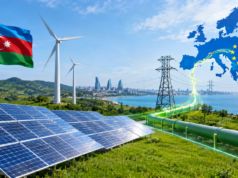
The “Caspian Sea – Black Sea – Europe Green Energy Corridor” project envisions the transmission of electricity generated from solar, wind, and hydro sources in Azerbaijan through Georgia and across the bed of the Black Sea to Romania and Hungary.
According to published data, the corridor will consist of three independent high-voltage direct current (HVDC) lines equipped with voltage-source converters (VSC), each rated at ±525 kV with a capacity of 1,300 MW. Upon completion of all three lines, the system’s total transmission capacity will reach 3,900 MW.
Overhead and underground power transmission lines will run through the territories of Azerbaijan and Georgia to the coastal areas of Anaklia and Poti on the Black Sea. Converter substations to be built in Ksani and Tskaltubo will ensure the corridor’s two-way connection with Georgia’s power grid. This will enable Georgia both to export surplus electricity generated from renewable sources and to import electricity when necessary.
Beginning from the Georgian coast and spanning approximately 1,120 kilometers each, the submarine cables will cross the Black Sea, running mainly along abyssal plains at depths of up to 2,200 meters to the landfall point in the Constanta-South area of Romania.
In Romania and Hungary, the corridor will connect to the European Union’s power system via an overland transmission line extending to the Constanta-South and Domnesti (Bucharest) nodes, as well as the Albertirsha substation near Budapest.
The project’s feasibility study, prepared by the CESI company, covering resource and demand assessment, technology and route selection, grid integration, and business modeling, was approved on July 8, 2026, at the 12th ministerial meeting of participating countries in Baku.
The project is currently in the development phase. Preparations for tender procedures are underway, and a roadmap for adopting the final investment decision is being formulated.
It should be noted that on December 17, 2022, Azerbaijan, Georgia, Romania, and Hungary signed a strategic partnership agreement for the implementation of the project. In September 2024, transmission system operators Transelectrica of Romania and Georgian State Electrosystem, Azerbaijan’s AzerEnergy OJSC, and Hungary’s MVM established a joint venture to execute the subsea cable project across the Black Sea.