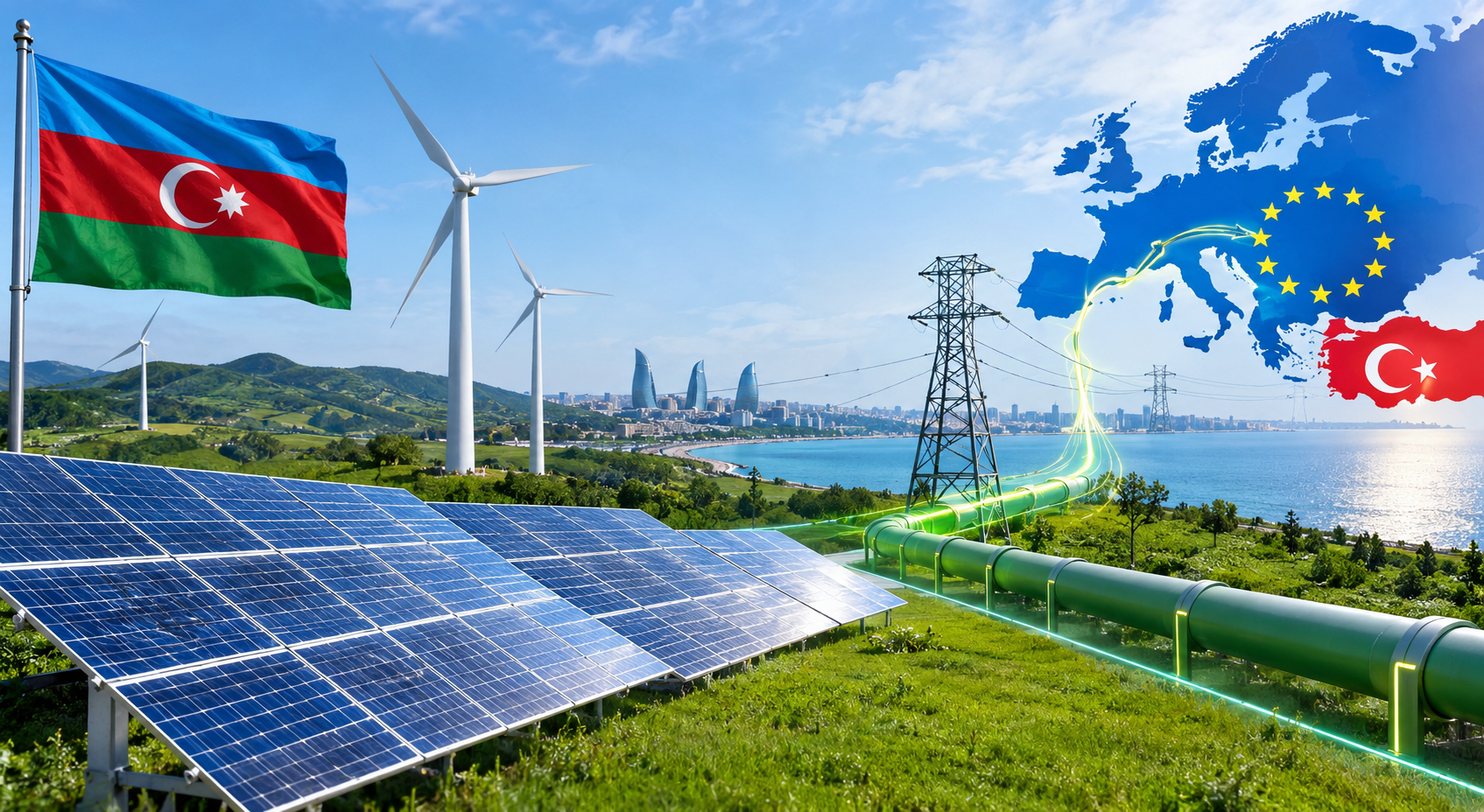
As one of the leading nations in the Caspian region in the field of renewable energy development, Azerbaijan is actively participating in international initiatives to establish energy corridors for exporting green electricity to Türkiye and the European Union. The preparation of these projects is advancing successfully. Technological and commercial solutions were presented, and project financing opportunities were discussed at the international forum titled “Green Energy Corridor: From Feasibility Study to Implementation,” held in Baku a few days ago.
Sea-news.az reports that in recent years, Azerbaijan has accelerated the application of advanced international practices in renewable energy. With the participation of investors from Gulf countries, China, Türkiye, and the European Union, solar, wind, and small hydroelectric power plants are being actively constructed across the republic. To match new generation capacity, the transmission grid is being modernized, substations are being digitized, and battery energy storage systems (BESS) are being integrated.
Furthermore, the Karabakh and Eastern Zangezur economic regions, alongside the Nakhchivan Autonomous Republic, have been designated as “green energy zones.” Total investment in the construction of 11 solar and wind power plants is expected to reach $2.8 billion by 2027. Consequently, an additional 2 GW of generation capacity will be integrated into the national power grid. By 2032, total renewable energy capacity in Azerbaijan is projected to reach 8 GW.
Thus, within the next one to two years, renewable energy sources will enable the saving of approximately 1.1 billion cubic meters of natural gas annually at local thermal power plants while generating 5 billion kilowatt-hours of electricity per year. Overall, the share of renewables in the country’s total power generation is expected to reach 43% by 2035.
This potential positions Azerbaijan to become a key regional exporter of electricity to the European Union market, which is experiencing energy deficits. In this context, as part of plans to form an Azerbaijan–Türkiye energy hub, the power transmission system in the Nakhchivan Autonomous Republic is undergoing modernization. Concurrently, preparations are underway to implement the Azerbaijan–Georgia–Türkiye–Bulgaria energy corridor project.
Specifically, utilization of the TRIPP route is planned to shape the Central Asia–Azerbaijan–Türkiye–Europe energy architecture.
The feasibility study for the Central Asia–Azerbaijan energy corridor project, financed by the Asian Development Bank and the Asian Infrastructure Investment Bank, is expected to be completed in May 2027.
It is worth noting that Kazakhstan, Uzbekistan, and Turkmenistan, which possess immense solar and wind energy potential, view Azerbaijan as a reliable transit route to access foreign markets. Against this backdrop, total planned investments in generation capacity and energy infrastructure across Central Asia and the South Caucasus have reached $289 billion.
Green Energy From the Caspian Sea to Europe via the Black Sea
The initial international initiative aiming to transmit green electricity to Europe reached a practical project phase following the signing of the “Agreement on a Strategic Partnership in the Field of Green Energy Development and Transmission” between the governments of Azerbaijan, Georgia, Romania, and Hungary on December 17, 2022.
The project involves laying a submarine power cable in the Black Sea at depths of up to 2,200 meters. Spanning a length of 1,195 kilometers, the line’s maximum design capacity will reach 3.9 GW. Green electricity generated in Azerbaijan and Georgia will be transmitted via the cable to Romania and Hungary, and onwards to other European nations.
To this end, an agreement on energy system integration for clean electricity export was signed with Kazakhstan and Uzbekistan during COP29 in Baku in 2024.
Since then, the feasibility study and commercial evaluation for the “Caspian Sea–Black Sea–Europe Green Energy Corridor” (Black Sea Energy) project have entered a practical phase. Azerbaijan is expected to commence operations on this green energy corridor by 2032, unlocking access to international markets.
Last Thursday, a session dedicated to the findings of the project’s feasibility study took place during the forum in Baku. Key results from the research conducted by the Italian engineering and consulting firm CESI were presented during the event.
Based on the findings of this analysis, the project’s commercial structure will be established, financing options will be evaluated, and preparations for a final investment decision (FID) in 2029 will begin.
According to the feasibility study, the project will foster the development of at least 8 GW of renewable energy generation facilities across the South Caucasus region. Starting in 2040, approximately 20 billion kilowatt-hours of electricity per year will be transmittable to Europe, reducing carbon dioxide emissions by up to 3.6 million tons annually.
Advanced Technologies and Financing Opportunities
The forum featured six thematic sessions and numerous technical presentations. Participants paid special attention to high-voltage direct current (HVDC) technologies, submarine cable manufacturing and installation, engineering services, procurement and construction processes, innovative technological solutions, and supply chain capabilities.
During one of the sessions, the company Jan De Nul introduced the world’s first subsea cable technology capable of deployment at depths exceeding 4,000 meters. Provided appropriate financing mechanisms are established, the application of this technology is deemed viable for the Green Energy Corridor project as well.
The sessions covered manufacturing and contracting capabilities required for technical execution, the readiness level of technology suppliers, and prospects for international industrial companies participating in large-scale energy infrastructure projects.
Discussions emphasized that implementing cross-border projects involving long-distance energy infrastructure requires close cooperation among international financial institutions, national governments, and private investors.
Simultaneously, a hybrid business model blending regulated and market mechanisms is under consideration to ensure the project’s commercial viability. This model relies on long-term power purchase agreements (PPAs), private equity engagement, and the development of cross-border electricity trade.
Azerbaijan Aims to Become a Regional Green Energy Hub
Delivering opening remarks at the forum, Azerbaijan’s Minister of Energy Parviz Shahbazov highlighted the strategic importance of the Black Sea Energy project regarding regional energy security, supply diversification, and the green transition.
The minister reported that research on the project concluded in July of this year, confirming its technical feasibility and economic attractiveness.
Parviz Shahbazov particularly emphasized that the project occupies a central position in President Ilham Aliyev’s strategy to transform Azerbaijan into a regional hub for green energy production, transmission, and export.
European Commission President Ursula von der Leyen reaffirmed support for this initiative during her visit to Baku in July. In this context, efforts by the European Commission to include the Black Sea Energy project in the 2026 Ten-Year Network Development Plan (TYNDP 2026) and grant it Project of Mutual Interest (PMI) status hold significant weight. Such status could substantially enhance the project’s investment appeal.
According to Parviz Shahbazov, the primary target is to reach a final investment decision (FID) on the project in 2029, built upon a sustainable business model, reliable financing structures, and solid partnerships.
The minister stressed that Azerbaijan’s strategic geographical location, extensive track record in delivering international energy projects, and trustworthy relationships with partner nations provide a firm foundation for achieving these objectives.