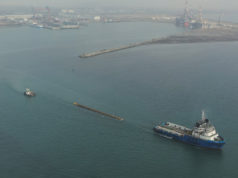
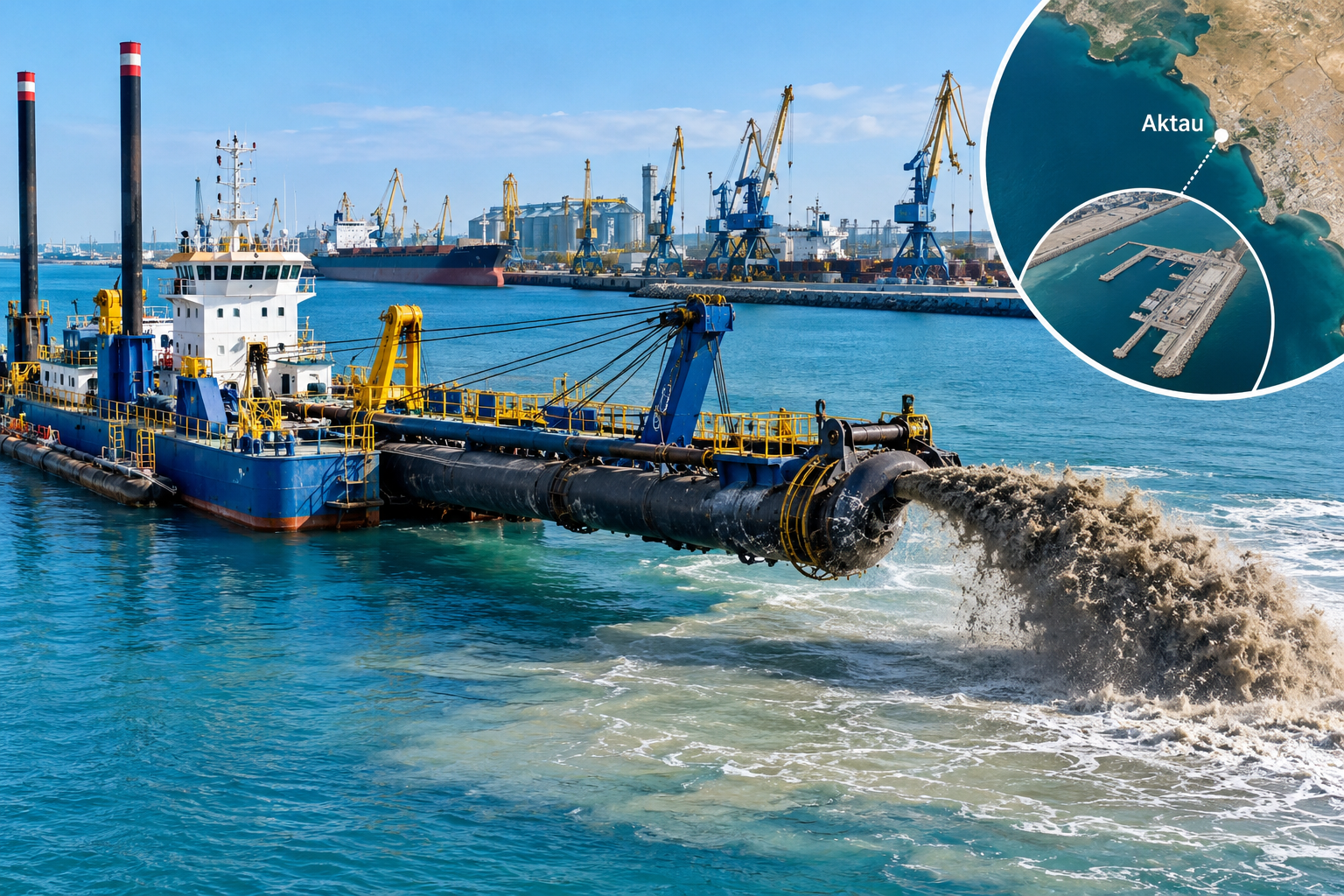
In October, major dredging operations commenced at the Aktau seaport. The implementation of the project will make it possible to boost cargo transit volumes and reduce transportation costs.
Sea-news.az reports that details regarding the project’s cost, contractor, and scheduled completion timeframe were provided by Joint Stock Company “National Company “Aktau International Sea Commercial Port”.
Dredging operations at the Aktau seaport are being carried out by China’s China Harbour Engineering Company Ltd (CHEC). As a state-owned enterprise, CHEC specializes in port infrastructure construction.
The company serves as the general contractor for the project and executes the full scope of work, ranging from geodetic surveys to soil extraction from the seabed. The port administration also clarified that reports claiming a French company was participating in the project are inaccurate.
The dredging operations cover the water basin of the Port of Aktau, including access channels and berth areas. The total area of work spans 77.1 hectares.
According to explanations from the port administration, declining water levels and shallowing in the Caspian Sea have prevented vessels from entering the port fully loaded. Currently, the depth near the berths ranges between 4.5 and 5 meters. Upon completion of the works, this figure is set to reach 6–7 meters. To achieve this, approximately 1.3 million cubic meters of soil will be dredged from the seabed.
The excavated soil will be transported to designated disposal sites. It will also be utilized in reclaiming artificial land for the construction of new berths.
Based on projections by the port administration, cargo transport along the Trans-Caspian International Transport Route (TITR / Middle Corridor) could increase by up to 30% following the completion of the dredging operations. By 2028, annual throughput capacity along this route is planned to rise from 6 million to 10 million tons. The project will also facilitate a reduction in shipping costs.
Company officials noted that as ships gain the capability to navigate fully laden, maritime freight costs are expected to decrease by approximately 10–15%.
The total value of the project stands at 20.6 billion Kazakhstani tenge. Funding is provided by the Government of Kazakhstan and the Ministry of Transport. A portion of the funds was raised through credit facilities.
All operations are scheduled for completion by the end of 2026.