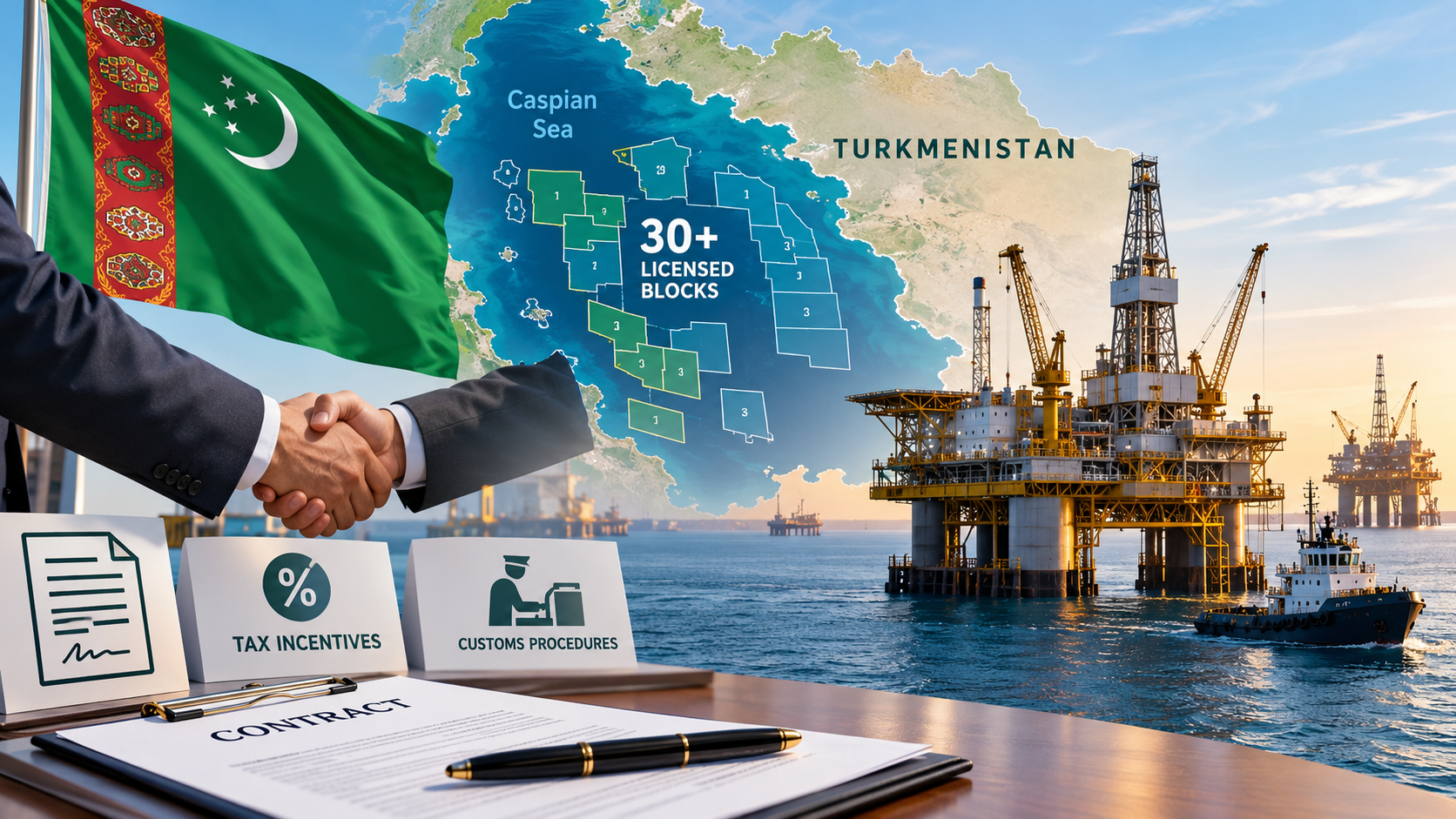
Turkmenistan is offering foreign investors the opportunity to operate across more than 30 licensed blocks within its sector of the Caspian Sea. In tandem, the country is outlining multiple contract frameworks, tax incentives, and streamlined customs procedures for energy firms taking part in oil and gas projects.
Sea-news.az reports that Batyr Jumayev, Deputy Chairman of the State Concern “Turkmennebit”, announced this during a panel discussion on investment opportunities and development prospects in the Turkmen sector of the Caspian Sea at the 31st International Conference and Exhibition “Oil and Gas of Turkmenistan” (OGT 2026) in Ashgabat on Thursday.
According to Jumayev, cooperation with foreign companies in the offshore sector is conducted in accordance with Turkmenistan’s Law “On Hydrocarbon Resources”. This legislation defines the legal guarantees for investors and the operational terms for conducting oil and gas activities.
“There are over 30 licensed blocks in the Turkmen sector of the Caspian Sea. Any potential investor interested in one or multiple blocks may submit a formal application to the State Concern ‘Turkmennebit’,” he noted.
Following the review of the application and verification of the investor’s qualification credentials, the parties may proceed to direct and non-exclusive negotiations. These negotiations can culminate in the signing of Production Sharing Agreements (PSAs), concession agreements based on royalties and taxes, joint operation agreements, or risk service contracts. The legislative framework also permits the combination of these contractual arrangements.
Jumayev stressed that the tax regime mandates the payment of profit tax and statutory fees for the right to use natural resources. Investors are exempt from a range of other mandatory payments and duties, as well as customs tariffs on imports and exports of goods, materials, and equipment required for oil and gas operations. These provisions extend to subcontractors as well.
Furthermore, investors retain the right to dispose of their entitled share of produced hydrocarbons. This includes having their share of oil refined at Turkmen petroleum refineries without incurring additional taxes, licenses, or permits.
Highlighting Turkmenistan’s current international partners in offshore resource development, Jumayev cited Dragon Oil, Petronas, and ADNOC, which operate under production sharing agreements.
He also made special mention of the production sharing agreement concluded in June 2026 between Turkmennebit, Malaysia’s Petronas Carigali (Turkmenistan) Sdn. Bhd., and the state enterprise Hazarnebit for contract areas “Block 19” and “Block 20”. According to him, this agreement opens the door to launching a new phase of offshore exploration and production operations.
Another key domain involves conducting 2D seismic survey operations across licensed blocks 11, 12, 13, and 14. The corresponding agreement was executed between Turkmennebit and Petronas Carigali. These efforts aim to expand geological insights into prospective areas and establish a foundation for assessing their hydrocarbon potential.
“Strategic partnership within the framework of production sharing agreements represents the primary mechanism for attracting large-scale foreign capital and technologies required to develop significant hydrocarbon reserves in the Turkmen sector of the Caspian Sea,” stated Jumayev.
He added that Turkmennebit remains open to dialogue with international energy corporations based on the principles of equality and mutual benefit.
It is worth noting that the second day of the 31st International Conference and Exhibition “Oil and Gas of Turkmenistan” (OGT 2026) has commenced in Ashgabat. The event features a dedicated session titled “Investment Opportunities and Development Prospects of the Turkmen Sector of the Caspian Sea”. Discussions focus on investment potential for developing the Turkmen sector, prospects for offshore hydrocarbon exploration and production, and the expansion of international partnerships.
The agenda also encompasses existing and new production sharing agreements (PSAs), as well as advanced seismic survey initiatives designed to evaluate reserve potential and prepare prospective structures for field development.