



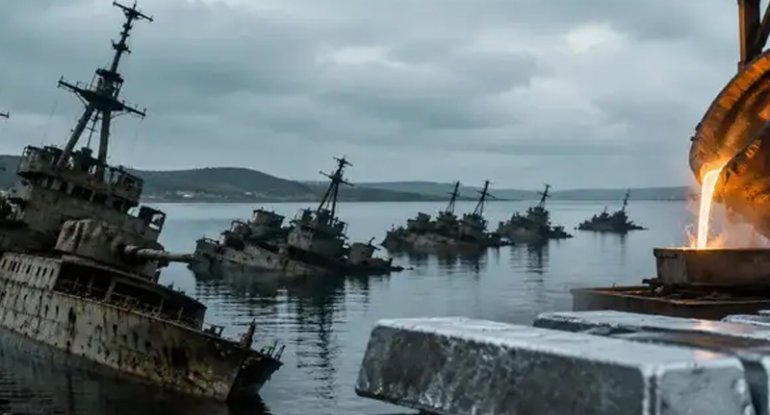
In the summer of 1919, an extraordinary event unfolded in the protected waters of Scapa Flow in Scotland’s Orkney Islands, where German sailors intentionally scuttled the bulk of their surrendered fleet to prevent the ships from being divided among the victorious Allied powers.
Sea-news.az reports citing The Economic Times, that these vessels—built prior to the nuclear era—possess steel free from the atmospheric contamination caused by subsequent nuclear weapons testing, making them an exceptionally valuable material for highly sensitive scientific and industrial applications.
How the German fleet arrived at Scapa Flow
Following the conclusion of World War I in November 1918, Germany’s powerful High Seas Fleet was surrendered under the terms of the armistice. Allied powers demanded the internment of the German ships while peace treaty details were negotiated, resulting in 74 vessels being stationed at Scapa Flow, formerly one of Britain’s most vital naval bases.
Under the command of Rear Admiral Ludwig von Reuter, German crews lived under strict restrictions. As negotiations surrounding the Treaty of Versailles progressed, von Reuter grew concerned that the ships would ultimately be permanently confiscated by the Allies, leading him to decide to scuttle the fleet rather than surrender it.
The mass scuttling
On June 21, 1919, von Reuter issued the order. German crews opened sea cocks and other valves, allowing water to flood the vessels. Realizing what was happening, British forces attempted to intervene; while a few ships were saved from sinking, the operation was too far advanced for most.
By the end of the day, 52 of the 74 German ships had gone to the bottom of the sea. Nine German sailors were killed by British gunfire during efforts to prevent the scuttling, and the survivors were taken prisoner. Today, the wrecks are protected under Scottish law and remain popular among divers.
Why the sunken ships became an unexpected source of valuable steel
Large quantities of steel produced before 1945 still exist, but finding suitable material in massive quantities can be challenging. Because ships concentrate huge amounts of steel into a single structure, these sunken vessels serve as an extraordinary source of “low-background steel.”
Untainted by radioactive isotopes released into the atmosphere by nuclear explosions after 1945, this pre-nuclear steel is uniquely prized for manufacturing scientific instruments, medical equipment, and industrial devices that are exceptionally sensitive to radiation. Thus, the remnants of these military vessels have evolved from instruments of war into protected historical monuments and invaluable material resources for modern science.



