



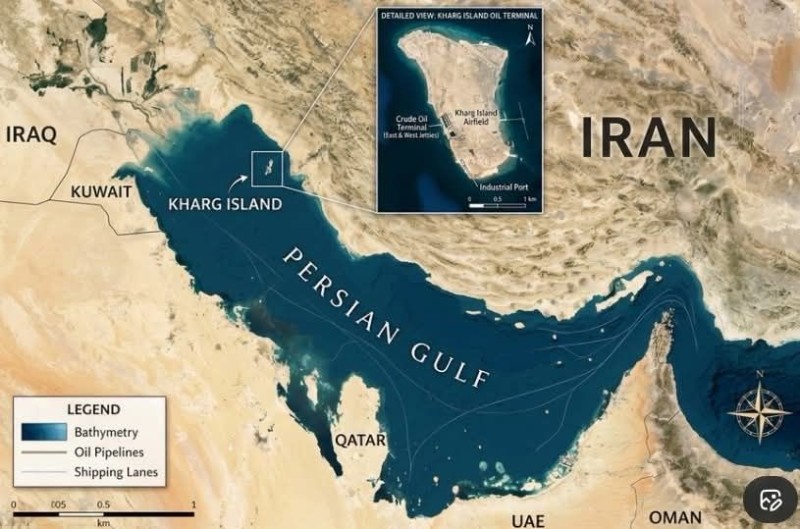
The Strait of Hormuz is one of the most critical strategic passages in the global energy market. Located between Iran and Oman, the strait connects the Persian Gulf with the Gulf of Oman and the Arabian Sea. In the first half of last year, an average of 20.9 million barrels of oil and petroleum products passed through the strait daily, accounting for roughly one-fifth of global oil consumption.
Sea-news.az reports that the closure of the Strait of Hormuz directly strikes at the energy exports of Gulf nations such as Saudi Arabia, Iraq, Kuwait, Iran, the United Arab Emirates, and Qatar. Unlike these countries, Azerbaijan exports its oil to world markets primarily via the Caspian Sea and through pipelines, meaning it is affected by the closure of the Strait of Hormuz indirectly rather than directly.
Azerbaijan’s primary oil export route is the Baku–Tbilisi–Ceyhan (BTC) pipeline, which has a throughput capacity of 1.2 million barrels per day. Traversing Azerbaijan, Georgia, and Turkey, the pipeline terminates at the Ceyhan marine terminal on the Mediterranean Sea. Over the 20 years since its commissioning, more than 560 million tons of Azerbaijani-origin oil and condensate have been exported via BTC. From its commissioning in June 2006 through the end of June of this year, a total of approximately 631 million tons (over 4.7 billion barrels) of crude oil has been transported through this 1,768-kilometer pipeline and loaded onto 6,276 tankers in Ceyhan for delivery to world markets. Additionally, the Baku–Supsa and Baku–Novorossiysk pipelines form integral parts of Azerbaijan’s oil export infrastructure.
The key advantage of these routes is that they bypass the Strait of Hormuz. Consequently, the closure of the strait does not create physical barriers preventing Azerbaijani oil from moving through that passage, as BTC routes Azerbaijani oil directly to the Mediterranean. Furthermore, the transfer of BTC operations from BP to SOCAR starting in July 2026 underscores the strategic importance of this infrastructure for Azerbaijan.
The closure of the Strait of Hormuz has led to a sharp reduction in global oil supplies, increasing the likelihood that Brent crude prices will climb further. Rising tensions around Hormuz since the beginning of August have already triggered price volatility in the oil market, with Brent crude surpassing $91 per barrel for the first time since July 30.
At first glance, this is a positive factor for Azerbaijan. As export prices rise, revenues generated from oil sales increase even if export volumes remain unchanged. The heavy weight of oil and natural gas in the country’s foreign trade makes this price effect particularly significant. Amid the Hormuz crisis, Azerbaijan stands among the nations securing additional revenue from elevated oil prices.
However, viewing the issue solely through the lens of higher oil prices would be incomplete. If the closure of the Strait of Hormuz triggers an energy shock in the global economy, economic activity in oil-importing countries will weaken, leading to a drop in demand for oil.
A significant portion of Azerbaijan’s oil exports is tied to European markets. Should global economic growth soften, energy demand in Europe’s industrial and transport sectors could decline. On the other hand, rising insurance and security costs for tanker transport could also make maritime shipping beyond Ceyhan more expensive. Thus, even though Azerbaijani oil does not pass through Hormuz, it cannot remain completely insulated from global logistics and insurance crises.
Another consequence of the Strait of Hormuz closing could be a redistribution of oil flows across global markets. According to the International Energy Agency, the vast majority of crude transiting Hormuz in 2025 was directed toward Asian markets, and the existing capacity of alternative pipelines is insufficient to fully replace the total volume moving through the strait. In this scenario, Asian nations show heightened interest in sourcing oil from alternative suppliers. Azerbaijani oil gains added importance as one such alternative source, with the transit of Caspian-origin oil to world markets via the Mediterranean granting Azerbaijan a distinct geoeconomic advantage.
Higher oil prices positively influence Azerbaijan’s state revenues and balance of payments.
The existence of Azerbaijan’s three main oil export pipelines—BTC, Baku–Supsa, and Baku–Novorossiysk—allows for the diversification of export routes. The daily throughput capacities of the Baku–Supsa and Baku–Novorossiysk pipelines stand at 150,000 barrels and 100,000 barrels, respectively.
These infrastructural assets represent a vital advantage for Azerbaijan’s energy security. At the same time, the rise of security risks along the Novorossiysk direction this year demonstrates the soundness of Azerbaijan’s export strategy in avoiding reliance on a single route.



