



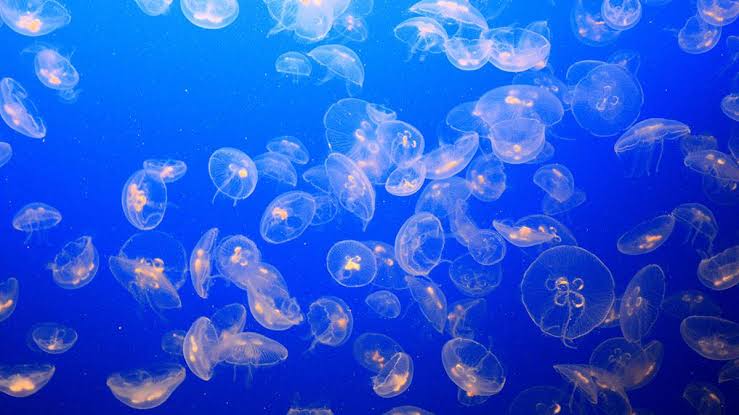
At the Gravelines Nuclear Power Plant (NPP) located in northern France, 3 power units have suspended their operations for safety reasons due to a massive influx of jellyfish entering the cooling water coming from the sea.
Sea-news.az reports that the plant’s operator, EDF (Électricité de France), has activated preventive measures to prevent the clogging of water intake channels and filter networks.
Reactors No. 2, 3, and 4 of the plant were disconnected from the grid due to the jellyfish influx. The power of reactor No. 1 has been reduced to 50 percent in a preventive mode. Reactor No. 5 is under scheduled maintenance, while reactor No. 6 is operating at full capacity.
Stationary surveillance cameras and warning systems have been installed to detect blockages in the water intake channels and filter drums (nets) at an initial stage. Furthermore, vessels of the Fishing Organization have been deployed in operations at sea using special nets to reduce jellyfish density.
According to the company’s engineers, no new jellyfish influx is observed, and the cleaning works of the channels using vacuum technology are nearing completion. The reactors are planned to resume full-capacity operations in the near future.
Cooled by a canal connected to the North Sea, the Gravelines NPP is one of the country’s largest nuclear facilities. With 6 reactors of 90 megawatts each, the station has a total capacity to generate 5.4 gigawatts of electricity. EDF emphasized that the incident posed no risk to the environment, personnel, or the nuclear safety of the facility.



