
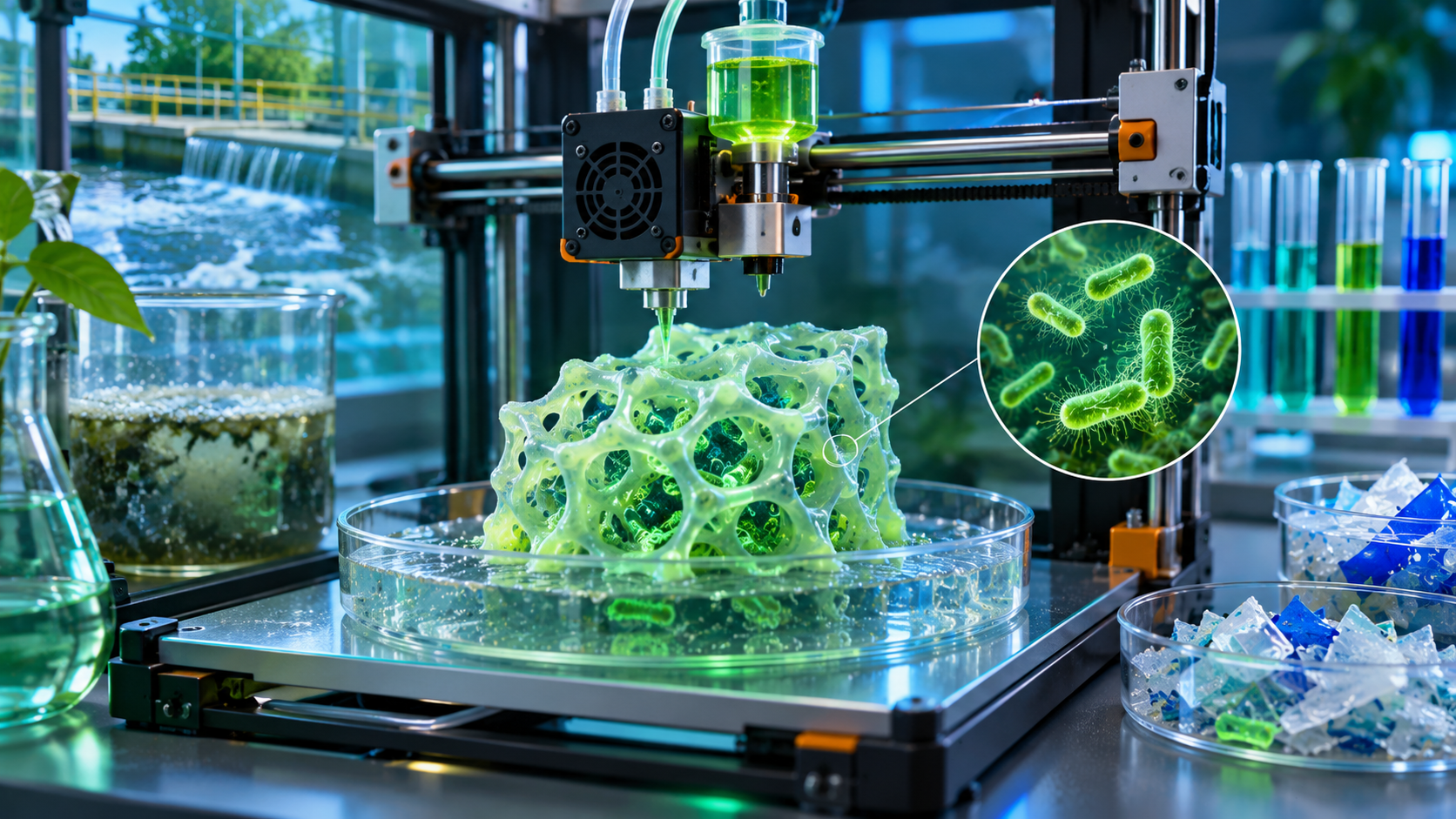
American researchers from the University of Rochester and Cornell University have converted a standard consumer 3D printer, the “Creality Ender 3,” into an affordable bioprinter for creating three-dimensional objects from living bacteria. The upgrade cost just $450, making it hundreds of times cheaper than industrial counterparts priced at over $100,000. Furthermore, the device is capable of building structures exceeding 100 layers (approximately 22 millimeters), which is five times higher than the previous limit of similar systems.
Sea-news.az reports citing foreign media, that the core of the engineering solution lies in replacing the standard printhead with a retractable syringe pump and submerging the nozzle into a special support gel made from gelatin or algae. Previously, soft bio-inks containing bacteria would simply collapse under their own weight after the 20th layer, whereas the supporting medium maintains the shape of the product until it fully solidifies. In addition, the nutrient-rich gel acts as an incubator: microorganisms can survive inside these hollow or lattice structures for up to four weeks instead of the previous nine days.
The primary practical benefit of this development is the broader accessibility of scientific research and the creation of effective biological filters. The printed hollow structures possess a large surface area, making them an ideal base for artificial biofilms that can purify wastewater, recycle plastic waste, and assist in testing new antibacterial agents. The scientists have already published the designs and software code openly on the “GitHub” platform, enabling any small laboratory or university to assemble a similar bioprinter.