For centuries, the Caspian Sea has held a vital place in people’s lives through both its wealth and its perils. Countless incidents, shipwrecks, storms, and tragedies have unfolded in its waters. Oil Rocks (Neft Dashlari), which holds a special place in the development of Azerbaijan’s oil industry, also witnessed one of the darkest pages of this history. A severe hurricane in November 1957 changed the lives of dozens of families and claimed the lives of 21 oil workers.
Sea-news.az recalls, citing Modern.az, that the tragedy is remembered as one of the gravest incidents in the history of Neft Dashlari. On the night of November 20–21, 1957, wind speeds in the Caspian Sea reached 44 meters per second, and wave heights hit 13 meters. The severe storm at sea caused serious damage to oil production facilities.
The tragedy struck in an area where drilling operations were underway at the “Palchig Pilpilasi” (Mud Volcano) field. Under the impact of massive waves, the offshore platform collapsed, plunging the oil workers operating on it into the waters of the Caspian. Although shouts and cries for help were heard until morning from the spot where they went down, rescuing them proved impossible given the technical capabilities of that era. As a result of the disaster, 21 members of two drilling crews led by Mikhail Kaverochkin and Suleyman Baghirov perished.
Among the victims was master driller Mikhail Pavlovich Kaverochkin, who had worked there since the earliest years of Oil Rocks and played a pivotal role in developing the field. He was one of the specialists who participated in drilling the very first exploration well at Oil Rocks.
Bakhtiyar Mammadov, an eyewitness to the 1957 events who was serving as acting field manager at Oil Rocks at the time, later shared details of that tragic night in his memoirs. According to him, around 9:00 PM on November 20, Bahman Hajiyev, chief engineer of the “Gurgyanneft” Oil Fields Trust, called to warn of strong winds and instructed him to check conditions across the field.
Weather conditions deteriorated rapidly that night. The force of the wind and waves paralyzed operations at offshore installations. The collapse of the offshore platform and heavy swells made rescue efforts extraordinarily difficult.
The storm did not only result in loss of life. Severe damage was also inflicted on the infrastructure of Oil Rocks, destroying several trestles, trestle platforms, and communication lines. Following the disaster, the safety of offshore structures—particularly their resilience against extreme weather conditions—began to be examined far more rigorously.
The memory of the tragedy’s victims has been kept alive over the ensuing decades. In 1999, on the eve of the 50th anniversary of Oil Rocks, a monument was erected in honor of the fallen oil workers, and in 2009, a new memorial complex was established at the site.
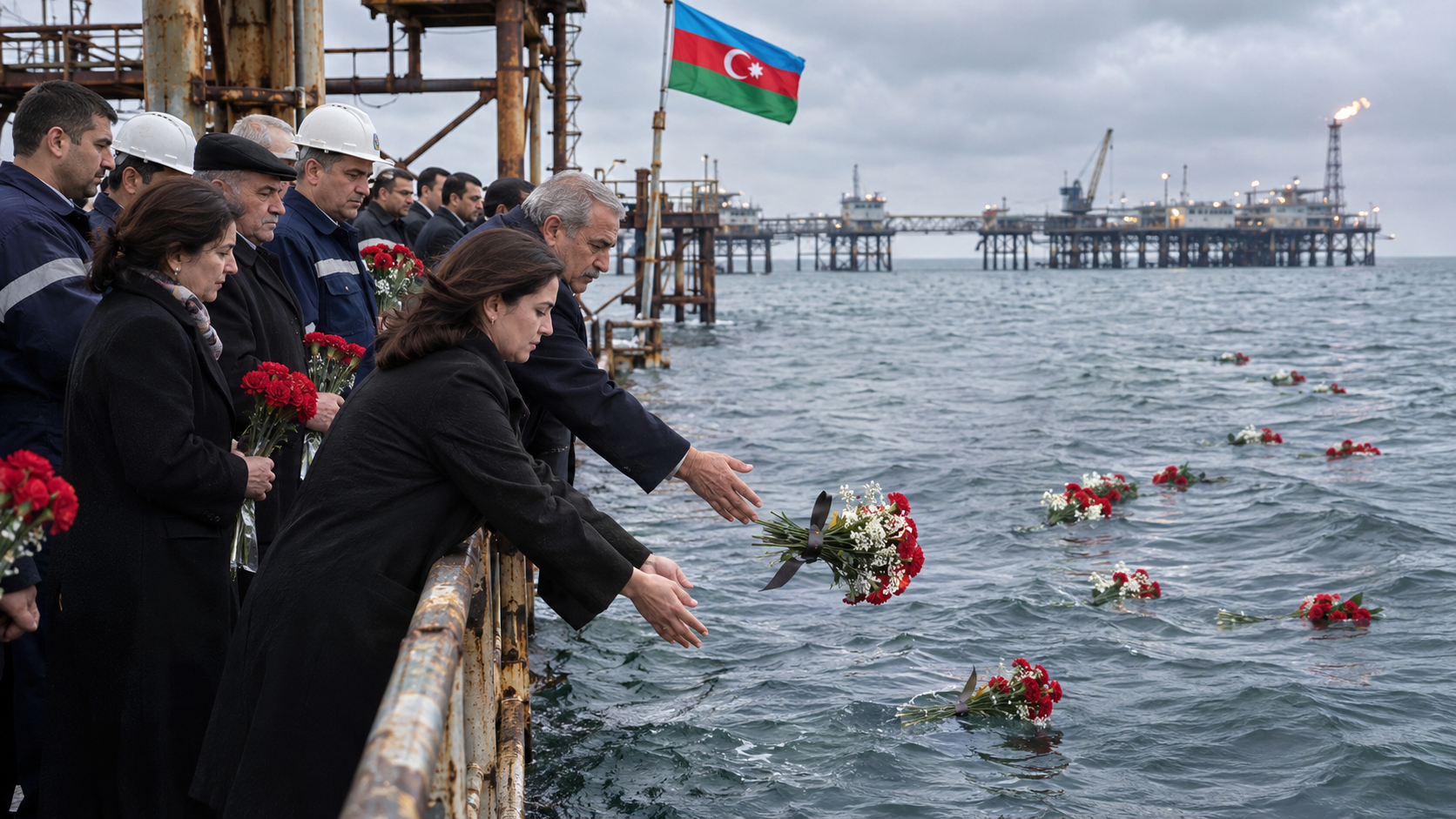
Every year on November 21, the victims of the 1957 tragedy are commemorated at Oil Rocks. During the memorial ceremonies, 21 bouquets of flowers are released into the sea—a tradition symbolizing reverence for the oil workers who lost their lives on that stormy night.
Today, the Caspian remains one of the primary witnesses to Azerbaijan’s energy history. And Oil Rocks, far more than an industrial town built upon its waters, stands as a reminder of the labor, dedication, and at times heavy sacrifices of the people who worked to bring forth this wealth.