
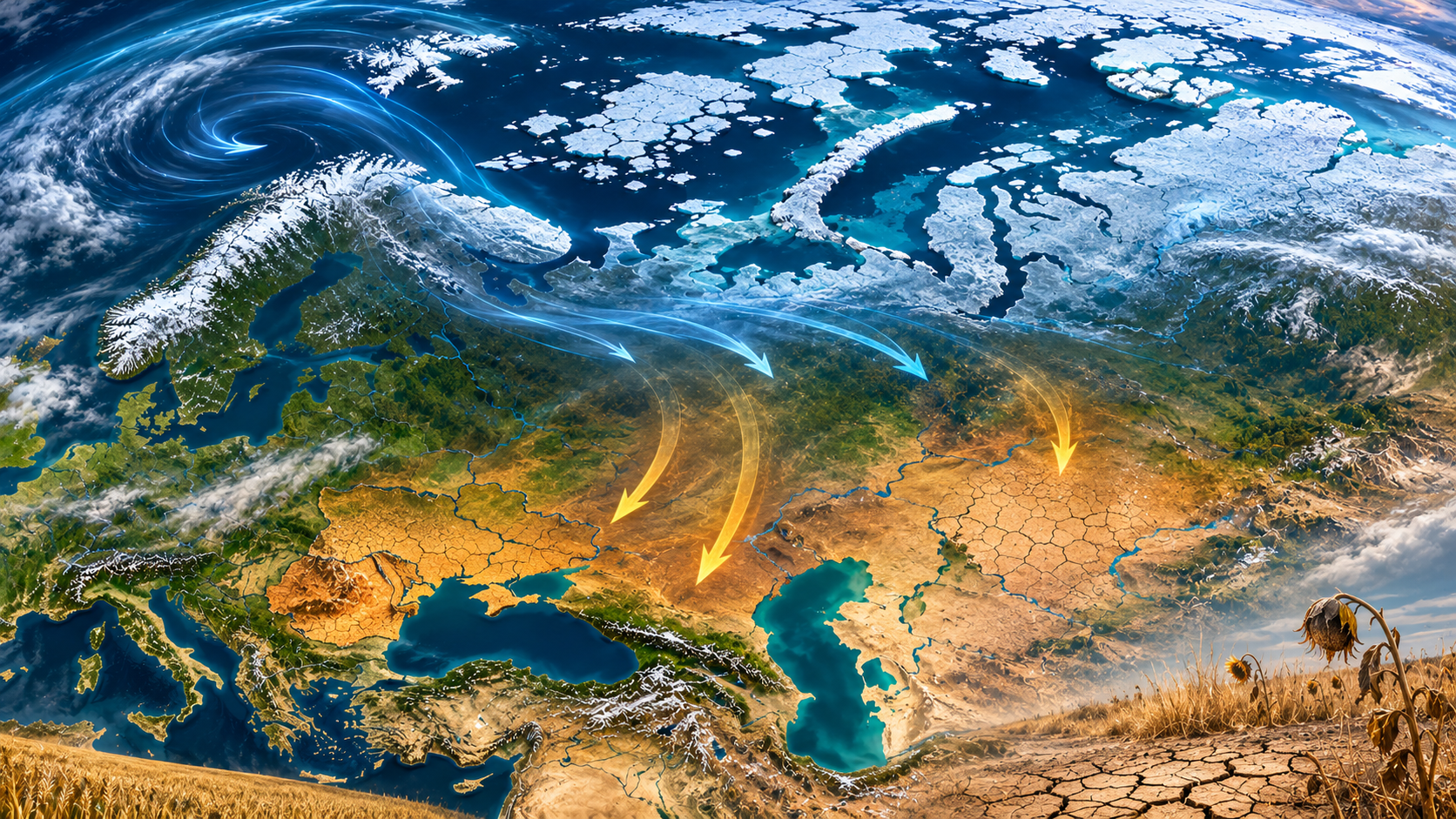
The reduction of winter sea ice extent in the Barents and Kara seas may be linked to intensified summer droughts across many parts of Eurasia, including Eastern Europe. This conclusion was reached by the authors of a study published in the scientific journal “Frontiers in Water.”
Sea-news.az reports that researchers identified a connection between changes in Arctic sea ice coverage during the winter season and the emergence of summer drought conditions in regions located far from the Arctic.
According to the study’s findings, the impact of these processes could extend to eastern Romania, Moldova, and Ukraine, the northern regions of the Black and Caspian seas, as well as western regions of Kazakhstan.
As part of the study, scientists analyzed archival data on sea ice extent in the Barents and Kara seas covering the period from October to March. The ERA5 database of the European Centre for Medium-Range Weather Forecasts (ECMWF), which compiles data on atmospheric conditions in Eurasia since 1940, was used as a primary source.
The researchers also evaluated drought indicators from May through September, accounting for both decreases in precipitation and increases in atmospheric moisture demand.
Results obtained after factoring in the long-term rise in atmospheric carbon dioxide concentrations differed from earlier findings, enabling researchers to determine whether the observed link is solely driven by overall global warming.
During the study, scientists focused particular attention on the Barents and Kara seas, which have experienced some of the steepest declines in winter sea ice extent in the Arctic since the 1980s.
According to projections by the UN Intergovernmental Panel on Climate Change (IPCC), unless carbon dioxide emissions are substantially reduced, sea surface temperatures in this region could rise by 4–5 degrees Celsius by the end of the 21st century.
The study’s authors note that investigating the relationship between Arctic sea ice conditions and summer droughts can help improve long-term forecasting of climate risks and enable countries to prepare in advance for dry periods.