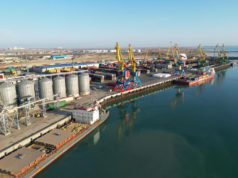

Drone attacks targeting commercial vessels in the Black Sea pose a grave threat to Bulgaria’s foreign trade, industrial production, and transport-logistics sector.
Sea-news.az reports citing the Bulgarian BTA agency and local economic publications, that deteriorating regional security has driven up maritime shipping insurance costs and freight charges, raising the risk of supply chain disruptions for the country’s key industrial enterprises.
Lachezar Bogdanov, an economist at the Bulgarian Institute for Market Economics, stated that attacks on merchant ships have already triggered higher insurance premiums and costlier sea transport. According to the expert, if the attacks continue, commercial shipping operations in the Black Sea could be severely restricted or even halted along certain routes.
According to data, 27.49 million tonnes of cargo were processed at Bulgarian seaports in 2025. In the first six months of 2026, seaport cargo turnover rose by 17 percent compared to the same period of the previous year.
Maritime transport is of critical importance to the country’s metallurgy, chemical, oil refining, and agricultural sectors. Approximately 46 percent of imported cargo consists of liquid bulk, including fuels and chemical products, while 28 percent consists of dry bulk cargo. Dry bulk accounts for over 60 percent of exports.
The economist warned that higher freight costs or operational halts could lead to production downtime, decreased product competitiveness, and weakened exports.
Specifically, metallurgical plants such as Aurubis Bulgaria and Stomana Industry, chemical firms Solvay Sodi and Agropolychim, and the Lukoil Neftochim Burgas oil refinery are among the major industrial facilities heavily reliant on stable maritime shipping.
The security situation in the Black Sea deteriorated further following drone attacks on two merchant vessels off the Bulgarian coast on October 13. The Malta-flagged vessel Chelsea-3 came under attack 17 nautical miles east of the town of Byala, with all 15 crew members rescued following the incident. Another vessel was hit and sunk near the settlement of Krapets.
Following the incidents, the Bulgarian government held consultations with the European Union and NATO, requesting international assistance to enhance the security of commercial shipping.
Political parties in the Bulgarian parliament have also expressed concern over the economic fallout of the Black Sea situation. Representatives of the Democratic Bulgaria coalition proposed creating a dedicated inter-agency mechanism under the government to assess import-export risks, investigate potential industrial losses, and formulate necessary compensation measures.
Beyond Black Sea risks, experts also highlight emerging challenges in Danube River transport. While Bulgarian river ports handled approximately 3.9 million tonnes of cargo in 2025, cargo turnover in the first half of 2026 dropped by roughly 14 percent year-on-year.
Furthermore, planned interruptions related to the modernization of the railway link across the Danube Bridge between Romania and Bulgaria are expected to create additional hurdles for regional freight transport.
Experts emphasize that securing navigation in the Black Sea is critical not only for the transport sector, but also for the overall stability of Bulgaria’s industrial output, energy supply, and foreign trade.