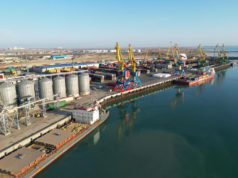

Azerbaijan’s position as an international transport and logistics hub continues to strengthen. As a result of the development of the East–West and North–South international transport corridors, as well as the modernization of transport infrastructure, transit freight volumes through the country in January–September 2026 exceeded 12 million tonnes, reaching a five-year record high.
Sea-news.az reports that transit cargo volume increased by 14.5 percent compared to the same period last year. Growth along the East–West route reached 20.2 percent, while the North–South direction registered a 19 percent increase.
Positive dynamics were also recorded in the performance of the Baku International Sea Trade Port. During the first nine months of the current year, container handling rose by 29 percent year-on-year to 100,000 TEU, while dry cargo handling surged by 71 percent to 1.73 million tonnes.
The growth in transit cargo volume is driven by infrastructure developments in transport and logistics, digitalization, strengthened inter-agency coordination among state bodies, and the expansion of international cooperation. Shifts in global trade routes also continue to boost demand for Azerbaijan’s transit capabilities.
Development of Transport Infrastructure
In recent years, a series of major projects across railway, highway, maritime, and aviation infrastructure have been executed to expand Azerbaijan’s transit capacities and enhance competitiveness along international transport corridors.
The Baku–Tbilisi–Kars railway line, a core component of the Middle Corridor, has been modernized, raising its annual throughput capacity to 5 million tonnes.
The infrastructure of the Baku International Sea Trade Port has also been expanded. The port’s annual container handling capacity was increased from 100,000 TEU to 160,000 TEU. Thanks to improved operational coordination, vessel processing times have been reduced from approximately 20 hours to 4–5 hours.
Currently, the port’s annual cargo handling capacity stands at 15 million tonnes. As part of ongoing expansion projects, this figure is targeted to reach 25 million tonnes, with container handling capacity scaling up to 500,000 TEU.
As part of the development of the Alat transport and logistics hub, the construction of a cargo airport is underway. Designed as a component of a multimodal logistics complex integrating sea, rail, road, and air transport, the airport will enhance cargo processing efficiency and expand the capabilities of the Middle Corridor.
Efforts are also underway to renew and expand the maritime fleet to meet the growing volume of freight across the Caspian Sea. Construction of four cargo vessels under the first international commercial order continues at the Baku Shipyard.
Furthermore, on September 16, 2025, a contract was signed between Baku Shipyard and AD Ports Group for the construction of two container ships, each with a capacity of 780 TEU.
The construction of large-capacity ferries, the expansion of Ro-Ro shipping, and the phased modernization of the fleet aim to increase the throughput capacity of the Caspian crossing and strengthen the sustainability of transport operations along the Middle Corridor.
Zangezur Corridor to Create New Transport Opportunities
The development of the Zangezur Corridor holds particular significance for expanding Azerbaijan’s transit potential and diversifying international transport routes.
In this direction, the construction of the Horadiz–Aghband highway has been completed, while construction on the railway line is ongoing. Simultaneously, work is being carried out to modernize Nakhchivan’s railway infrastructure.
The development of the Zangezur Corridor is expected to contribute to expanding regional transport connectivity by generating an additional transit potential of up to 15 million tonnes per year.
Expanding Border Crossing Capabilities
To improve the efficiency of transit shipments, border crossing infrastructure is being modernized, customs procedures are being simplified, and information exchange between state agencies is being refined.
Currently, 12 active border crossing points suitable for motor vehicles operate across the country. The combined daily throughput capacity of these checkpoints in one direction is 4,350 vehicles.
In recent years, the Khanoba modular border checkpoint on the Azerbaijan–Russia border and the Astara modular checkpoint on the Azerbaijan–Iran border have been commissioned.
These measures serve to manage border transport flows more efficiently and boost the competitiveness of international transport corridors.
Accelerating Digitalization in Transport and Logistics
The implementation of digital technologies plays a vital role in enhancing the efficiency of transit operations. The “Single Window” Information System — Digital Logistics Platform established by the Ministry of Digital Development and Transport facilitates faster document circulation, simplifies procedures, and creates a more agile logistics environment for businesses.
In the next phase, the platform is planned to be integrated with similar systems of partner countries along the Middle Corridor. This will create favorable conditions for increasing operational efficiency and data exchange along the entire route.
Additionally, in cooperation with international partners, the ministry is working toward the phased implementation of electronic document systems including e-CMR, e-Permit, and e-CIM/SMGS. These tools will enable the digitalization of international transport, reduce paper usage, and streamline transport data exchange.
Azerbaijan and Kazakhstan Expand Cooperation on Middle Corridor Development
To develop international transport links and increase transport efficiency, Azerbaijan has signed several bilateral and multilateral agreements, roadmaps, and memorandums of understanding.
On October 15, 2026, an Agreement on Cooperation for the Development of the Middle Corridor was signed between Azerbaijan and Kazakhstan. The document is of significant importance for the future evolution of the route and the strengthening of its institutional framework. Efforts are currently underway to facilitate the accession of other nations to the agreement.
Transit Potential Supports Economic Growth
The increasing volume of transit freight not only drives the growth of the transport sector but also contributes to value creation in the non-oil economy, expands investment opportunities, and reinforces regional economic integration.
Consolidating Azerbaijan’s position in global supply chains, diversifying international transport routes, and improving logistics services enhance the country’s status as a regional transport and logistics hub.
Infrastructure, digitalization, and international cooperation projects implemented in this direction generate new opportunities for further expanding Azerbaijan’s transit capabilities, diversifying the non-oil sector, and securing long-term economic development.